Netizens urge Government to address hawker food price hikes stemming from rent issues
Netizens expressed skepticism about Singapore's latest "Budget Meal" Initiative aimed at addressing food price hikes, citing high rents at hawker centres as a fundamental issue. Some suggested the government should abandon open bidding for hawker stalls to address these concerns effectively.


SINGAPORE: The Singapore government has launched a new initiative to introduce budget meals in more heartland coffee shops by the end of July, aiming to provide Singaporeans with affordable food options.
On Monday (1 July), the Housing and Development Board (HDB) and Enterprise Singapore (EnterpriseSG) announced that 330 coffee shops across HDB estates will offer these budget meals by the end of the month. This initiative includes 180 coffee shops operated by nine private chains.
HDB and EnterpriseSG said they will continue to engage with operators of privately owned HDB coffee shops to encourage them to provide budget meal options, "while considering their business sustainability."
The rollout will see these eateries gradually introducing affordable meal options and accepting CDC vouchers, extending beyond HDB rental coffee shops.
The private coffee shop chains participating in this initiative are Badaling, Broadway, De Tian, Chang Cheng, FoodFare Kopitiam, Kimly, Kim San Leng, Koufu, and Select.
Of the 180 coffee shops, 120 are privately owned, representing nearly 30 per cent of privately owned coffee shops in HDB estates.
The remaining 60 are rental coffee shops that will now voluntarily offer budget meals ahead of their lease renewal.
Budget meals include lunch or dinner options priced at S$3.50 (US$2.60) and below, with drinks priced at S$1.20 and below.
Around 150 rental HDB coffee shops islandwide offer over 1,000 budget meals and drinks, according to the press release on Monday.
On 1 July, Senior Minister of State (SMS) for National Development Sim Ann and Senior Minister of State for Trade and Industry Low Yen Ling unveiled community budget meal decals at four stalls in the Chang Cheng Mee Wah coffee shop at Block 802 Tampines Avenue 4.
Stalls displaying these red and blue decals will accept CDC vouchers as payment.
Scepticism surrounding effectiveness of PAP Government's latest initiatives to address rising food prices
Notably, comments on Singapore's mainstream media outlets CNA and The Straits Times Facebook posts revealed scepticism about the effectiveness of these initiatives in addressing rising food prices.
Netizens highlighted that the root cause of the issue lies in high rents at hawker centres, which they argue significantly contributes to the high cost of living in Singapore.
They suggested that the government could lead by example by initiating rent reductions, starting with establishments like Kopitiam.

One suggestion proposed that the government should consider abandoning the open bidding process in favour of balloting, with a maximum limit imposed to prevent exorbitant bids that cater only to the wealthy.
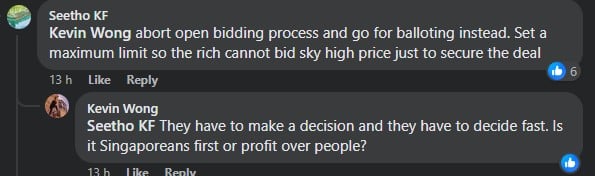
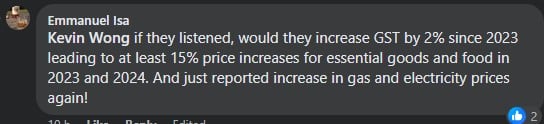
Some point out specific instances where government policies, such as the increase in GST and utility prices, have further exacerbated the financial burden on citizens, particularly affecting essential goods like food.
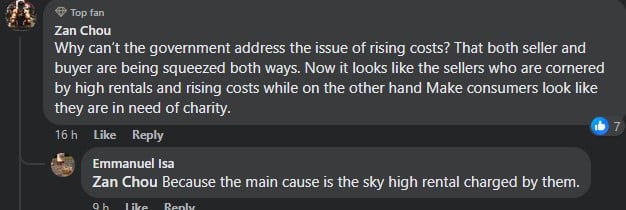
A netizen questioned why the government seems unable to effectively tackle the issue of rising costs that affect both businesses and consumers.
He highlighted a perceived imbalance where businesses, particularly small businesses facing high rentals and other costs, are struggling while consumers are portrayed as needing charity or assistance due to high prices.
"Needle in a haystack"
Another comment expressed frustration with the accessibility of budget meals, likening it to a "needle in a haystack, " added that transportation to reach these affordable meal options might offset the savings, emphasizing the broader challenges faced by consumers in managing living expenses.

While the latest government initiative aims to provide affordable food options for ordinary Singaporeans, some netizens pointed out that Singaporeans still struggle to find affordable food that offers reasonable nutrition.
One netizen flagged that some food stalls offer smaller portions of items other than rice.
This observation raises concerns about whether these initiatives truly ensure adequate portions for customers, despite efforts to provide affordable options.
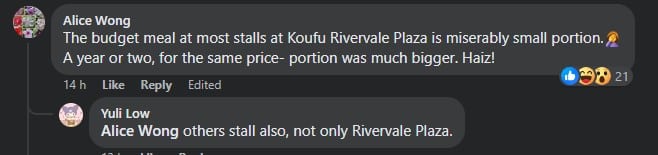


As reported by The Straits Times, SMS Sim Ann addressed criticism regarding the budget meal food portion issue by emphasizing that authorities collaborate with operators and stallholders in response to feedback on portion sizes and nutritional balance.
"So far they have been quite responsive to feedback and quite cooperative, and adjustments have been able to be made relatively quickly.”
Additionally, she confirmed that HDB officers conduct regular visits to evaluate the quality of meals offered under the scheme and mentioned plans to implement mechanisms for gathering public feedback on the budget meal initiative.
Netizen's concern: Are CDC vouchers evolving into food coupons for the poor?
Separately, SMS Low Yen Ling Low provided an update on the CDC voucher scheme, stating that as of 25 June, more than 883,000 families, constituting 67 per cent of all Singaporean households, have claimed their vouchers from the latest tranche.
Since 25 June, every Singaporean household has been eligible to claim S$300 in CDC vouchers for spending at participating hawkers, heartland merchants, and supermarkets.
Combined with the S$500 distributed in January, each household will receive a total of S$800 in 2024.
However, a netizen pointed out that CDC vouchers cannot possibly last for six months.
There are also comments questioning whether the use of CDC vouchers is indeed transitioning towards functioning more like food coupons for the economically disadvantaged.


Meanwhile, a sarcastic comment questioned the disparity between national wealth and individual financial security, implying that the need for budget meals suggests widespread economic challenges that a wealthy nation should ideally mitigate.

WP MP Louis Chua proposes rental cap for NEA hawkers over bidding practices
In March, Mr Louis Chua Kheng Wee, Workers’ Party (WP) Member of Parliament (MP) for Sengkang GRC, had argued against a purely price-based tender system, where hawker stalls are awarded to the highest bidder.
Participating in the Committee of Supply Debate for the Ministry of Sustainability and the Environment (MSE) budget on 4 March, Mr Chua emphasized the need for measures to ease the financial pressures on hawkers and ensure the affordability of hawker food for the public, especially in the face of the rising cost of living in Singapore.
One of Mr Chua’s proposals involved considering the adoption of a rental cap, drawing parallels with its successful introduction in this year’s Geylang Serai Ramadan bazaar.
He suggested that a similar approach could be extended to stalls in NEA-operated hawker centres.
In response to Mr Chua’s proposal, Dr Koh Poh Koon, the Senior Minister of State (SMS) for Sustainability and the Environment, staunchly defended NEA’s commitment to fostering a supportive environment for hawkers.
This environment, he argued, allows them to find a delicate balance between pricing their offerings affordably and sustaining their livelihood.
“NEA lets out hawker stalls through monthly tender exercises, which are transparent and fair.”
Dr Koh explained, “Rent will be adjusted towards the assessed market rent, after the first three years. In fact, only about 4% of cooked food stalls in hawker centres today are paying rent at above the assessed market rent. ”
“These stalls would be in their initial 3-year tenancy, and their rental would be based on their tender bid. When they renew their tenancy at the end of the three years, it will be adjusted to the assessed market rent. ”
Median rental across non-subsidised cooked food stalls has remained constant at about S$1,250 since 2015, said Dr Koh.
For SEHCs, Dr Koh said NEA considers proposals from operators with lower rental and operating costs for hawkers. Operators are not allowed to vary charges to hawkers over the tenancy term.
Dr Koh added that NEA has implemented measures such as the Productive Hawker Centre (PHC) program and Hawkers’ Productivity Grant (HPG) to help hawkers enhance their operations and productivity.
He further emphasized that NEA does not regulate hawker food prices, allowing hawkers autonomy to price their food based on various considerations such as operating costs and market conditions.
“NEA’s Hawkers’ Development Programme (HDP) and Incubation Stall Programme (ISP) provide holistic training to equip aspiring hawkers with skills needed to run a successful hawker business. Over 60 hawkers have joined the trade through these programmes.”
Dr Koh announced the opening of three new SEHC hawker centres – Woodleigh Village, Anchorvale Village, and Punggol Coast Hawker Centres – designed to offer affordable and tasty hawker food in pleasant dining environments.