Indonesia's Red and White Village Cooperative programme faces mounting scrutiny as viral videos fuel criticism
Indonesia's flagship Red and White Village Cooperative programme is facing growing criticism over village fund allocations, construction costs, financing risks and concerns that new outlets could undermine existing rural businesses.
- Critics say mandatory village fund allocations undermine local development priorities and village autonomy.
- Economists warn the programme could compete with existing small businesses instead of strengthening rural economies.
- The government says location complaints are limited and each reported case will be verified.

Indonesia's Red and White Village Cooperative (Koperasi Desa Merah Putih) programme is facing growing criticism from economists, village leaders and cooperative administrators, with opponents questioning its financing model, construction costs and impact on existing village businesses.
The programme, one of President Prabowo Subianto's flagship rural economic initiatives, aims to establish tens of thousands of cooperative outlets across the country.
However, concerns have intensified over the allocation of village funds, the cost of building cooperative facilities and whether the new outlets will compete with existing small businesses rather than strengthen local economies.
Village fund allocation sparks controversy
At the centre of the debate is a government policy requiring villages to allocate 58.03 per cent of their village funds to support the implementation of the programme.
Under Finance Ministry Regulation No. 7 of 2026 on Village Fund Management, approximately Rp34.57 trillion of Indonesia's Rp60.57 trillion village fund budget for 2026 has been earmarked for Red and White Village Cooperatives.
Using an exchange rate of approximately Rp16,000 per US dollar, the allocation amounts to around US$2.16 billion.
The remaining Rp25 trillion, equivalent to roughly US$1.56 billion, is available for other village development priorities.
Critics argue that the policy reduces village autonomy and diverts funding from projects that communities may consider more urgent.
The Regional Autonomy Monitoring Committee (KPPOD) has warned that directing more than half of village funds towards a centrally mandated programme risks disrupting village development plans that have already been approved through local planning mechanisms.
Questions over construction costs
The programme has also attracted scrutiny over the cost of developing cooperative facilities.
PT Agrinas Pangan Nusantara President Director Joao Angelo De Sousa previously stated that the construction cost of a single cooperative outlet was estimated at Rp1.6 billion, equivalent to approximately US$100,000.
Government figures cited in public discussions have suggested that the total cost of a cooperative facility could reach Rp3 billion, or around US$187,500, including physical construction and operational funding.
The figures have prompted questions from cooperative administrators and policy observers over whether such spending is justified for newly established cooperatives, particularly in villages where retail facilities already exist.
Unusual cooperative locations become social media talking point
The programme has also become the subject of widespread discussion on social media following the emergence of videos and photographs showing some cooperative outlets in locations that many users consider unusual or impractical.
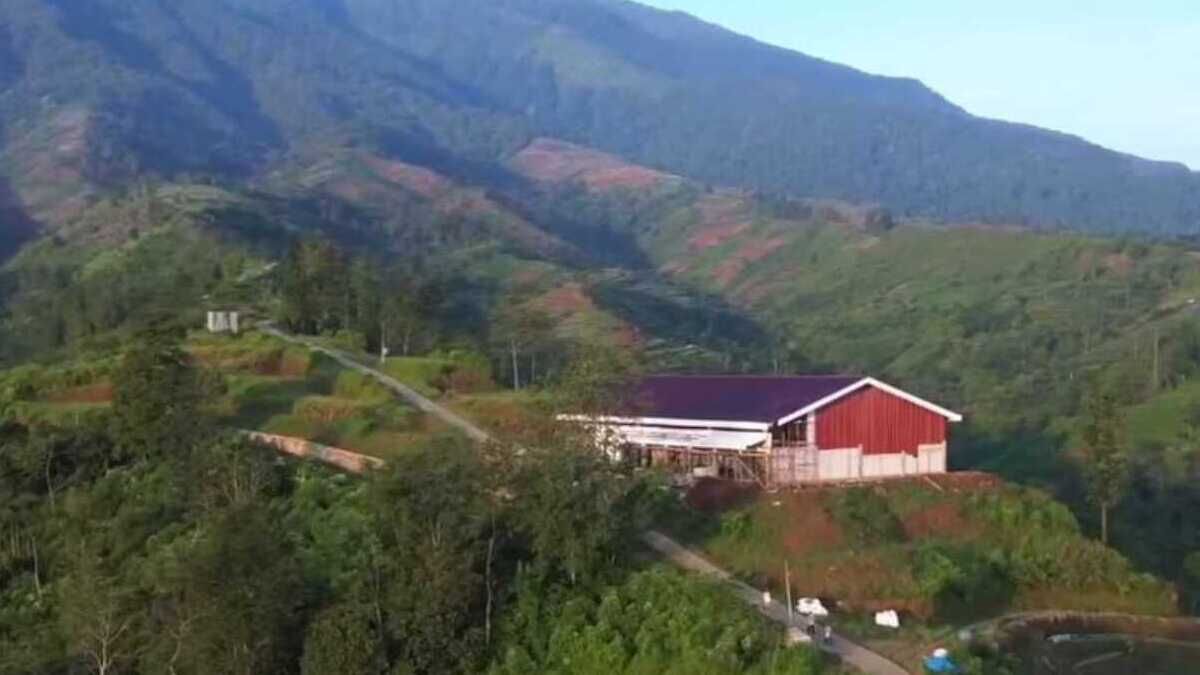
Posts shared across social media platforms have featured Red and White Village Cooperative buildings situated on hillsides, facing open rice fields, adjacent to other cooperatives and near cemetery areas. The images have circulated widely, becoming one of the most visible aspects of public debate surrounding the programme.
The controversy has been amplified by a wave of parody content created by influencers and content creators. Among them is Gilang Heryawan, whose satirical videos referencing some of the locations gained significant attention online. Similar parody posts from other creators have also spread widely, reflecting growing public discussion about the programme's implementation.
The viral posts prompted questions about how some sites were selected and whether the facilities were being built in locations capable of attracting sufficient economic activity. While the government maintains that the number of formal complaints is very small compared with the scale of the programme, the images have become a focal point of criticism online.
Cooperatives Minister Ferry Juliantono said government monitoring of public reports and social media posts found fewer than 10 complaints concerning cooperative locations out of approximately 30,000 units currently under development.
According to Ferry, each reported case will undergo a verification and validation process. He said cooperative locations were originally determined through consultations between village residents and village administrations and that the government would discuss possible solutions if any locations are ultimately deemed unsuitable.
Economist says programme departs from cooperative principles
Among the most vocal critics is economist Bima Yudhistira, who argues that the programme does not reflect the traditional principles of a cooperative movement.
Speaking during a public discussion, Bima said the programme had effectively "failed from the very beginning" because it was being implemented through a top-down government approach rather than being driven by community participation.
He pointed to cooperative models in Singapore and the United Kingdom, which he said developed through voluntary membership rather than state intervention. According to Bima, the Red and White Village Cooperative programme resembles a government-directed retail project more than a member-driven cooperative institution.
Concerns over competition with existing businesses
A major concern raised by critics is the potential impact on existing village businesses.
Indonesia already has an extensive network of traditional warung shops, neighbourhood retailers, small grocery stores, village-owned enterprises and national minimarket chains operating across urban and rural areas.
Bima warned that small traders, micro, small and medium-sized enterprises (MSMEs) and family-run stalls could lose customers if cooperatives receive preferential access to subsidised goods such as cooking oil, fertiliser and other necessities.
He argued that the programme risks creating direct competition for businesses that already serve local communities, describing it as a form of "cannibalism" within village economies.
Focus should be on farmers and distribution, critics say
Rather than operating as retail outlets, Bima said cooperatives should focus on helping farmers and producers gain better access to markets.
Drawing on observations from Cianjur, West Java, he noted that many farmers still rely on middlemen despite the presence of government-backed food programmes. According to him, the core challenge lies in distribution and market access rather than a lack of retail outlets.
He argued that cooperatives would be more effective if they strengthened supply chains and connected local producers with larger buyers instead of competing directly with existing village retailers.
Financing concerns remain
Bima also questioned the programme's financing model, warning that loans from state-owned banks could eventually become a burden if cooperatives fail to generate sufficient income.
According to him, repayment obligations could place pressure on village budgets and reduce funds available for infrastructure and public services.
As debate continues, some local officials are reportedly exploring ways to integrate Red and White Village Cooperative facilities with existing village-owned enterprises to reduce financial risks and avoid duplication.
While Bima said cooperative systems remain relevant to Indonesia's economy, he expressed doubts about the current model's prospects, particularly as concerns persist over purchasing power, financing and competition with existing businesses.
The debate comes as the government continues construction of thousands of cooperative facilities nationwide, making the programme one of the largest and most closely scrutinised rural economic initiatives in Indonesia.