Financial planner: Expats with families need over S$300K/year to live in Singapore
An Australian financial planner estimated that an expat family with four members need to make more than S$300,000 to sustain a comfortable lifestyle in Singapore, taking into account costs like renting a condo and paying for international schooling for children.
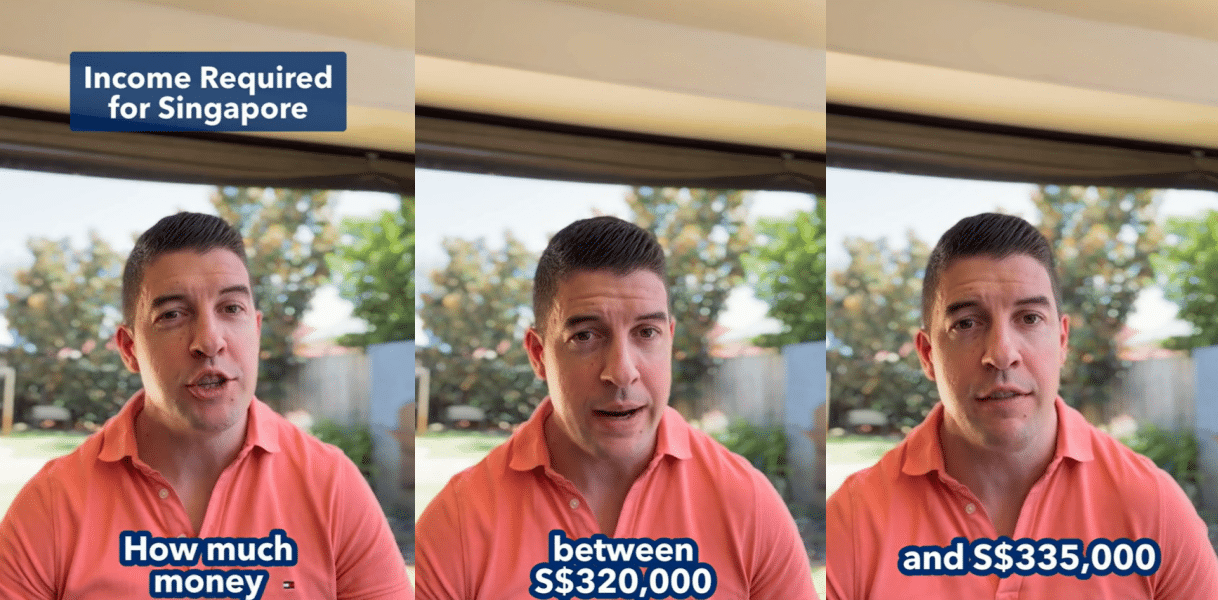

SINGAPORE: An Australian financial planner, Jarrad Brown, has stirred discussion with his recent claim that expatriate families with four members must earn over S$300,000 annually to sustain a comfortable lifestyle in Singapore.
Through a TikTok video, Brown meticulously dissected various expenses such as rent, education, utilities, and savings, shedding light on the financial prerequisites for expatriate families in the Lion City.
Brown, whose expertise lies in aiding Australian expats in Singapore, presented his breakdown on 13 March. The video quickly gained traction, amassing over 145,000 views at the time of this writing.
Brown's assertions have ignited a discussion regarding the financial dynamics of expatriate life in Singapore, prompting reflection on the cost of living and strategies for financial management in the city-state.
According to Brown's calculations, an "average family" with two children studying in an international school, requires an annual income between S$320,000 and S$335,000 to cover basic necessities in Singapore
However, he clarified that these figures exclude indulgent expenditures.
In summary, Brown outlined the following expenses:
- rental for a 3-room condominium unit at S$6,000 per month or S$72,000 annually;
- international school fees amounting to S$48,000 per annum for one child and S$96,000 for two children;
- utilities at S$250 monthly or S$3,000 annually;
- food and groceries costing S$1,000 monthly or S$12,000 yearly;
- public transport expenses of S$100 per month or S$1,200 annually;
- insurance at S$12,000 annually;
- entertainment and discretionary costs at S$500 monthly or S$6,000 yearly;
- phone, Internet, TV expenses totaling S$6,000 annually;
- and clothing and personal care expenses amounting to S$6,000 annually.
Factoring in a 20% savings requirement from gross income, Brown concluded that a family of four, including two children, must earn between S$320,000 and S$335,000 annually to maintain financial stability.
https://www.tiktok.com/@australian.expat/video/7345633925722590472?embed_source=121374463%2C121404359%2C121351166%2C121331973%2C120811592%2C120810756%3Bnull%3Bembed_masking&refer=embed&referer_url=mustsharenews.com%2Faustralian-expats-300k%2F&referer_video_id=7345633925722590472
Online responses to Brown's calculation
Online reactions to Brown's assertions varied.
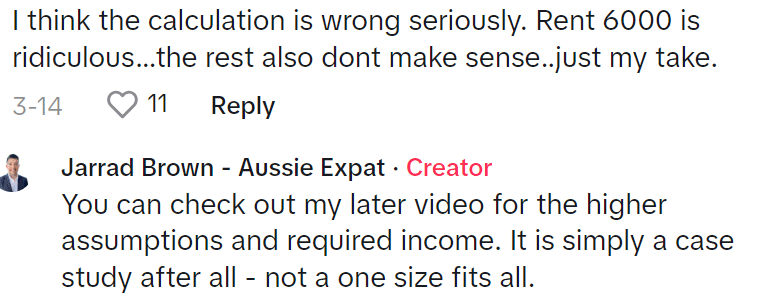
Some TikTok users expressed astonishment at the perceived high costs, with one user criticizing the S$6,000 monthly rental figure as "ridiculous."
However, Brown clarified that his calculations serve as a case study rather than a universal standard.
One expat commented, "Been here in SG for 20+ years, you are out with your calculations by about 50%-80%."
Netizen: even a Singaporean household earning S$150k annually "is already struggling"
Notably, one user commented that, for locals, the monthly expenses equate to the yearly income of a retail staff member.
Brown concurred, acknowledging the significant income gap.
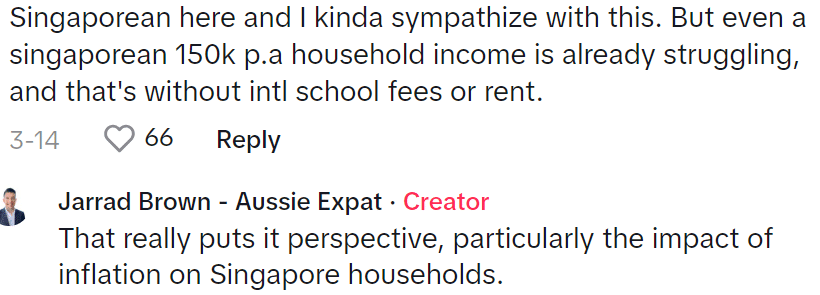
Another TikTok user from Singapore contributed to the discussion, expressing empathy towards the steep expenses.
They highlighted that even a Singaporean household earning S$150,000 annually "is already struggling," even without international fees or rent.
In response, Brown remarked, "That really puts it perspective, particularly the impact of inflation on Singapore households."
One user agreed with Brown's take on the video, stating, "This is very accurate."
"Of course it will vary depending on your family needs. We spend more than double the groceries. It's good that you include savings. I think some expats forget," the user added.
"This is a pretty good estimate, assuming the basics. It can go higher but this is a good baseline," another user wrote.
Additionally, a user mentioned that adding a car and hiring a helper would result in an extra monthly expense.

Cost-saving recommendations
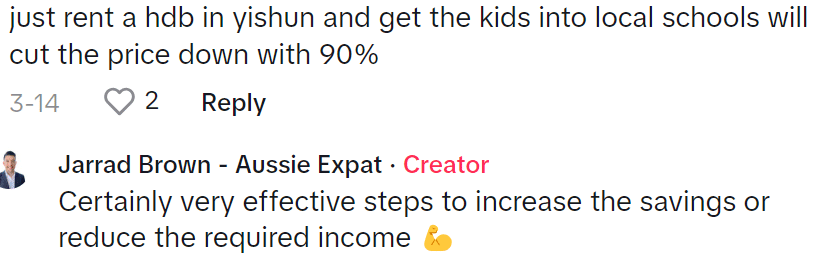
One user suggested cost-saving strategies, such as opting for Housing Development Board (HDB) flats and public schools.
Brown seemed to agree with this proposal, recognizing the effectiveness of these strategies in increasing savings or reducing the required income.
According to the Ministry of Foreign Affairs Singapore, International students who wish to study in a Singapore public school need to apply for a Student’s Pass unless they hold a Dependant’s Pass or an Immigration Exemption Order.
The admission of international students into mainstream schools is subject to the availability of school vacancies, among other criteria.
MTI disputes Economist’s costliest city ranking, questioning its accuracy in reflecting Singaporean cost of living
In December last year, a survey published by The Economist magazine indicated that Zurich and Singapore are the most expensive cities in the world ahead of New York amid the ever-rising cost of living.
The findings of the Worldwide Cost of Living survey published by the Economist Intelligence Unit (EIU) highlighted that Singapore kept its position as the world’s most expensive city this year, for the ninth time in 11 years.
After the survey was released, the Ministry of Trade and Industry (MTI) defended that the survey might not accurately portray the cost of living for Singaporeans.
A spokesperson for the MTI asserted that the EIU’s survey aims to assist human resource and finance managers worldwide in calculating living costs, providing allowances for expatriates and business travellers, and formulating compensation plans.
The spokesperson emphasized that the consumption basket used in the survey does not align with the typical spending patterns of Singaporeans.
Furthermore, the survey converts the prices of goods and services in the surveyed cities into US dollars to facilitate comparisons between cities, said MTI.
“Our country’s strong exchange rate places us high in the rankings compared to other cities, but the strengthened currency does not raise the cost of living for Singaporeans earning income in Singapore dollars.”
“Conversely, a stronger Singapore dollar helps to curb imported inflation in Singapore by reducing import prices, subsequently lowering consumer prices.”