WP's Gerald Giam challenges Indranee Rajah over allocation of PAP's GPC resources
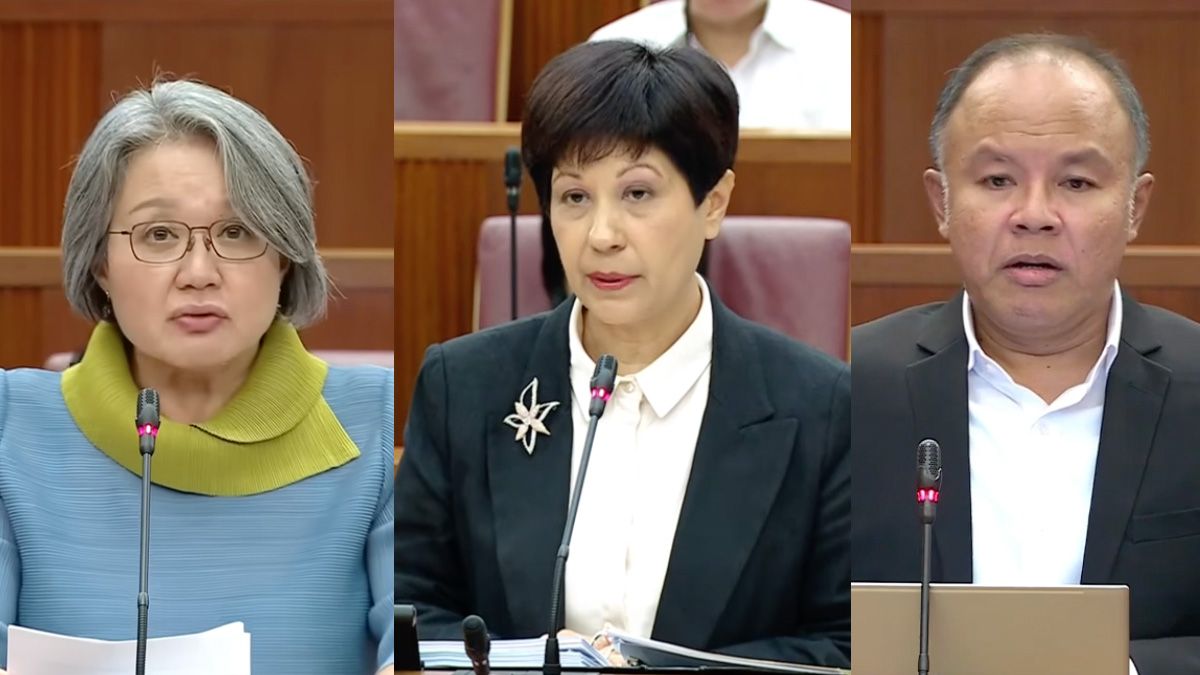
Leader of the House Indranee Rajah rejects WP MP Gerald Giam's proposal for Standing Select Committees for Ministries, citing it would be unproductive. Giam counters, questioning the resource allocation for Government Parliamentary Committees under PAP.


During the Committee of Supply (COS) debate in Parliament on Thursday (7 March), Workers' Party (WP) Members of Parliament (MPs) presented an extensive suggestion, advocating for a more accessible, transparent, and conducive Parliament to participatory democracy, especially in a world that is becoming increasingly unpredictable and volatile.
Ms He Ting Ru, WP MP for Sengkang GRC, advocated for increased openness and reduced secrecy to enhance the public's understanding of the legislative process and government spending, arguing that maintaining the principle of parliamentary transparency and openness can encourage participatory democracy and better governance.
Meanwhile, Mr Gerald Giam, WP MP for Aljunied GRC, proposed establishing Standing Select Committees for each Ministry or group of related Ministries to enhance scrutiny, facilitate informed debate, and contribute to more effective governance, political consensus, and national unity.
Mr Giam highlighted that while Parliament currently has seven Standing Select Committees, none are specific to individual ministries.
He drew attention to established practices in other legislatures, citing examples from the UK’s House of Commons and Australia’s Parliament.
In these systems, select committees dedicated to specific government departments play a crucial role in scrutinizing government actions, policies, and spending, he said.
Mr Giam called on Parliament to set up Standing Select Committees for each Ministry or group of related ministries, consisting of MPs from all political parties represented in Parliament.
He said Select Committees examine each Ministry’s policies, spending and administration. They are empowered to inquire into and report on any matter referred to them by the House or a Minister. The Committees may call in subject matter experts to give testimony and answer questions from Members that can inform their considerations.
“After thorough scrutiny of legislation and policies, the select committees can make recommendations to Parliament before bills and motions are debated and voted on by all MPs.”
“This process will lead to more informed and constructive debate and better decision-making in Parliament. The committees thus help to contribute to more effective governments build political consensus, and strengthen national unity, ” Mr Giam added.
Ms Indranee dismisses WP's proposal to set up Select Committees for Ministries
In response, Ms Indranee drew scepticism over the effectiveness of having numerous committees overseeing various ministries.
She argued that having more standing committees or more select committees would not be very productive. She defended that Singapore's governance, transparency, and low corruption levels are already well-regarded internationally.
She said, "It would be unproductive for every ministry to have to answer to a standing select committee setting up a committee for each ministry requires significant time."
"Ministries will also have to expand scarce resources reporting to and preparing answers for their respective committees. and these are resources which could be spent on important policy work."
Instead of standing select committees for each ministry, Ms Indranee advocated for convening ad-hoc select committees when necessary.
Mr Giam challenges Leader of the House's assertion that select committees for ministries could be "unproductive"
Mr Giam, seeking further clarification, questioned whether the minister asserted that select committees do not contribute to better governance and trust.
He expressed scepticism about the assumed causality between Select Committees and diminished trust in government, particularly emphasizing examples from other countries.
In response, Ms Indranee clarified that she did not claim that select committees inherently lead to poorer governance or trust.
She addressed the underlying assumption that proposing select committees inherently suggests a belief in their capacity to enhance governance and accountability.
She argued that the current parliamentary processes already provide substantial room for holding the government and ministers accountable.
"I do not think that having select committees essentially overseeing or having ministries reporting to them will improve things."
Mr Giam challenges Government Parliamentary Committees' resource allocation
Then Mr Giam posed a counterargument, questioning the justification for the time and resources spent by Government Parliamentary Committees (GPCs).
"How is the time and resources that ministries spend answering questions and briefing GPCs justified even more so, given that they are not Parliament organs but PAP's party organs?"
Ms Indranee then explained that GPCs were established to assist ruling party MPs in fulfilling their duties effectively, providing a channel for political feedback and expertise within the party structure.
Ms Rajah underscored the distinction between GPCs and select committees, noting that select committees include representation from all parties, while GPCs do not.
She emphasized that GPCs aim to enhance the policymaking process by offering feedback to ministers and ministries.
"The role of the GPCs within the party construct is to give feedback to the ministers and to the ministries to enable the government to do better policy-making."
Mr Giam then sought clarification on whether GPC receives confidential briefings from government ministries that are not disclosed to opposition MPs.
"The minister said that GPCs get information through the ministers, does that mean that civil servants do not brief the GPCs?"
In response, Ms Indranee explained that ministries may indeed provide briefings to GPCs for their internal purposes, seeking feedback or updating them on specific matters.
"But if there is anything which is political, that's really not for the civil servants, that is really for the minister and the GPCs because the GPCs come from the same party as the minister."
However, Ms Indranee did not addressed Mr Giam's question on the resources allocated to GPCs.