The real challenge for Singapore: Demographic shifts threatening national identity over climate change concerns
While climate change is critical, the true challenge for Singapore lies in addressing the demographic shift that threatens to alter its national identity, overshadowing the urgency of environmental concerns.


Minister for Sustainability and the Environment Grace Fu stated, "The daily average temperature could rise by up to 5°C by the century’s end as Singapore faces the wrath of climate change."
“The study shows that we will have to contend with more extreme climate conditions – higher temperatures, heavier rainfall, and longer, more frequent dry spells,” said Ms. Fu.
Announcing these findings at a symposium at Marina Bay Sands last Friday (5 Jan), Ms. Fu added, “These climate conditions may also lead to other indirect challenges, including disruptions to water and food supplies.”
Singapore is already planning how to cope, with measures ranging from building new developments 4m above mean sea level to exploring the best ways to cool the city down.
In 2019, Prime Minister Lee Hsien Loong announced that Singapore would need to spend S$100 billion over the next 100 years to protect against rising sea levels. Since that announcement, the government has allocated S$5 billion towards a coastal and flood protection fund.
In addition to this spending, aimed at addressing future rising sea levels, Singapore is increasing its carbon tax from S$5 to S$25 per tonne of emissions, resulting in a hike in electricity tariffs for January to March 2024.
However, do not be distracted by politicians' narratives. The primary concern for Singaporeans at large should not be the rising temperatures or climate change; rather, it is the looming demographic shift that threatens the core of Singaporean identity.
Singapore's future is at risk, not primarily from the environmental threats of climate change but from the declining birth rates within its population. The country's total fertility rate has plummeted to alarming levels, signalling a potential crisis where native Singaporeans could become a minority in their own land.
Singapore's resident total fertility rate hit an all-time low of 1.05 in 2022, dipping below the previous record of 1.1 in 2020 and 1.12 in 2021. The figure has been below 1.2 since 2017. This demographic shift poses a grave threat to the cultural and societal fabric that has been woven over generations.
While efforts to mitigate climate change are commendable, they should not overshadow the urgent need to address our demographic decline. The government's commitment of S$100 billion to combat rising sea levels, though important, pales in comparison to the effort spent to promote the birth rate of Singaporeans.
In Budget 2023, Deputy Prime Minister and Finance Minister Lawrence Wong announced a slew of measures to strengthen support for Singaporeans on their parenthood journey, along with adjustments to existing tax relief schemes to support families with greater needs. All these provisions will cost the Government an additional $240 million per birth cohort of children. Now compare this with the spending meant for climate change.
For the People's Action Party government, it appears much easier to import new citizens than to introduce or amend policies to make it conducive for Singaporeans to bear the future generations of Singapore.
Based on population figures, with a historical record of 5.92 million in 2023, it would be safe to say that Singapore is still on its projected target of reaching a 6.9 million population by 2030 through the awarding of new citizenships and permanent residencies.
Singapore granted around 23,100 new citizenships last year, with 1,300 going to children born overseas to Singaporean parents, and 34,500 new permanent residencies were granted. The scale of granting new citizenships and PRs (Permanent Residencies) has grown and been maintained since the introduction of the Population White Paper in 2013.
If we consider the low birthrate and the spike in population, it would not be too far-fetched to say that the population growth over the years has primarily been due to foreign immigrants. True enough, Singapore’s government has emphasized its strategic use of immigration policies as a countermeasure to the challenges posed by an ageing population and decreasing birth rates.
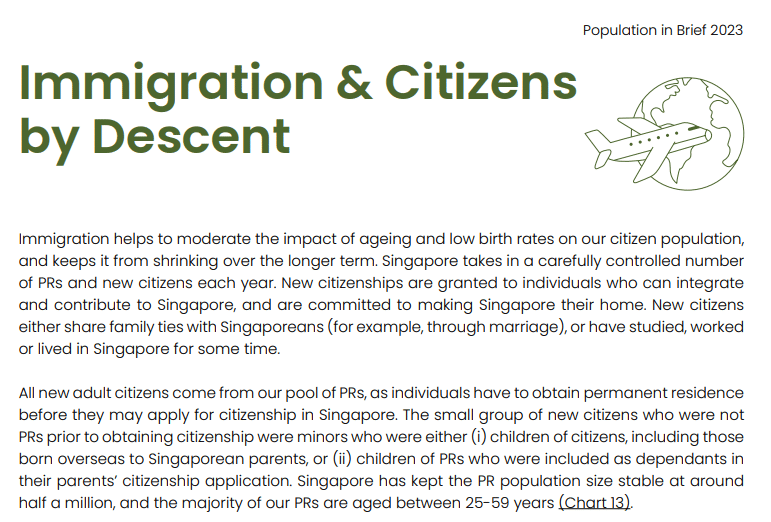
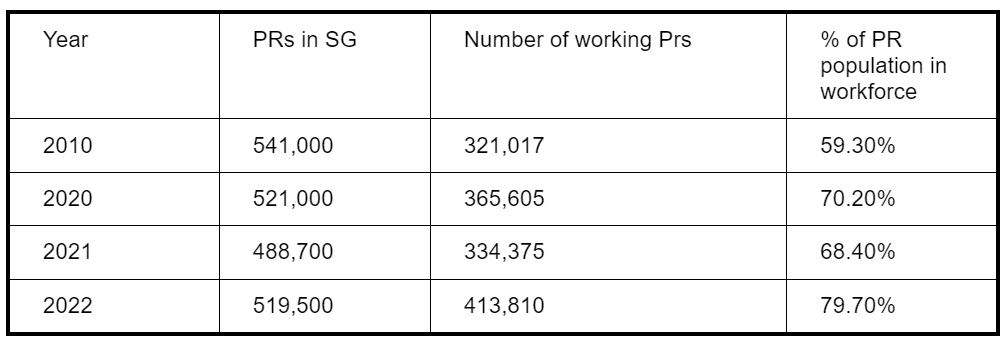
Even though the Government states that PR population size has been kept stable, a closer look at the figures would suggest there has been an increasing trend of most of the new PRs granted, or those who stayed in Singapore, are workers in the workforce rather than dependents as shown by the increase of percentage of PRs in the workforce over the years.
Furthermore, the most recent Gross Domestic Product (GDP) numbers suggest that the significant influx of immigrants, intended to boost Singapore's population, has had a limited impact on the economy.
In 2023, Singapore's GDP grew by only 1.2% despite substantial government spending on infrastructure. This modest growth starkly contrasts with our neighbours, Malaysia and Indonesia, where GDPs grew by 3% and 5%, respectively.
Notably, this occurred while Singapore's population increased by 5% within the same year, compared to annual population growth rates of 1.08% in Malaysia and 0.64% in Indonesia.
Climate change is undoubtedly a global challenge, but for Singapore, the priority should be clear: to nurture and grow our population, especially considering our trillion-dollar reserves saved to prepare a better life for our future generations.
Every effort should be made to encourage and support families in their parenthood journey, ensuring that the Singaporean spirit continues to flourish. It is hard for the PAP government to deny that the declining population trend has nothing to do with it and the policies it enacted since it ruled Singapore uninterrupted since its independence in 1965.
If Singapore's future generations are primarily going to be composed of new immigrants in the coming decades, it raises questions about the purpose of hoarding our reserves, particularly when there is a reluctance to spend more of the investment returns. This issue becomes even more pertinent when considering suggestions to use these returns to offset the need for a GST hike.
This concern becomes particularly relevant if these new immigrants and their parents have contributed little or nothing to this shared fund. This situation is in stark contrast to the PAP politicians' constant rhetoric about saving for future generations, juxtaposed with their reluctance to spend more on current Singaporeans who are struggling with inflation.