PM Lee emphasizes POFMA as a 'serious requirement' to flag falsehood as deemed by PAP Govt
Prime Minister Lee stressed the critical role of POFMA in addressing misinformation. He described it as a "serious requirement," highlighting its function in flagging online falsehoods and ensuring that people understand the lack of factual basis in such claims, actively disputed by the government.
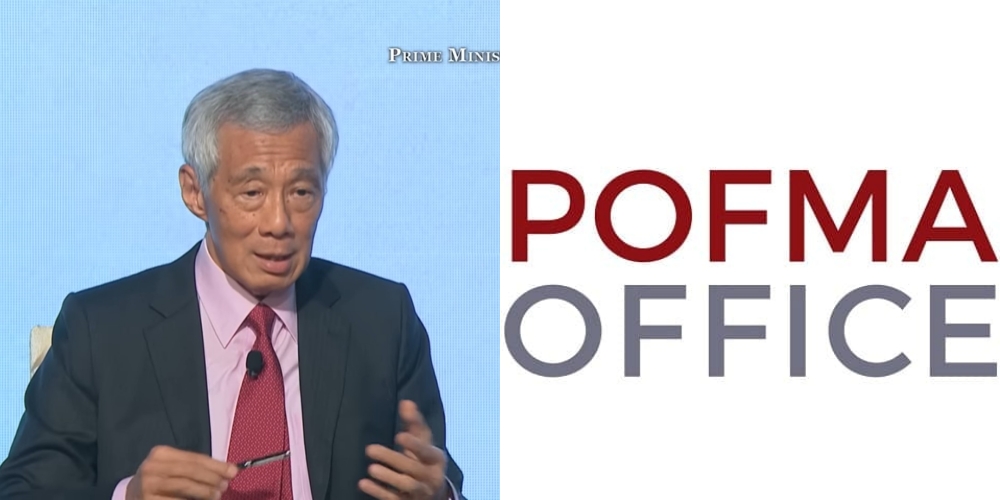

SINGAPORE: Prime Minister Lee Hsien Loong emphasized the importance of using the Protection from Online Falsehoods and Manipulation Act (POFMA) as a "serious requirement" to combat misinformation.
He stated that POFMA provides a mechanism to flag online falsehoods and ensures people are informed about such claims, emphasizing that these claims lack a factual basis and are actively disputed by the government.
PM Lee, who is also the head of the ruling People's Action Party (PAP), made these remarks during a dialogue session at the Asia Future Summit on 5 October.
In the session, PM Lee addressed a range of topics, from U.S.-China Relations to Singapore's foreign policy strategy and the challenge of misinformation.
Gillian Koh, Deputy Director (Research) at LKYSPP's Institute of Policy Studies, delved into Singaporeans' understanding of the government's foreign policy and the efforts to shape this understanding, whether overtly or covertly.
She questioned if the Prime Minister felt Singaporeans sufficiently understood these concepts and inquired about the government's influence compared to external sources.
Responding, PM Lee noted that Singaporeans have extensive exposure to international news because of the country's global openness and their frequent travels abroad. Yet, everyday concerns often overshadow international matters, emphasizing the need for widespread understanding of Singapore's foreign policy.
He expressed confidence in domestic support for Singapore's international stances, such as its position on Ukraine. He highlighted the importance of internal backing for these decisions.
Recognizing the vast amount of information, including disinformation on platforms like WhatsApp and Telegram, PM Lee pointed out the government's efforts in countering false narratives.
"We have to go out and counter them. We've been diligent in ensuring our messages are accurate and that people discern the sources and intentions behind what they read."
On 1 April 2019, the POFMA Bill was presented for its first reading in parliament. During its second reading, Minister K Shanmugam clarified the legislation's aim: to safeguard society from intentional online falsehoods by malevolent actors, focusing on falsehoods and not opinions, criticisms, satire, or parody.
After a two-day debate, the bill was approved with a 72-9 vote, with all Workers Party (WP) MPs dissenting. The law characterizes a falsehood as a misleading statement of fact. Juridically, POFMA encompasses both explicit and implicit statements.
PM Lee emphasized POFMA's crucial role in ensuring truthful online discussions, saying:
"The term 'POFMA' has turned into a verb – 'I can POFMA you.' But this isn't a trivial matter. It ensures that online falsehoods are identified, ensuring the public knows which claims the government deems incorrect."
Emphasizing Singapore's openness, he asserted the impracticality of insulating the nation from global information and misinformation.
While the Singapore Government has frequently used POFMA against local individuals and entities, it has been hesitant with large foreign media outlets, even those accused of spreading falsehoods about Singapore.
Reflecting on Lee Kuan Yew's leadership, PM Lee credited contingency and luck for Singapore's success. He recounted Singapore's past, including the unfruitful merger with Malaysia leading to independence.
"Remarkably, the left-wing opposition party of the time, with 13 to 14 parliamentary seats, boycotted the government, deeming it a pseudo-independence. The PAP, seizing this opportunity, secured all parliamentary seats, enabling undistracted nation-building and development for about 15-16 years."
He accentuated the public's trust as pivotal and urged politicians to stay connected and serve the people. While acknowledging Singapore's unique success story, PM Lee mentioned evolving global dynamics and the necessity for policies, like adult education, to match the changing job landscape.