ST editor Chua Mui Hoong relocate to Perth in June, defends her loyalty to Singapore
Ms Chua Mui Hoong, Associate Editor and senior Columnist at the Singapore's state media Straits Times, recently revealed her relocation to Australia in June of this year. \n \nIn her recent article, she defended that she is not a 'quitter', and believes that a Singaporean journalist can write about Singapore from outside country. \n \nMs Chua gained substantial recognition for her steadfast advocacy of Singapore's ruling party, the PAP, notably on critical issues such as the GST and public housing.
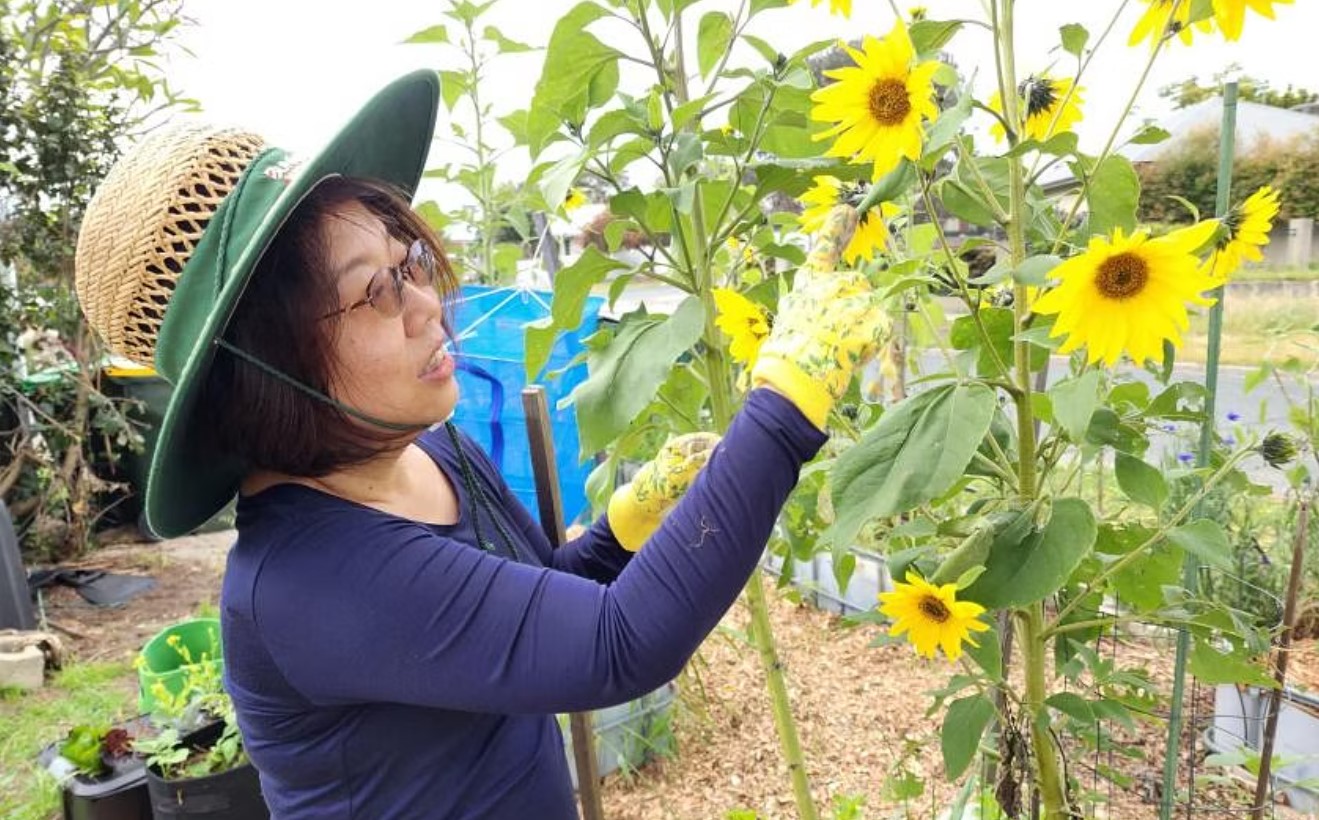

SINGAPORE: Chua Mui Hoong, a prominent Associate Editor and senior Columnist at the Straits Times, recently disclosed her relocation to Australia in June this year.
Last Friday (22 Sep), Ms Chua penned an opinion piece titled 'I never thought I’d emigrate. But now I’m living in Perth and mulling over questions of identity,' which was published in the Straits Times.
In this subscriber-only article, Ms Chua shared her relocation to Australia in June. She initially planned to return for the 2023 Presidential Election on September 1st but couldn't due to her partner's hospitalization, which necessitated her stay in Perth.
Chua Mui Hoong reflects on her experience of relocating to Australia and how it has led her to question her identity as a Singaporean living abroad.
She delves into her career as a journalist and writer for The Straits Times, where she has primarily focused on writing about Singaporean issues and influencing Singaporeans through her writings.
Furthermore, she raises the question of whether a Singaporean journalist can effectively cover Singapore from outside the country and expresses concerns about the longevity of her connection with Singapore and her relevance to readers back home, given her new life in Australia.
Ms Chua believes a Singaporean journalist can write about SG from outside
"Can a Singaporean journalist write about Singapore from outside Singapore? The hopeful answer is yes. It is easier to do so these days, aided by social media that lets one keep in constant contact with a flow of friends and contacts from home. "
"At the same time, distance has advantages, and can help one see things more clearly. But being away can make one lose touch with the pulse of the land."
She ponders the possibility of finding a new purpose beyond Singapore as she makes a major life change and settles in a foreign country.
As she navigates her life in Perth, Australia, Ms. Chua expresses the tug of missing significant Singaporean events and battling occasional feelings of being a "quitter" for living abroad.
She references Prime Minister Goh Chok Tong’s 2002 National Day Rally speech, which criticized young Singaporeans who sought opportunities abroad during an economic downturn.
Mr Goh later clarified that loyalty to Singapore can be upheld regardless of one’s geographic location, not before being criticized for how his daughter was living in London with her husband.
Hence, Ms Chua went on to defend that Singapore Government was also encouraging Singaporeans to work and live overseas, "One need not be a resident in a country to be loyal to it."
According to official data, in 2021, there were 179,500 overseas Singaporeans, of whom 123,900 were in the working ages of 20 years to 64 years.
In her article, Ms Chua also discussed various arguments against dual citizenship, including concerns about splitting loyalties, military service and maintaining a clear national identity.
She acknowledges that many countries permit dual citizenship and suggests a possible solution of restricting dual citizenship to those with at least one Singaporean parent, which would allow children born to Singaporean parents abroad to maintain ties to Singapore.
Regarding the challenge of how one gauges loyalty she said, "Perhaps loyalty is tested in a crisis: If Singapore was threatened, would I get on a plane to fly back to Singapore? I used to reply with an unequivocal yes. No matter where in the world I am, if the Red Dot were in dire danger and I thought that my writing – my one useful talent – could have an impact for the good, I would be home in a heartbeat."
She emphasized that she is not a "quitter", suggesting that her loyalty may now be influenced more by personal and family ties than strict national loyalty. She emphasizes that true loyalty should be demonstrated in everyday actions rather than just in exceptional circumstances.
She also argues that those born as Singaporeans, living abroad for various reasons, should still consider themselves part of the larger Singaporean diaspora.
"To confine Singaporeanness to those who live within the confines of the Singapore city-state is limiting. Life cycles and life circumstances change; people move in and out of cities. But the core of being Singaporean can remain a bedrock of our identity through those changes."
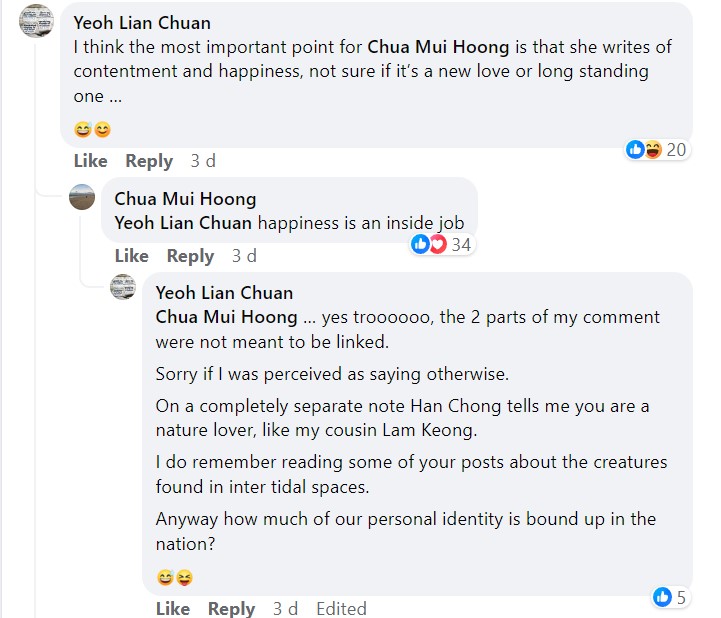
Ms Chua: Happiness is an inside job
Bertha Henson, the former Associate Editor of The Straits Times, also shared Ms Chua's article on her Facebook.
Mr Yeoh Lian Chuan, a Singaporean lawyer, commented on Ms Henson's Facebook post, expressing his curiosity about what Ms Chua values most in her writing—whether it stems from newfound happiness or a long-standing source of contentment.
Replying to Mr Yeoh, Ms Chua commented: "Happiness is an inside job"
Ms Chua, a vocal supporter of PAP's policies, previously praised the affordability of BTO flats compared to other Asian cities
Chua Mui Hoong, a former government scholar, is widely recognized for her staunch advocacy of Singapore’s ruling party, the PAP, particularly on issues like the GST and public housing.
For instance, in November 2022, Chua Mui Hoong argued in an opinion piece that Built-to-Order (BTO) flats sold by the Housing Development Board (HDB) in Singapore are affordable compared to many Asian cities, as most first-time buyers spend less than 25% of their income on monthly loan repayments, typically covered by their Central Provident Fund (CPF).
She mentioned the price-to-income ratio (PIR) as an important measure of affordability, with Singapore's HDB flat PIR at 4.5 and her calculation for a 4-room BTO flat at 6.8, still low compared to other Asian countries.
Additionally, she pointed out higher PIRs for private properties in Singapore, Hong Kong, Beijing, and Tokyo to provide context.
However, her comparison received sharp criticism from Mr Foong Swee Fong, a vocal critic, who contended that it was misleading and created a false impression of affordable housing in Singapore.
He pointed out that there are cities with lower price-to-income ratios (PIR) than Singapore, which she did not mention, and accused her of selectively choosing comparisons to support her argument, thereby compromising objectivity.
He highlighted that Singapore's PIR, calculated by Demographia, has rapidly deteriorated from 4.6 in 2019 to 5.8 in 2021, placing it in the severely unaffordable category. Ms. Chua's calculation of 6.8 for a 4-room BTO flat reinforces this classification.
While the Urban Land Institute report rates HDB flats at 4.5, in the seriously unaffordable category, it curiously describes Singapore as the only city-state where housing is deemed affordable.
Despite Singapore being less unaffordable than other Asian cities, it doesn't make its housing any more affordable, and Mr Foong highlighted the contrast with earlier generations when housing was more affordable, attributing the current affordability crisis to various factors, including CPF use for housing, land price inclusion in HDB flats, and foreign property ownership.