Saudi-led coalition strikes Hodeidah as Houthis threaten Saudi ports
Saudi-led coalition strikes on Yemen’s Hodeidah port have prompted the Houthis to threaten Jeddah and other Saudi Red Sea ports, escalating tensions and raising concerns over civilian safety and international shipping.
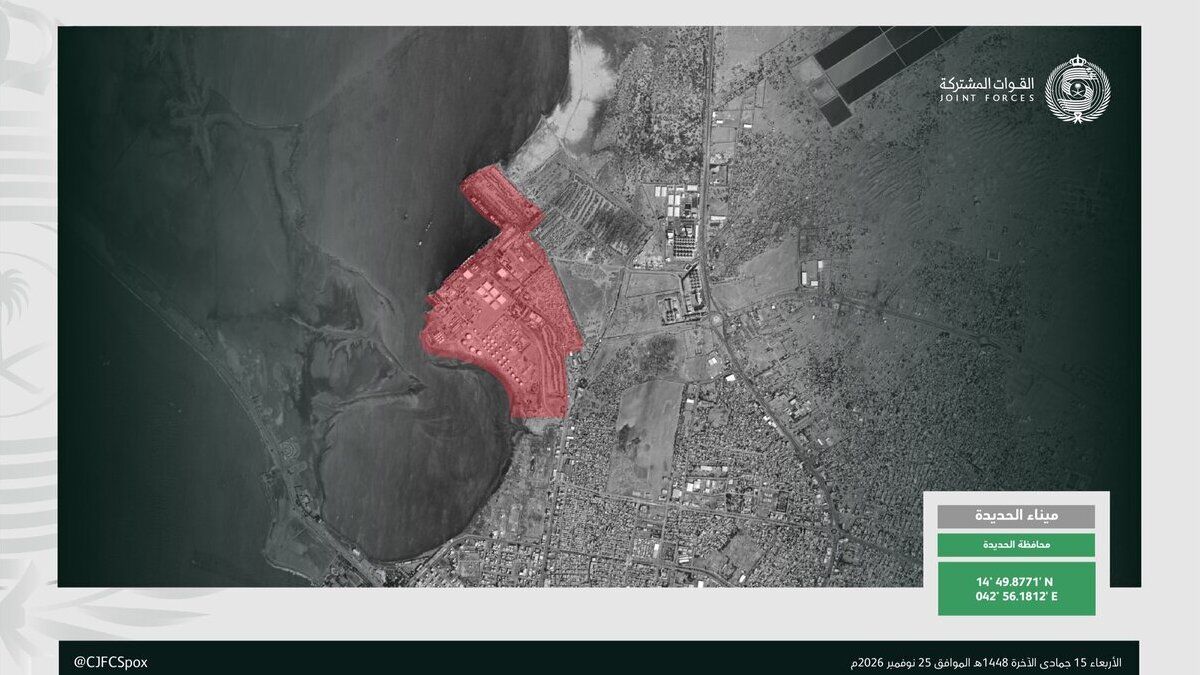
- Saudi-led coalition forces confirmed strikes on Hodeidah, Saada and Amran governorates.
- The Houthis threatened to target Jeddah and other Saudi Red Sea ports if further attacks continued.
- Renewed fighting threatens Yemen’s humanitarian supplies and maritime security along a major international shipping route.

Saudi-led coalition forces have launched strikes on Yemen’s Red Sea port city of Hodeidah, prompting the Iran-backed Houthi movement to threaten attacks on Jeddah and other Saudi ports if further bombardments target the city.
Houthi-affiliated media reported on Wednesday, 25 November 2026, that Saudi forces had attacked Hodeidah port and its international airport after the Saudi-led coalition issued an evacuation warning to civilians in the area.
The Houthi television network Al-Masirah reported that intense airstrikes and military aircraft overflights were continuing over the city. However, it did not immediately provide details of the damage.
No deaths or injuries had been confirmed in the latest reported attack at the time of publication.
The Saudi-led coalition subsequently confirmed that it had targeted what it described as Houthi operational capabilities at Hodeidah port, as well as targets in Saada and Amran governorates.
The latest confrontation follows repeated cross-border attacks between Saudi Arabia and the Houthis, including a drone strike on a prominent skyscraper in Riyadh that injured 11 people on Tuesday.
Houthis threaten to target Jeddah and Saudi ports
Houthi military spokesperson Yahya Saree warned that the group would retaliate if Saudi Arabia continued attacking Hodeidah.
In a statement published on Telegram on Wednesday, he said Jeddah port and other Saudi ports along the Red Sea coast would become military targets if the coalition carried out further attacks on Hodeidah.
He also urged workers, residents and shipping companies to evacuate the ports and withdraw their vessels.
The warning followed an earlier statement by the Saudi-led coalition instructing civilians to leave Hodeidah port for their safety.
The coalition's announcement was accompanied by an evacuation map identifying the area of concern.
The threats have raised concerns over maritime security along the Red Sea, an important international shipping route connecting the Mediterranean Sea with the Indian Ocean through the Suez Canal and Bab al-Mandeb Strait.
Saudi coalition confirms strikes on Hodeidah
The Saudi-led coalition said its operation targeted military capabilities used by the Houthis for weapons smuggling and other military activities.
Coalition spokesperson Major General Turki al-Maliki said operational capabilities at Hodeidah port had been targeted. The coalition also reported destroying other targets in Saada and Amran.
The internationally recognised Yemeni government has previously defended coalition strikes on Hodeidah, accusing the Houthis of using port facilities to receive weapons smuggled from Iran and transport materials for manufacturing missiles and drones.
In a statement published on X, the Yemeni cabinet said the targeted facilities were being used for military purposes and weapons transfers.
It maintained that the coalition had taken measures to warn civilians and evacuate them before the strikes.
The government also said commercial shipments, humanitarian assistance and essential goods would continue entering Yemen through operational ports and other entry points under government control.
The Houthis have not publicly provided independently verifiable evidence supporting their claims about the latest strikes.
Riyadh skyscraper attack leaves 11 injured
The latest escalation follows a drone attack on the Public Investment Fund (PIF) Tower in Riyadh's King Abdullah Financial District on Tuesday, 24 November.
The Saudi-led coalition said 11 people were injured in the incident. They included four Egyptians, three Nepalese, two Indians and two Saudi nationals.
The tower, which houses Saudi Arabia's sovereign wealth fund, had also been targeted the previous Thursday, causing damage to several floors and neighbouring buildings.
Coalition spokesperson Turki al-Maliki described the attacks on civilian buildings and infrastructure as terrorism and warned that they would receive a firm response.
Saudi Arabia has not publicly provided further details about the military response to the latest incident.
The attacks have also affected Saudi Arabia's airports, oil facilities and other strategic infrastructure in recent months.
Previous strikes in Hodeidah killed at least eight
The latest reported attack comes days after another round of airstrikes on Hodeidah on 23 November.
Houthi-run media initially reported that coalition airstrikes had targeted a telecommunications facility, killing workers and damaging administrative buildings, staff accommodation and a mosque.
The Houthi Telecommunications Ministry subsequently reported 17 deaths and 11 injuries.
However, health officials in Sanaa initially reported eight deaths and 17 injuries, while later Houthi-affiliated media gave a higher toll of 10 deaths and more than 20 injuries.
The different figures have not been independently verified.
The strikes reportedly disrupted telecommunications and internet services, affecting tens of thousands of people.
Houthi military spokesperson Yahya Saree also accused coalition forces of attacking buses and transport vehicles in Lahj governorate, although details of the casualties were not independently confirmed.
The Saudi government did not immediately comment on those particular casualty claims.
Hodeidah is vital to Yemen's food supplies
Hodeidah is one of Yemen's most important commercial and humanitarian entry points.
The port serves millions of people in northern Yemen, where the Houthis control large areas, including the capital, Sanaa.
According to reporting by Al Jazeera, more than 90 per cent of Yemen's imported goods enter through Hodeidah.
The port is particularly important for food, fuel, medicine and humanitarian assistance in a country where millions of people depend on imported supplies.
The United Nations has repeatedly warned that attacks affecting Yemen's ports could worsen the humanitarian crisis.
UN spokesperson Farhan Haq said the organisation was concerned about the escalation and called on all parties to comply with international humanitarian law.
"We urge all parties to uphold their obligations under international humanitarian law, including the prohibition of directing attacks against civilians and civilian infrastructure, and to take constant care to spare the civilian population and civilian objects," he said.
He also reiterated that there was no military solution to the conflict and urged the parties to return to political negotiations.
Yemen's civil war reignites amid wider regional conflict
Yemen has been embroiled in civil war since 2014, when the Houthis seized Sanaa and expanded their control over much of the country's north.
Saudi Arabia intervened militarily in March 2015, leading a coalition supporting Yemen's internationally recognised government.
The conflict continued for years before a United Nations-brokered truce in 2022 significantly reduced fighting.
However, hostilities resumed in July 2026 amid the wider conflict involving Iran and US-led military operations.
Since then, the Houthis have expanded their military operations against Saudi targets, including airports, oil facilities and other infrastructure.
The Saudi-led coalition has responded with airstrikes against Houthi positions across Yemen.
The renewed fighting has also affected the country's southern regions. Houthi forces have advanced towards Aden, the temporary seat of Yemen's internationally recognised government, while government-aligned forces have attempted to strengthen their defences.
According to the latest United Nations figures cited by international media, the renewed fighting has killed more than 1,600 people and displaced more than 300,000 since hostilities resumed.
Public reactions focus on civilian risks and shipping security
The latest escalation has generated international discussion about the potential consequences for civilians and commercial shipping.
Public commentary surrounding the Hodeidah strikes has centred on two main concerns: the humanitarian consequences of attacking a major food-importing port and the possibility that the conflict could spread to Saudi commercial ports and international shipping routes.
Some online discussions have focused on the Houthis' threats against Jeddah and other Red Sea ports, while others have questioned the risks of military operations around infrastructure used for civilian supplies.
However, independently attributable comments from individual netizens could not be verified sufficiently to reproduce as direct quotations.
The United Nations has meanwhile called for restraint and protection of civilian infrastructure as the confrontation continues.