Shanghai's Communist Party chief Chen Jining falls in Xi Jinping's widening corruption purge
China has placed Chen Jining, Shanghai's Communist Party chief and a Politburo member, under investigation for suspected serious breaches of discipline and law. He is the fourth member of the 24-strong body to fall this term, and the first Shanghai leader probed in office since 2006. (281 characters)
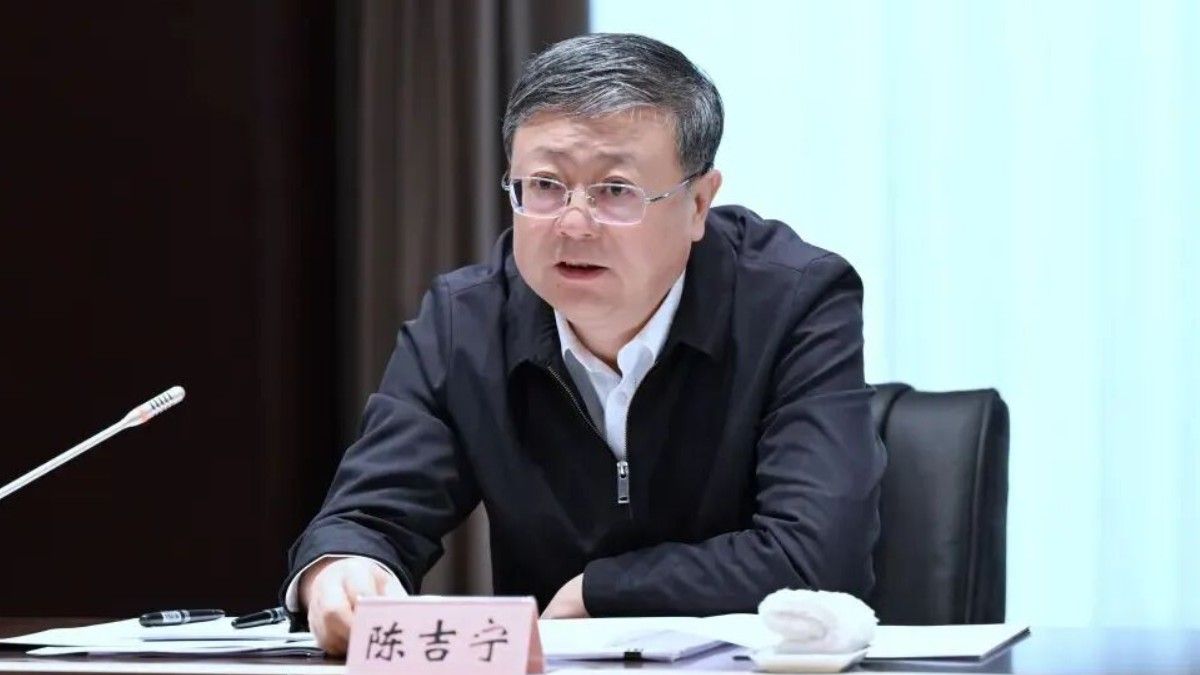
- Chen Jining, Shanghai party chief and Politburo member, is under investigation for suspected serious discipline and legal violations.
- He is the fourth of 24 sitting Politburo members to fall since 2022, a record for the reform era.
- Timing, under a year before the party congress, unsettles expectations about China's next senior leadership line-up.

BEIJING, CHINA: China's top anti-corruption agency has opened an investigation into Chen Jining, the Communist Party secretary of Shanghai and a member of the ruling Politburo, state media announced on 24 November 2026.
The official Xinhua news agency gave a single sentence.
Chen, 62, is suspected of "serious violations of party discipline and the law" and is being examined by the Central Commission for Discipline Inspection and the National Supervisory Commission.
No specific allegation was disclosed. The phrase is the standard formula used in China to signal corruption allegations, and officials named in such notices are normally expelled from the party before facing prosecution, conviction and imprisonment.
Chen's last recorded public appearance was on 18 November 2026, six days before the announcement, when he met the chairman of the Swiss pharmaceutical group Roche, Severin Schwan, in Shanghai.
Fourth member of the 24-strong Politburo to fall in this term
Chen is the fourth member of the 24-person Politburo chosen in 2022 to be removed or investigated.
The three before him were Central Military Commission vice-chairmen Zhang Youxia and He Weidong, and former Xinjiang party secretary Ma Xingrui.
That tally is without precedent since China began its economic opening in the late 1970s. In earlier terms, no more than one sitting Politburo member was brought down at a time, and in two terms none was.
Those earlier cases involved Beijing party secretary Chen Xitong, Shanghai party secretary Chen Liangyu, and the Chongqing party chiefs Bo Xilai and Sun Zhengcai. Several more senior figures were pursued after leaving office.
Mingda Qiu, a senior analyst at the Eurasia Group, described the case as part of an "unprecedented pattern", adding that the campaign driven by President Xi Jinping "has no limits".
From Imperial College laboratories to the Shanghai party secretary's desk
Chen was born in February 1964 in Lishu, in the north-eastern province of Jilin. He studied at Tsinghua University, was sent abroad on a state scholarship in 1988, and earned a doctorate at Imperial College London.
He returned to Tsinghua in 1998 to teach environmental engineering and rose to become the university's president. A water treatment specialist, he worked on several high-profile pollution cases, including the 2010 chemical spill on the Songhua river.
In 2015 he was appointed minister of environmental protection. Days into the job, the independent journalist Chai Jing released her documentary on air pollution, Under the Dome, which Chen publicly praised before the film was removed from Chinese platforms.
He became acting mayor of Beijing in 2017, moved to Shanghai in 2022, and joined the Politburo in October that year, placing him among China's most senior leaders.
Why the Shanghai post matters in the race for China's top table
The Shanghai party secretary's job has long been the clearest route to the apex of Chinese politics. Of the nine officials formally confirmed in the post since 1989, eight later joined the Politburo Standing Committee.
Jiang Zemin became general secretary in 1989 while holding the Shanghai post. Zhu Rongji, Wu Bangguo and Huang Ju all advanced from the city to the national leadership. Xi Jinping himself held the job for about seven months in 2007.
Han Zheng, now vice-president, and Premier Li Qiang both served as Shanghai party secretary before promotion. The sole exception was Chen Liangyu, removed in 2006 over a pensions fund scandal and sentenced to 18 years in prison.
Chen Jining is therefore the first Shanghai party secretary in roughly two decades to be investigated while in office.
A wider sweep through the networks of former personnel chief Chen Xi
The case follows a run of investigations touching officials linked to Chen Xi, the former head of the party's Organisation Department, which controls senior appointments. Chen Xi was a university classmate of Xi Jinping at Tsinghua.
Among those detained or disciplined are former Organisation Department deputies Zhang Jianchun and Cao Xingxin, the former Central South University president Zhang Yaoxue, and the Beijing officials Wei Xiaodong and Xia Linmao.
Chen Xi relinquished his remaining posts at the Central Party School and the National Academy of Governance in June 2026. Both roles passed to Cai Qi, a close aide to Xi.
Chen Jining served alongside Chen Xi at Tsinghua and is widely regarded as having benefited from his patronage. He is the most senior figure connected to that network to be investigated.
Timing points to the leadership reshuffle due at next year's congress
The announcement came less than a month after the party's fifth plenary session adopted a decision on tightening internal discipline, and less than a year before the 21st Party Congress, where Xi is expected to secure a further term.
Analysts had regarded Chen as a candidate for the Standing Committee, or for a vice-premiership, given his scientific background and the leadership's technology priorities.
Earlier in November, Chen chaired a Shanghai meeting at which he told officials to "raise political standing, stay clear-headed and vigilant" over abuses of power.
In a separate case announced the same week, Liu Min, a senior official at the Ministry of Science and Technology, was also placed under investigation.
The commentator Yaita Akio recalled a remark by a former Shanghai leader: the city's chiefs end up either in Zhongnanhai or in Tilanqiao prison.