Malaysia and Japan agree to strengthen maritime security and explore defence technology transfers
Malaysia and Japan have agreed to deepen maritime security cooperation, expand defence technology transfers and explore military equipment projects following talks between their defence ministers in Tokyo on 19 October 2026.
- Malaysia and Japan agreed to develop a comprehensive maritime security cooperation plan, including information sharing and joint exercises.
- Both countries will accelerate discussions on defence equipment transfers, technology cooperation and potential joint industrial projects.
- Japan is among Malaysia's potential suppliers of replacement anti-ship missiles following Norway's export licence cancellation.

TOKYO, JAPAN: Malaysia and Japan have agreed to strengthen maritime security cooperation and accelerate discussions on defence equipment transfers, as both countries seek closer military and industrial ties amid regional security challenges.
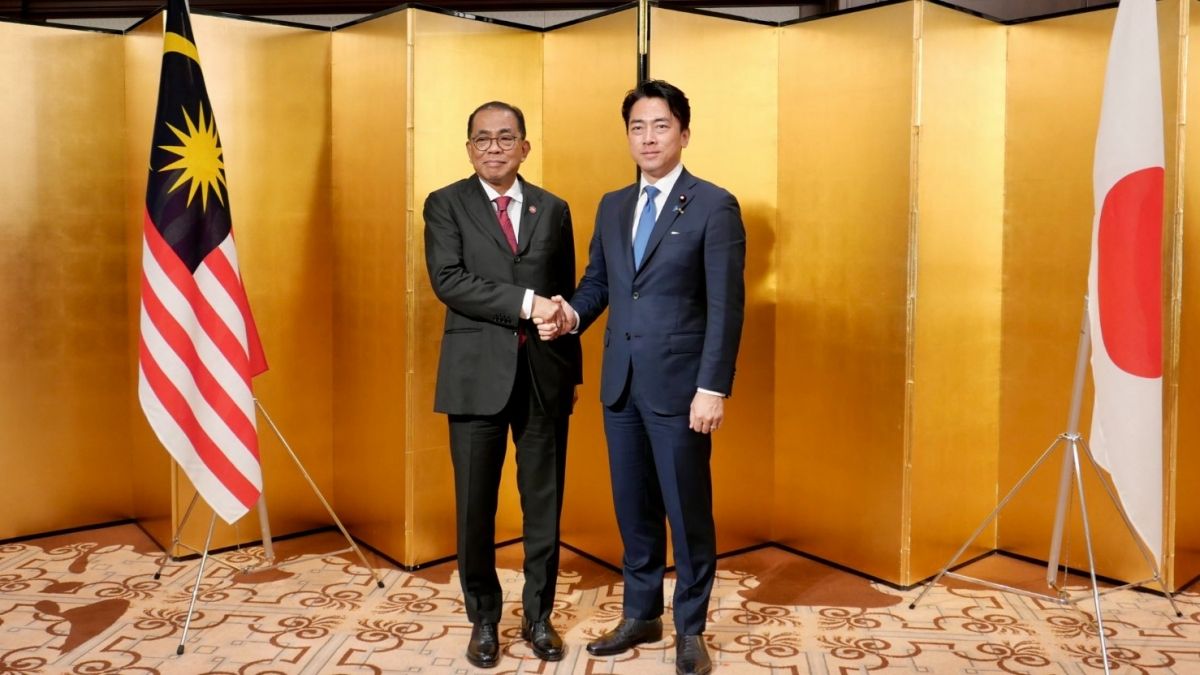
The agreement followed talks between Malaysian Defence Minister Datuk Seri Mohamed Khaled Nordin and Japanese Defence Minister Shinjiro Koizumi in Tokyo on 19 October 2026.
According to Japan's Ministry of Defence, the ministers agreed to develop a comprehensive maritime security cooperation plan and pursue potential defence equipment projects that would benefit both countries.
The discussions also covered military technology transfers, joint training, intelligence sharing and regional security developments in the South China Sea and East China Sea.
The meeting formed part of Khaled's working visit to Japan, beginning on 19 October, under the Malaysia-Japan Comprehensive Strategic Partnership, which was elevated in 2023.
Maritime security cooperation to expand
In its statement on 19 October, Japan's Ministry of Defence said Koizumi described Malaysia as an indispensable partner in achieving a Free and Open Indo-Pacific, Japan's vision for regional stability and rules-based maritime cooperation.
Koizumi highlighted Malaysia's strategic location along major international shipping routes, particularly the Strait of Malacca, which connects the Indian Ocean with the South China Sea.
Both ministers welcomed existing defence cooperation, including the MALPAN naval exercise, military port visits and personnel exchanges involving Malaysia and Japan.
These exchanges have also included Malaysian personnel studying at Japan's National Defense Academy.
Building on a memorandum signed in 2018, Koizumi proposed expanding cooperation between the two countries' navies through a more comprehensive maritime security framework.
Both ministers agreed on the need to develop such a plan to support long-term cooperation and their shared maritime interests.
In a Facebook post, Khaled said discussions focused on maritime domain awareness, which involves monitoring activities at sea, as well as information sharing and joint military exercises.
He also expressed appreciation for Japan's Official Security Assistance (OSA), a programme supporting the security capabilities of partner countries, including the Malaysian Armed Forces.
Defence equipment and technology transfers
The ministers also discussed expanding defence equipment cooperation through an existing director-level Joint Working Group on defence equipment transfers.
Japan's Ministry of Defence said Khaled welcomed revisions to Japan's Three Principles on Transfer of Defense Equipment and Technology and their implementation guidelines.
According to the statement, Khaled considered the changes an opportunity to broaden cooperation between the two countries' defence institutions.
Both ministers agreed to instruct the working group to accelerate consideration and development of potential projects offering mutual benefits.
Separately, Khaled met Japan's Acquisition, Technology and Logistics Agency (ATLA), which oversees defence procurement, technological development and logistics under Japan's Ministry of Defence.
The meeting, led by ATLA Commissioner Manabu Imakyurei, examined opportunities for technology transfers, local component production and Malaysian participation in international defence supply chains.
“I received a briefing on Japan's approach to developing its defence industry, while exchanging views on potential cooperation in technology transfer, local component development and global supply chains,” Khaled said.
“I believe closer ties based on trust and mutual respect will open up more opportunities for defence cooperation that benefit both countries.”
The discussions suggest Malaysia is exploring industrial partnerships beyond conventional purchases of foreign-made military equipment, including opportunities for domestic companies to participate in defence manufacturing.
Japan among potential missile suppliers
The closer defence relationship comes as Malaysia considers alternative anti-ship missile systems following Norway's cancellation of an export licence involving Kongsberg's Naval Strike Missile (NSM).
The cancellation affected the original missile arrangement for Malaysia's first Littoral Combat Ship (LCS 1), part of a programme to modernise the Royal Malaysian Navy.
Malaysia is considering spending up to RM1 billion on a replacement anti-ship missile system, with Japan reportedly among potential suppliers alongside South Korea, Türkiye, France and Italy.
Japan's more permissive defence export policy in 2026 could create further opportunities for military equipment and technology transfers to Malaysia.
However, the official statement on the Tokyo meeting did not identify any specific missile system, confirm a procurement agreement or announce that Japan would supply replacement weapons.
Japan's expanding defence relationship with Malaysia had also attracted attention in August 2026, when former Malaysian health minister Khairy Jamaluddin appeared in an Instagram story riding a Japanese Type 90 main battle tank.
The footage, reportedly recorded at a Japan Ground Self-Defense Force base, prompted speculation about possible Malaysian interest in Japanese military equipment.
South China Sea and regional stability
The two ministers also exchanged views on security developments in the South China Sea and East China Sea, where competing territorial and maritime claims have contributed to regional tensions.
According to Japan's Ministry of Defence, both reaffirmed the importance of freedom of navigation and overflight, as well as compliance with international law.
They specifically referred to the United Nations Convention on the Law of the Sea (UNCLOS), the international treaty establishing legal rules governing maritime rights and activities.
Both countries agreed to maintain close coordination in supporting a free and open maritime order based on the rule of law.
Further meetings planned
Following the Tokyo meeting, Koizumi said on X that it was his first meeting with Khaled in Japan since becoming defence minister.
He noted that the two had previously met in Malaysia and Munich, Germany, allowing them to hold what he described as frank and substantive discussions.
Koizumi also said they expected to attend the same meeting in the Philippines later in October, providing another opportunity to follow up on their discussions.
Japan's Ministry of Defence said both ministers agreed to use future meetings to advance cooperation and turn the initiatives discussed in Tokyo into concrete outcomes.