SpaceX rocket launch creates glowing ‘space jellyfish’ cloud over US
A SpaceX rocket launch from Cape Canaveral, Florida, created a glowing, jellyfish-shaped cloud in the early morning sky on 13 October, drawing attention across parts of the southeastern and Mid-Atlantic United States. The unusual formation was caused by rocket exhaust gases freezing into ice crystals and reflecting sunlight.
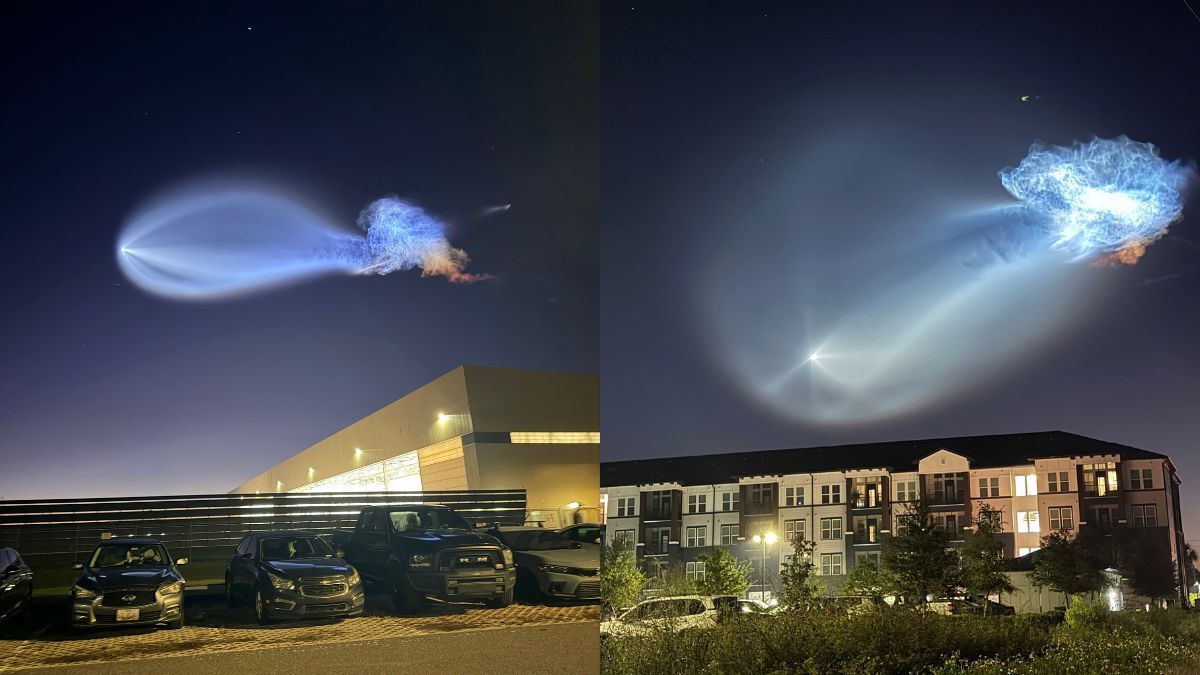

UNITED STATES: A rocket launch by SpaceX, an American aerospace company founded by Elon Musk in 2002, created a spectacular, glowing cloud resembling a giant jellyfish in the early morning sky on Tuesday (13 October).
The company, formally known as Space Exploration Technologies Corp., launched a Falcon 9 rocket from Cape Canaveral Space Force Station in Florida, carrying a Dragon cargo spacecraft on a resupply mission to the International Space Station (ISS).
The glowing formation was visible across parts of the southeastern and Mid-Atlantic United States, prompting some observers to share footage of the striking sight online.
SpaceX announced the launch on its X account on 13 October, identifying the mission as CRS-35.
The post had attracted about 1.3 million views, according to the information provided.
Why the rocket created a glowing cloud
The unusual formation, often described as a “space jellyfish”, occurs when gases released by a rocket expand and freeze in the extremely cold upper atmosphere.
According to Space.com, water vapour and carbon dioxide in the rocket's exhaust can form ice crystals that spread out behind the ascending rocket, creating a broad, translucent plume.
When a launch takes place around dawn or dusk, sunlight can illuminate the plume while the ground and lower sky remain relatively dark.
This contrast produces the glowing, jellyfish-like appearance.
Although the formation can look unusual, it is a visual effect associated with rocket launches rather than an unexplained object in the sky.
Dragon cargo spacecraft heads to the space station
The launch marked CRS-35, the 35th mission SpaceX is conducting to deliver supplies to the ISS under its Commercial Resupply Services agreement with NASA.
The Dragon spacecraft carried cargo for the orbiting laboratory, including supplies and materials to support the station's crew and scientific research.
According to Space.com, the spacecraft was expected to take a couple of days to reach the ISS.
If the mission proceeded as planned, Dragon was scheduled to dock autonomously with the station's Harmony module at around 11am Eastern Daylight Time (3pm GMT) on Thursday (15 October).
The ISS is a research facility orbiting Earth where astronauts conduct scientific experiments and other work in microgravity.