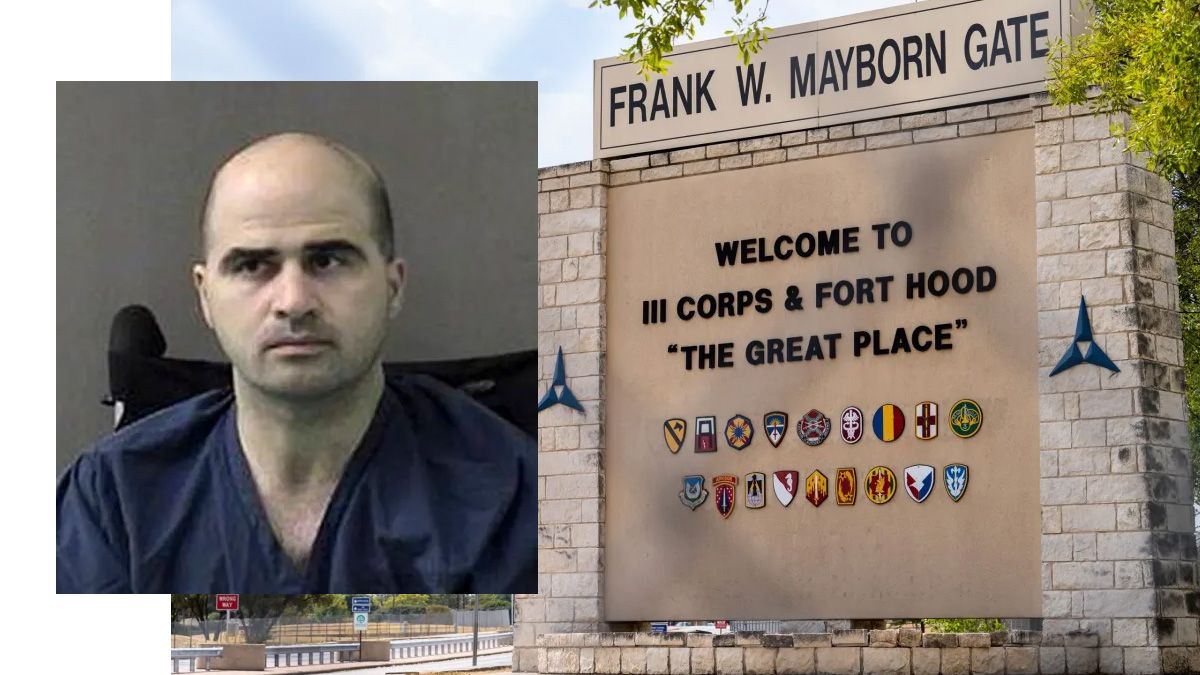
Fort Hood gunman Nidal Hasan to be executed by firing squad, first for US Army since WWII
Nidal Hasan, convicted of the 2009 Fort Hood mass shooting that killed 13 people, is set to be executed by firing squad on 3 December 2026 after President Donald Trump approved the method recommended by Defence Secretary Pete Hegseth.
- Trump approved Hegseth's recommendation that Fort Hood gunman Nidal Hasan be executed by firing squad.
- The execution is set for 3 December 2026 at Fort Hood, Texas.
- It would be the US military's first execution in about 65 years.

Nidal Hasan, the former US Army major convicted of the 2009 mass shooting at Fort Hood in Texas, is scheduled to be executed by firing squad on 3 December 2026, following approval from President Donald Trump.
According to CNN, it would be the US Army's first execution of a soldier by firing squad since World War Two. It would also be the first time in 65 years that the military has carried out a death sentence on a service member.
Approval announced by the Pentagon
The Pentagon announced on the night of Monday, 5 October 2026, that Defence Secretary Pete Hegseth had recommended death by firing squad for Hasan and that Trump had approved the recommendation.
Acting Army Secretary Adam Telle announced on Tuesday, 6 October 2026, that the execution would take place at Fort Hood at 2pm Eastern Time.
Pentagon spokesperson Sean Parnell announced the decision on X. He noted that Hasan had killed 13 people and wounded 32 others while shouting "Allahu Akbar" during the attack. "Judgement day for Hasan has finally come," Parnell wrote.
Hegseth replied to Parnell's post with a single word: "Justice."
Conviction and trial
Hasan, an Army psychiatrist from Virginia, was convicted in July 2013 of 13 counts of premeditated murder and 32 counts of attempted murder. A jury panel of 13 officers unanimously recommended the death sentence.
He admitted in court that he was the gunman and apologised for "any mistakes".
Hasan, a US-born citizen of Palestinian descent, said he had targeted soldiers he was due to deploy with to Afghanistan. He said he wanted to protect the Taliban and its leaders from the US military.
He told his court-martial that he believed he was protecting Muslims and the Taliban in Afghanistan. He also told the military judge that the deploying soldiers were about to engage in what he described as "an illegal war".
The attack on 5 November 2009
The shooting on 5 November 2009 remains the deadliest non-combat attack ever carried out on an American military base.
Hasan walked into a crowded processing centre at the base, where troops were gathered for final medical checks and vaccinations before deployment, and opened fire.
As soldiers tried to flee outside, Hasan followed them through the back door, where he confronted police.
He was arrested after an exchange of gunfire with two officers, Senior Sergeant Mark Todd and Sergeant Kim Munley, during which Hasan was struck and fell to the ground.
According to trial testimony, Todd ran up, kicked Hasan's weapon away, turned him onto his stomach and searched him. He found a second gun, additional ammunition magazines and a mobile phone.
Duane Mitchell, an officer with the Army Criminal Investigation Division (CID), testified that 177 unfired rounds in 30-round and 20-round magazines were recovered from Hasan.
Mitchell also told the court that Hasan had two laser sights to help him shoot accurately: a red laser for low-light conditions and a green laser, which is most effective in sunlight.
The wound Hasan sustained that day left him paralysed from the waist down. He now uses a wheelchair.
How military executions are approved
Military executions are rare. Under military law, they require the approval of the president, who also has the power to commute a death sentence.
A death sentence must also pass appellate review and receive a final judgment on its legality before it can proceed.
Once the president gives approval, the Secretary of the Army determines the method and date of execution, according to a May 2026 article in the military's Army Lawyer journal.
The journal stated that the execution date must fall between 60 and 150 days after the president's approval.
CNN said it had asked the Pentagon to clarify whether the date and time would be set by the Army secretary or by the defence secretary, as the Pentagon spokesperson had indicated.
Condemned prisoners may still challenge the legality of their imprisonment by filing a petition of habeas corpus, the journal noted. Such a filing could lead to a stay of execution while the appeal proceeds through the courts.
There are 15 crimes punishable by death under military law. According to the Death Penalty Information Center (DPIC), the US military has executed 135 service members since 1916.
Hasan is one of four inmates on the military's death row. Three other soldiers are on death row at Fort Leavenworth in Kansas, the Department of Defense's only maximum-security facility.
All three were found guilty of murder, among other offences, according to Army Lawyer.
The last US Army execution of any kind took place in 1961 at Fort Leavenworth. Private John Bennett was hanged after being convicted of raping and attempting to kill an 11-year-old Austrian girl.
Legal history of the military death penalty
The military's highest appellate court, now known as the US Court of Appeals for the Armed Forces, ruled the military death penalty unconstitutional in 1983.
It was reinstated the following year through an executive order issued by then-President Ronald Reagan.
Firing squads and capital punishment in the US
Military executions differ from those carried out by states, which account for the majority of executions in the US.
Capital punishment remains legally available in 27 states, as well as to the military and the federal government.
Death by firing squad is uncommon. South Carolina carried out an execution by firing squad in 2025, the first in that state and the first use of the method in the US in 15 years, the BBC reported.
Idaho, Mississippi, Oklahoma and Utah also allow the use of a firing squad.
Trump, a proponent of the federal death penalty, reinstated it through an executive order on the first day of his administration in January 2025.
Under his predecessor, President Joe Biden, the Justice Department had imposed a moratorium on federal executions.
Trump's executive order describes capital punishment as "an essential tool" for deterring and punishing the most heinous crimes and acts of lethal violence against American citizens.
The execution of Private Slovik
The last US soldier executed by firing squad was Private Eddie Slovik, who was shot by a 12-member squad in France on 31 January 1945, during the final months of World War Two in Europe.
A military court had found Slovik guilty of desertion. Of an estimated 50,000 American deserters during the war, he was the only one executed, and his case has drawn significant attention since.
His story formed the basis of the 1974 television film The Execution of Private Slovik, with Martin Sheen in the title role.
Journalist Charles Glass, author of the book The Deserters, told National Public Radio (NPR) in 2013 that Slovik was not a bad soldier but was simply afraid.
Glass added that Slovik had turned himself in rather than flee.
According to a 2020 article by the anti-death penalty non-profit organisation Reprieve, the officers of the military court that sentenced Slovik did not expect the sentence to be carried out.
However, General Dwight D Eisenhower, then the Supreme Allied Commander, approved the execution as an example to other deserters while the Battle of the Bulge raged, according to Glass and Reprieve.
Reprieve reported that only 11 members of the firing squad had live rounds in their rifles, giving each member psychological deniability over the death.
Although carried out in secret, the execution was used as an example, according to Glass and Reprieve.
Glass told NPR that the military told no one about the execution, not even Slovik's wife, who was informed only that her husband had died in Europe.
The case became public knowledge only in the mid-1950s, when journalist William Bradford Huie investigated it and published a book on it, Glass said.