Chinese judoka disqualified after appearing to bite Japanese opponent at Asian Games
Japanese judoka Rin Maeda advanced after Chinese opponent Tang Jing was disqualified for appearing to bite her during their Asian Games match on 1 October. Maeda later won gold, while footage of the incident sparked debate online over sportsmanship, safety and penalties.
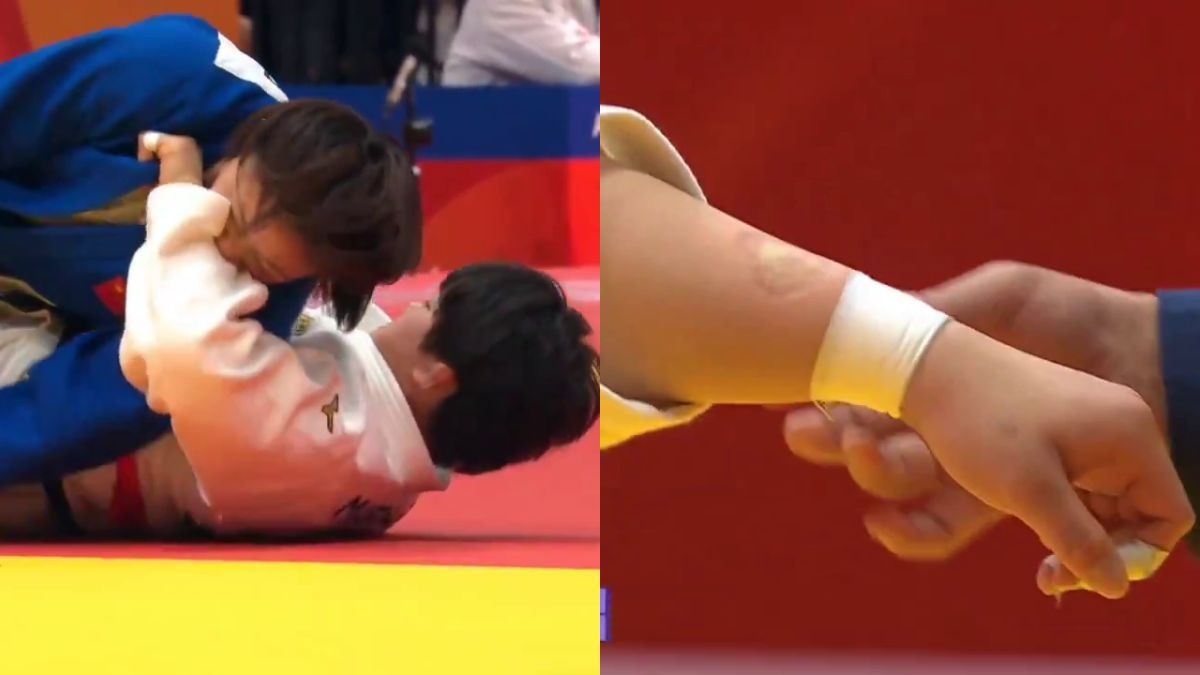

A women’s judo quarter-final at the Asian Games in Nagoya ended with a disqualification after Chinese judoka Tang Jing appeared to bite Japanese opponent Rin Maeda during their 70kg contest on 1 October 2026.
The incident occurred while the athletes were engaged on the ground.
Tang appeared to bite Maeda just above the wrist, after which Maeda showed the referee visible teeth marks on her arm.
The officials reviewed footage of the incident before Tang was disqualified, allowing Maeda to advance.
Maeda subsequently won the women’s 70kg gold medal, defeating Kazakhstan’s Azhar Askhat in the final.
Visible marks remained after the bout
According to The Japan Times, Maeda was wearing protective tape on the affected part of her arm, but the bite marks were still visible.
Japan women’s judo coach Maki Tsukada told sports website The Digest that she had never encountered a similar incident during her long career.
She said the marks were sufficiently pronounced that the team initially feared Maeda could bleed.
Tsukada said the injury did not require disinfection, but described the teeth marks as clearly visible.
Maeda, meanwhile, said she was focused on the competition and did not pay much attention to the incident because she was “pumped with adrenaline”.
Maeda continues to gold
Despite the unusual interruption, Maeda continued through the competition and eventually secured the gold medal in the women’s 70kg category.
The 21-year-old said she had entered the tournament determined to win gold and felt she had prepared appropriately for the demands of a multi-sport event.
“I entered this tournament with a strong determination to win gold,” Maeda said, according to The Japan Times.
“Preparing for a multi-sport event like this was a unique experience, but I was able to prepare properly each day and deliver my best performance.”
Online footage fuels discussion
Footage of the incident was widely circulated online, attracting millions of views and generating a range of reactions from viewers.
Many comments focused on whether biting should ever occur in judo, while others discussed the potential harm caused by human bites and questioned what penalties should apply at international competitions.
The reactions also included praise for Maeda for continuing in the tournament and winning gold after the incident.
Concerns over biting and safety
Several commenters focused on the reported bite, questioning how such an incident could occur during a judo match and raising concerns about the potential consequences of a human bite.
One commenter questioned whether biting had ever been considered acceptable in judo, reflecting on the unusual nature of the incident.

Other commenters discussed the potential risks associated with human bites. One commenter who identified themselves as having judo experience said they believed the bite appeared intentional and questioned whether it could have happened accidentally.
The commenter also expressed concern about the example the incident could set for children watching an international sporting event.

Another commenter questioned whether an incident resulting in visible teeth marks could have implications beyond the sporting penalty, asking whether it could potentially be considered an assault.

Calls for stronger sporting penalties
Some commenters argued that the disqualification should not necessarily be the only consequence for a biting incident, with several calling for additional disciplinary measures.
One commenter used humour to focus on sportsmanship and conduct, suggesting that athletes should observe basic manners alongside learning the techniques of judo.

Another commenter recalled what they believed was a previous incident involving a Korean athlete, although they were uncertain about the sport in which it occurred.
They argued that athletes who use conduct they consider outside the rules should face consequences beyond losing the match.

Another commenter suggested that biting offences should result in permanent exclusion from international competitions, putting forward the idea as a possible disciplinary measure.
A further commenter described the reported incident as a “malicious foul” and called for a ban from international competitions. The commenter also argued that publicly addressing and criticising such incidents could discourage similar behaviour in future.

Praise for Maeda’s response
Other reactions focused on Maeda’s conduct following the incident rather than the question of penalties.
One commenter praised what they viewed as sportsmanship from Japanese athletes, referring specifically to the practice of shaking hands with opponents after a match.

Maeda continued competing after the incident and ultimately won the women’s 70kg gold medal, defeating Kazakhstan’s Azhar Askhat in the final.