Swiss glaciers lose 5.5 per cent of ice volume in 2026
Swiss glaciers lost 5.5 per cent of their total ice volume in 2026, the second-largest annual decline on record, after low snowfall and exceptional summer warmth accelerated melting.
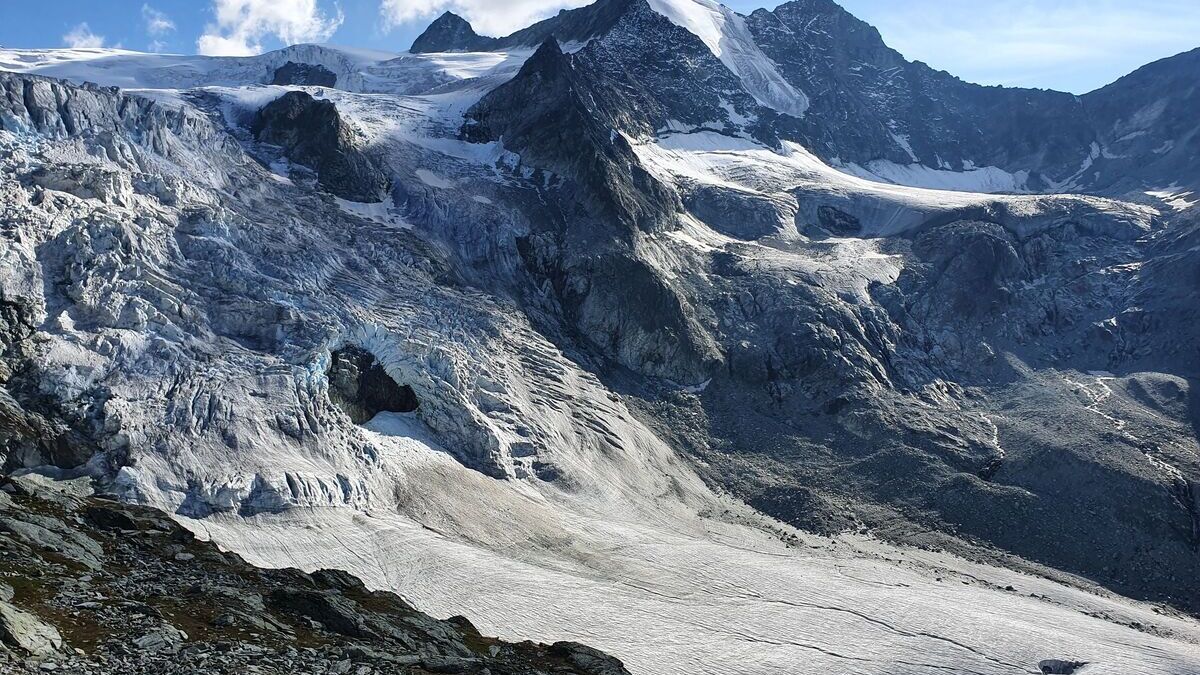
- Swiss glaciers lost 5.5 per cent of their total ice volume during 2026.
- Record warmth and low snowfall exposed glaciers to prolonged and exceptionally severe melting.
- Glacier meltwater is declining as Switzerland's remaining ice reserves become smaller.

Swiss glaciers lost 5.5 per cent of their total ice volume in 2026, one of the largest annual losses recorded, after a winter with little snow was followed by exceptionally warm conditions through the summer.
The figure was reported on Thursday (1 October) by the Swiss Glacier Monitoring Network (GLAMOS) and the Swiss Commission for Cryosphere Observation, based on measurements taken at glaciers across the Swiss Alps.
The loss amounted to about 2.5 cubic kilometres of ice, or roughly 2.5 trillion litres of water. It was the second-largest percentage loss recorded since systematic measurements began, narrowly below the 5.9 per cent decline recorded in 2022.
The latest loss means Swiss glaciers have shed almost one-fifth of their ice volume over the past five years, according to GLAMOS.
Little snow followed by record warmth
Scientists attributed the severe melt to the combination of unusually low winter snowfall and high temperatures from spring onwards.
Snow accumulation was about 25 per cent below the 2010-2020 average by the end of April. The deficit was particularly pronounced in eastern and southern Switzerland.
The limited snow cover disappeared early, exposing glacier ice to melting for a longer period. This was followed by exceptionally warm conditions between May and September.
June to August was the hottest summer period recorded in Switzerland, according to the GLAMOS report. The freezing level — the altitude at which temperatures reach 0°C — remained above 4,000 metres for 76 days, more than twice the long-term average and a new record.
The first major heatwave occurred in the second half of May, followed by another prolonged heatwave in June. By July, several glaciers had lost their seasonal snow cover even at their highest monitored locations.
The average date on which the monitored glaciers had lost all the snow accumulated during the winter was 2 July, the second-earliest date recorded after 2022.
Major glaciers record exceptional losses
The impact varied between individual glaciers, but several recorded their largest annual losses since measurements began.
The Grosser Aletsch, Rhône, Allalin and Clariden glaciers all recorded their most negative annual mass balances on record.
At some lower-altitude glacier tongues, local ice losses approached 10 metres. The lowest measurement site on the Grosser Aletsch Glacier, at about 1,980 metres above sea level, recorded an ice loss of around 13 metres.
At higher measurement sites on glaciers including Clariden, Giétro, Gries, Murtèl, Otemma, Plaine Morte, Silvretta and Tsanfleuron, losses ranged between about 2.5 and four metres of ice.
Across 23 monitored glaciers, the average annual mass balance was minus 2.9 metres of water equivalent. This is a standard measure of glacier gain or loss, with snow and ice converted into the equivalent amount of water.
Ten of the monitored glaciers recorded losses exceeding three metres of water equivalent. GLAMOS said losses of this magnitude had previously been observed only at some glaciers during the exceptional melt year of 2022.
Five years of rapid ice loss
The 2026 figures add to a sharp acceleration in glacier loss in Switzerland.
GLAMOS estimates that the country had about 42.6 cubic kilometres of glacier ice remaining at the end of 2026, while glacier-covered land had fallen to about 714 sq km.
The decline has accelerated over successive decades. Swiss glaciers lost about 10 per cent of their volume between 1990 and 2000, 14 per cent between 2000 and 2010, and 17 per cent between 2010 and 2020.
Between 2016 and 2026, the loss reached about 27 per cent.
The five-year period from 2022 to 2026 had a melt rate more than twice that recorded during any previous five-year period in the monitoring record, according to GLAMOS.
Glacier meltwater is also declining
Glacier melt contributes to river flows during warm and dry periods, providing water for downstream ecosystems, agriculture and hydropower.
The large amount of ice lost in 2026 therefore released substantial quantities of meltwater. However, GLAMOS said the amount of water available from glacier melt is beginning to decline as the glaciers themselves become smaller.
This means that although melting can temporarily increase water availability during periods of high temperatures, there is progressively less stored ice available to provide that water in future.
GLAMOS also reported continued fragmentation and disappearance among Switzerland's smallest glaciers and individual glacier tongues.
More than 1,000 Swiss glaciers disappeared between 1973 and 2016, according to the monitoring network, while around another 100 disappeared between 2016 and 2023.
A further assessment of glacier losses in 2026 will be incorporated into the next Swiss Glacier Inventory, which GLAMOS expects to complete around 2028.