Trump greets Xi on the tarmac as US and China extend trade truce to January
US President Donald Trump personally welcomed Chinese President Xi Jinping at Joint Base Andrews on 23 September 2026, a rare planeside greeting that came as Treasury Secretary Scott Bessent announced a two-month extension of the US-China trade truce.
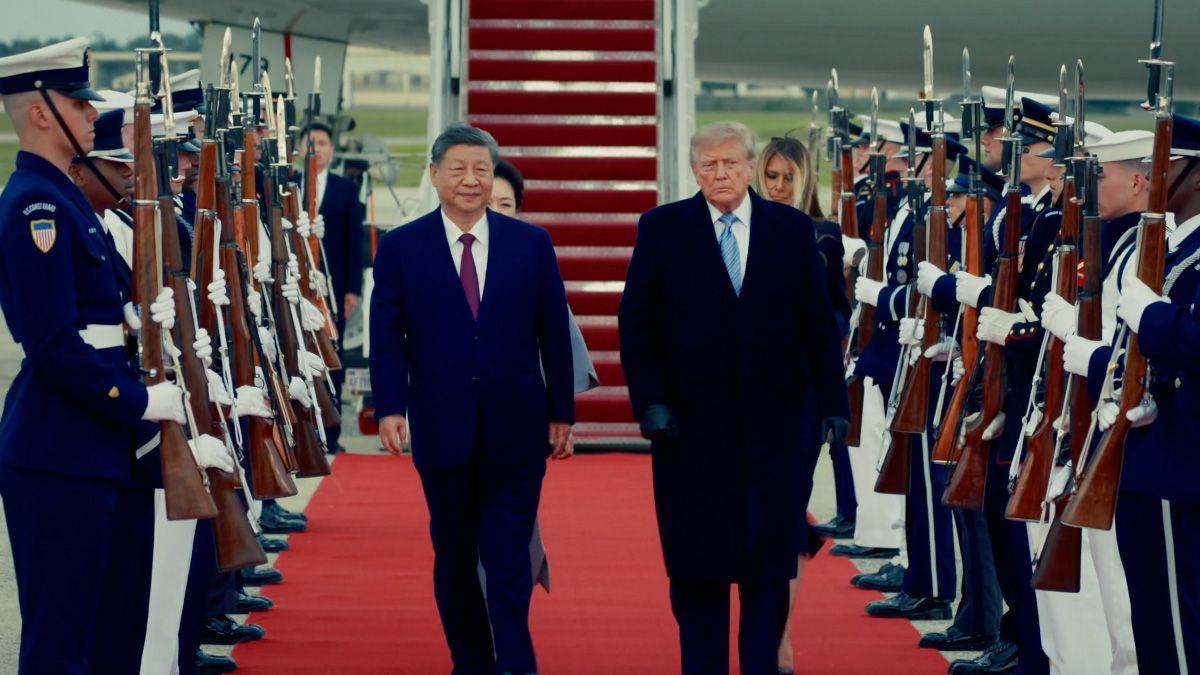
- Trump met Xi planeside at Joint Base Andrews, an honour rarely given to foreign leaders.
- Bessent said the US-China trade truce will be extended from 10 November to 10 January.
- The three-day visit includes closed-door talks, a state dinner and a National Archives tour.

US President Donald Trump personally welcomed Chinese President Xi Jinping on the tarmac at Joint Base Andrews on Wednesday, 23 September 2026, as Xi began his first state visit to Washington in more than a decade.
The rare planeside greeting came as the two governments agreed to extend their trade truce, under which both countries scale back tariffs and refrain from imposing new trade restrictions, until 10 January 2027.
Treasury Secretary Scott Bessent announced the extension during a Fox News Channel interview broadcast as Trump greeted Xi at the military base in Maryland, about 13 miles south-east of the White House.
Truce extended by two months
The truce was agreed when Trump and Xi met in Busan, South Korea, on the sidelines of the Asia-Pacific Economic Cooperation (APEC) summit in October 2025. It had been due to expire on 10 November 2026.
"I don't know whether a bigger deal can be done. I don't know whether we will just roll the current deal," Bessent said in the interview.
He noted that the extension would give the two leaders more time to discuss outstanding issues at summits scheduled in China in November and in Florida in December.
According to CNBC, Bessent met Chinese Vice Premier He Lifeng in New York ahead of Xi's arrival. Bessent said the two sides discussed setting up an alert system for incidents involving artificial intelligence (AI).
The Associated Press (AP) reported that China had wanted a longer extension. Wendy Cutler, a former US trade negotiator now serving as senior vice president at the Asia Society Policy Institute, said the short timeframe was telling.
"It underscores that the United States is still concerned about China's full implementation of its commitments under the truce, particularly with respect to critical mineral exports and agricultural purchases," Cutler said.
Craig Singleton, a senior fellow at the Foundation for Defense of Democracies, said the tight window allowed Washington to test whether Beijing would fulfil unmet pledges to buy US farm goods.
"This is less about buying two months of calm than making China earn the next extension," Singleton said. Trump had not commented on the extension at the time of reporting.
A rare airport welcome
Trump's decision to meet Xi at the aircraft, rather than wait for him to arrive at the White House, was described by the AP as a sign of how far the US president is prepared to go to honour China's leader.
According to Axios, US presidents typically receive visiting leaders at the White House. Trump greeted Ukrainian President Volodymyr Zelensky at the West Wing entrance in February 2025, while King Charles III was received at the South Portico in April 2026.
Axios noted that recent presidents have occasionally met visiting popes at airports in the Washington area, but airport welcomes for other foreign leaders have largely fallen out of use.
A 30-metre red carpet was laid at the foot of the stairs leading from Xi's aircraft, flanked by a 21-person honour guard. Trump and First Lady Melania Trump greeted Xi and his wife, Peng Liyuan, with handshakes.
The ceremony also featured a flyover by two B-1 bombers, platoons from each branch of the US military, and the presentation of both countries' flags and national anthems.
The leaders' exchanges could not be heard by reporters. Trump, who wore gloves and an overcoat despite a relatively mild 17°C, removed one glove to shake Xi's hand and at one point patted him on the back.
"I think they appreciate it, tremendous people," Trump told reporters after returning to the White House.
Melania Trump told Fox & Friends that her husband chose to greet Xi personally because "they have a great relationship".
"He's coming on our soil, and we need to welcome them with the most respect," she said of Xi and Peng.
CNBC reported that footage aired by China's state broadcaster did not show the two leaders shaking hands. Instead, it focused on Xi and Peng shaking hands with two children who presented them with bouquets.
The welcome took place amid a dispute over press access. On 21 September 2026, ABC, CBS, NBC, Fox News and CNN suspended their pooled television coverage of Trump after he barred CNN, MS NOW and Politico from the White House.
Trump imposed the ban over what he claimed was unfavourable coverage. The networks, which have set no end date for the suspension, said no administration should restrict a news organisation because it objects to its reporting.
CNN, MS NOW and Politico have sued Trump and three White House officials, alleging First Amendment retaliation. A judge heard arguments on 23 September 2026 but did not rule from the bench.
Xi calls for partnership
In a statement marking his arrival, Xi said the two countries "should be partners, not rivals".
"Achieving the great rejuvenation of the Chinese nation and making America great again can go hand in hand, and the two countries can contribute to each other's success, thereby benefiting the wider world," Xi said.
Reciprocating Beijing's pageantry
The state visit is intended to reciprocate the ceremonial welcome Trump received during his visit to China in May 2026.
On that occasion, Xi did not meet Trump at the airport and sent Vice President Han Zheng instead. A long red carpet was nonetheless rolled out for Air Force One at Beijing Capital International Airport.
Trump was also greeted by a military honour guard, a military band and about 300 Chinese youths waving both countries' flags. The children wore white and light blue uniforms matching the colours of the US presidential aircraft.
In an analysis published by the Council on Foreign Relations (CFR), the think tank questioned why Trump chose to greet Xi personally after Xi pointedly declined to do the same in Beijing, and whether this signalled a shift in the balance of power.
The AP noted that the long red carpet recalled a similar one laid out for Russian President Vladimir Putin when he arrived at a US Air Force base in Alaska in 2025 for a summit on ending the war in Ukraine.
A packed three-day programme
According to the AP, Thursday's schedule includes a formal arrival ceremony at the White House and a review of troops, followed by closed-door talks between the two leaders.
The day will close with a black-tie state dinner featuring technology industry figures, including Nvidia's Jensen Huang and SpaceX's Elon Musk. Expectations that the visit will produce major breakthroughs remain low, the AP reported.
On Friday, Xi and Peng are due to join the Trumps for a private tea at the White House, followed by a tour of the National Archives to view historic documents on relations between the two countries.
Trump has told reporters he was pleased that his new helicopter landing pad, which he called a "work of art", would be ready for the visit, but lamented that his White House ballroom would not.
"I wish we had it for tomorrow night," Trump said. "We have a packed house tomorrow night for President Xi."
The CFR noted that the visit marks the third in-person meeting between Trump and Xi in 11 months, and that Xi is expected to leave Washington less than 48 hours after arriving.
Following their May meeting in Beijing, the two leaders agreed to begin discussions on possible guardrails for AI development. According to the CFR, those talks only began this week.
Tensions beneath the ceremony
The visit takes place amid heightened tensions between the two countries over trade, AI, Trump's war with Iran and Beijing's claims over Taiwan.
Beyond seeking what the White House has called "strategic stability", Trump has praised Xi as a "great leader" and described him as a friend. The AP reported that Trump has given Xi a pass on many issues.
The welcome has drawn criticism from within Trump's own party. Senator Roger Wicker, the Republican chairman of the Senate Armed Services Committee, criticised the "lavish welcome" in a Senate floor speech on Tuesday, 22 September 2026.
Wicker said Trump should not have invited Xi given "all of the troubling issues" with the Chinese leader and the Chinese Communist Party (CCP).
He suggested Trump raise China's military build-up and its support for Iran at the state dinner, and described Xi as "a brutal, unelected and oppressive dictator" whose arsenal was "aimed directly at the United States of America".