Busan shark sighting draws crowds, boosts local trade and sparks ‘Baby Shark’ stock frenzy
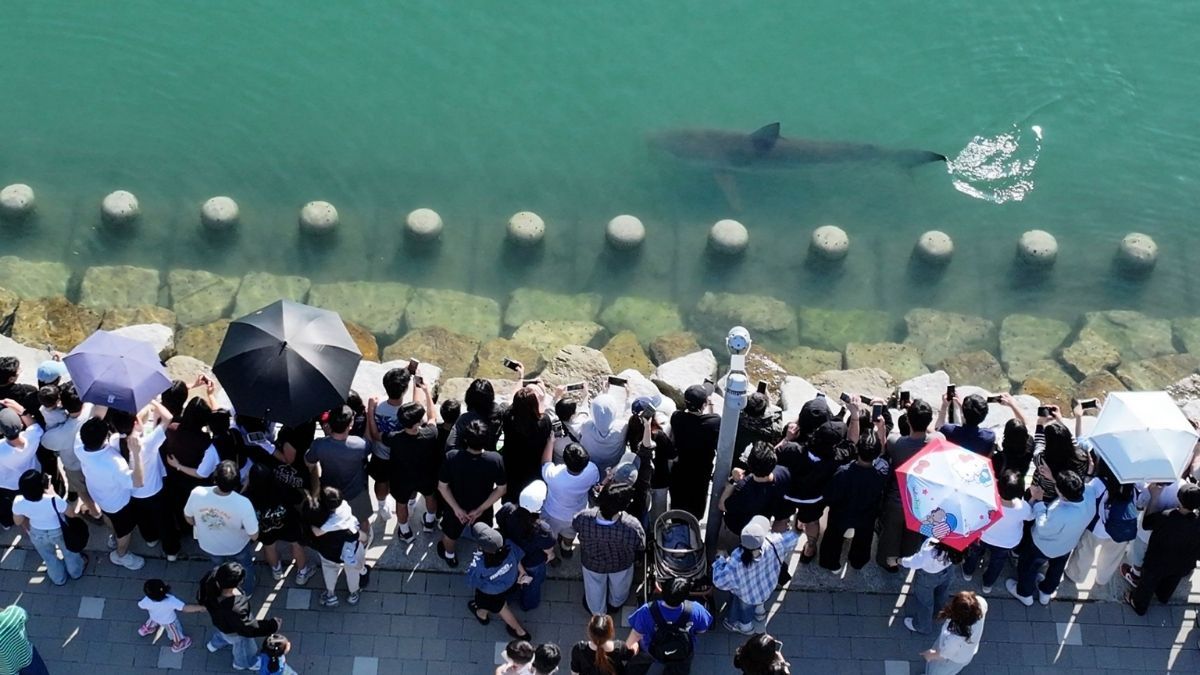
A 3.5-metre shark has drawn hundreds of visitors to Busan’s Bukhang Waterfront Park for three days, prompting safety measures, benefiting nearby businesses and briefly driving a “Baby Shark” stock-market theme.
- A shark estimated at 3.5 metres has appeared in Busan’s Bukhang Waterfront Park waterway for three consecutive days.
- Authorities have increased patrols and safety measures while allowing the shark to return to sea naturally.
- Viral interest extended to local businesses and a short-lived rise in The Pinkfong Company shares.

A shark measuring about 3 to 4 metres has drawn crowds to a waterfront park in South Korea's southern port city of Busan after appearing in its waterway for three consecutive days, turning the unexpected sighting into a social media sensation and a short-lived stock market theme.
The shark was first reported at about 8:57 a.m. on 18 September after a passerby spotted it in the waterway at Bukhang Waterfront Park in Dong-gu, according to the Busan Coast Guard. The waterway is connected to the sea and the shark was reported to have approached areas close to the public walking path.
Busan authorities issued a safety alert advising people using the park and nearby residents to exercise caution.
Videos and photographs of the shark quickly spread across social media and online communities. Hundreds of people gathered along the waterway, with some visitors travelling from other parts of South Korea specifically to see the animal.
The shark was reported to surface every five to 10 minutes, prompting spectators to gather along the waterfront for a glimpse.
One social media post described a day trip from Gyeonggi Province to see the shark, saying the visitor had left at 4 a.m. Children were photographed holding shark plush toys, while some visitors ate shark-themed "Jaws Bars" as they waited.
Online users began referring to the area as the "Busan Shark Expo" and a "natural aquarium".
Authorities monitor shark rather than capture it
The Coast Guard deployed the Central Maritime Special Rescue Unit, coastal rescue boats and patrol vessels after receiving the initial report, while requesting assistance from fire authorities and other agencies, Yonhap reported.
Authorities initially attempted to guide the shark towards the open sea rather than capture it, following advice from the National Institute of Fisheries Science. Equipment normally used to deter dangerous fish was also deployed, but had little effect.
The Coast Guard ended the operation at about 3:15 p.m. on 18 September, roughly six hours after the initial report.
The decision followed advice from the National Institute of Fisheries Science that forcing the shark out could cause it to become aggressive, making it safer to wait for the animal to return to the sea naturally.
The Coast Guard asked the Busan Port Authority to install warning signs about the shark and said it would continue checking for further sightings during land and sea patrols.
On 19 September, the Safe Korea emergency alert system also reported a shark sighting at about 1:05 p.m. in the waterway and advised walkers and nearby residents to exercise caution.
Busan City and the police later increased safety measures as visitor numbers grew. Certain bridges and ramps were restricted, while patrols were increased. Authorities also urged visitors not to lean against railings or feed the shark.
According to the Bukhang Waterfront Park General Control Room operated by the Busan Facilities Corporation, police removed a man from the park on 19 September after he threw raw chicken towards the shark.
Shark identification remains unconfirmed
The National Institute of Fisheries Science estimated the shark to be about 3.5 metres long and identified it as a mutae shark, or houndshark, based on its brownish body and size.
The species is found in subtropical waters of the Pacific, Atlantic and Indian oceans, including along the Korean coast, and is classified as having a relatively high risk of attack.
Researcher Ji Hwan-seong of the National Institute of Fisheries Science said rising water temperatures had led to continued reports of the species appearing along South Korea's eastern coast.
"It appears to have come this far in search of food," he said.
The institute also attributed the recent increase in shark sightings in waters off Busan to high summer sea temperatures and the influx of warm-water fish, which can provide a food source for sharks.
Authorities have not confirmed whether the sharks reported over the three days were the same individual.
Local businesses benefit from the unexpected crowds
The influx of visitors also brought an unexpected boost to businesses around Bukhang Waterfront Park.
The park's 462-space car park filled with vehicles, while surrounding roads and walkways became crowded with people waiting to see the shark.
One nearby cafe reportedly faced such a surge in orders that customers waited about 40 minutes for drinks. With demand becoming difficult to handle, the cafe owner posted an apology online.
Food trucks also appeared around the park over the weekend to cater to the increased number of visitors.
Busan mayor links sighting to warmer waters
Busan Mayor Jun Jaesu addressed the sighting in a social media post on 19 September titled "Please Enjoy Bukhang Safely".
He said the shark was believed to have entered the area in search of food as more warm-water fish had begun gathering in Bukhang because of climate change.
"Due to climate change, more warm-water fish have begun gathering in Bukhang, and the shark is believed to have come here in search of food," Jun wrote.
He added that shark sightings could continue around Bukhang in the future.
"Conversely, this is evidence that the ecosystem of Bukhang Waterfront Park is that healthy," he said.
"We will continue to preserve Bukhang so that a diverse array of marine life can coexist in a beautiful sea," Jun added, while urging people to continue visiting the area and saying, "We will take responsibility for your safety."
'Baby Shark' shares rise amid viral trend
The online fascination with the shark extended beyond the waterfront and into South Korea's stock market on 21 September.
Shares of The Pinkfong Company, whose intellectual property portfolio includes the globally popular "Pinkfong Baby Shark" content, rose sharply in morning trading on the KOSDAQ market.
According to the Korea Exchange, the shares were trading at 13,080 won at 11:03 a.m., up 8.10% from the previous day's close, after rising as much as 11.36% to 13,430 won during intraday trading.
Seoul Economic Daily reported that the stock was at 13,060 won at 10:36 a.m., up 960 won, or 7.93%, from the previous session. It opened at 12,270 won and reached an intraday high of 14,280 won, representing a rise of as much as 18% from the previous close.
The Pinkfong Company was the highest-traded character merchandise stock by trading value that day, according to Seoul Economic Daily. Aurora also rose more than 6%, while Devsisters, SAMG Entertainment and Daewon Media were flat or lower.
Market participants cited by the newspaper said the buying appeared to be linked to the viral shark story rather than company-specific developments, forming a short-term theme around the word "shark".
Online jokes included comments such as "Buy Baby Shark when the stock market opens" and "Did the shark go all-in?"
The shark's appearance has no direct connection with The Pinkfong Company's business performance or earnings. The episode nevertheless evoked the company's flagship "Baby Shark" intellectual property and became a short-term trading catalyst, according to analysts cited by Seoul Economic Daily.
"The shark sighting being cited as the reason for today's gain is not something directly connected to the company's earnings or business value, so investors need to be mindful of share price volatility driven by short-term theme-based flows," an official in the financial investment industry told the newspaper.
The Pinkfong Company operates a character and content intellectual property business centred on "Baby Shark".