Unitree unveils humanoid robot that jumps 2 metres and reaches 12.66 m/s
Unitree Robotics has unveiled a new humanoid robot capable of a 2-metre standing vertical jump and a top speed of 12.66 metres per second, surpassing human records in both disciplines as Chinese robotics firms push the limits of machine athletic performance.
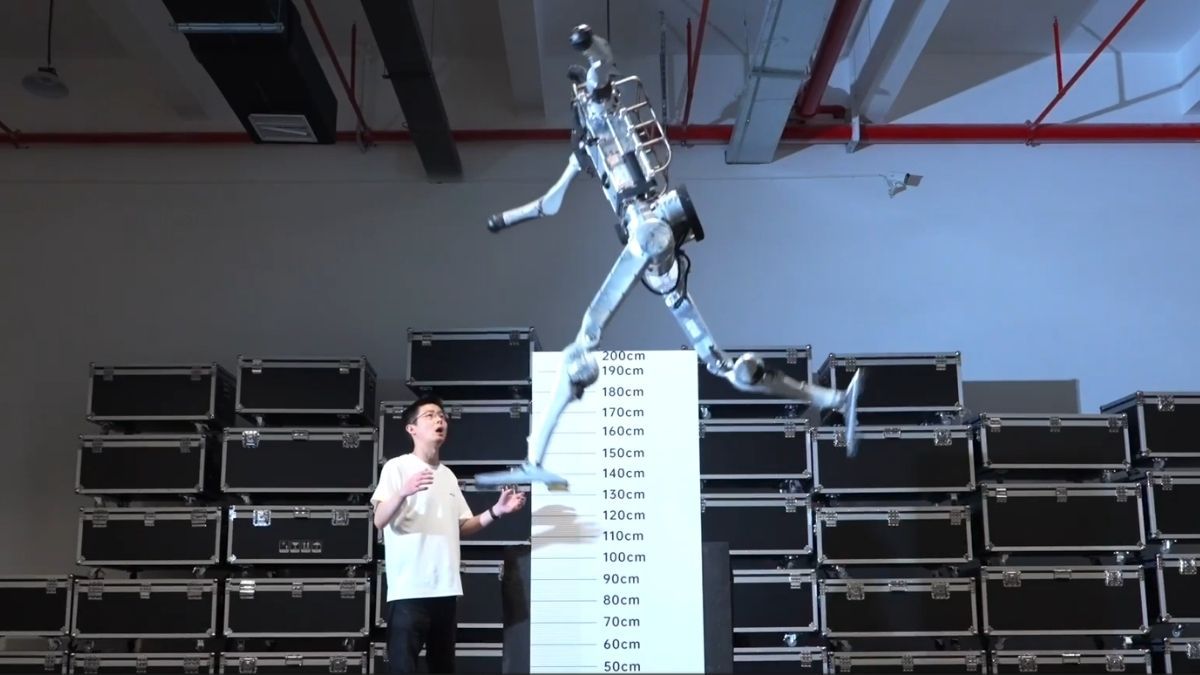
- Unitree Robotics unveiled a humanoid robot capable of a 2-metre standing jump and a top speed of 12.66 m/s.
- The robot was developed in just over three months, with experts highlighting its balance, whole-body coordination and potential for use in complex environments.
- Unitree ranked second globally in humanoid shipments in the first half of 2026, with about 5,900 units shipped and a 31% market share.

Unitree Robotics has unveiled a newly developed humanoid robot that can jump 2 metres vertically from a standing position and reach a maximum speed of 12.66 metres per second, exceeding human records in both events.
The robot achieves those figures with legs measuring just 0.85 metres, according to a statement from Unitree cited by the Global Times.
Unitree said the machine had been developed in slightly more than three months and that its performance could improve substantially in the months ahead.
Footage released by the company on Monday showed the robot completing the 2-metre jump before landing steadily.
The latest machine is part of Unitree's continuing efforts to expand the physical capabilities of humanoid robots. In April, the company's H1 humanoid reached a running speed of 10 metres per second in what was reported as a world record, a pace approaching the peak speed achieved by sprinting great Usain Bolt.
Unitree described the latest machine on X as a “‘Superman’ breaking the limits of humanity”, citing its 2-metre standing high jump and 12.66 m/s top speed.
Tests designed to expose technical limits
Unitree said on August 12 that it had manufactured about 18,000 humanoid robots as of July, with the figure covering bionic bipedal humanoids but excluding other humanoid robots and wheeled-base models.
Ma Jihua, a veteran technology industry analyst, said extreme demonstrations such as these can function as “stress tests” of the hardware and software working together inside a robot.
Running at high speed, jumping, generating explosive force and maintaining balance all place systems under pressure and help establish the boundaries of their capabilities, Ma said.
He compared the process with extreme testing used in the development of vehicles and aircraft, where identifying technical limits is necessary before systems can be reliably adapted for practical applications.
Xiang Ligang, director-general of the Zhongguancun Modern Information Consumer Application Industry Technology Alliance, said high-intensity movements require particularly sophisticated stability and whole-body coordination.
For a robot to sprint or perform a 2-metre standing jump, multiple joints have to be synchronised in real time. It must also absorb the landing while maintaining its balance and avoiding damage, Xiang said.
Achieving that requires mechanical engineering, power systems and artificial intelligence-based control algorithms to work closely together, he said.
Dynamic movement could expand applications
Xiang said stability during rapid and demanding movements could become increasingly important as humanoid robots are introduced into unpredictable environments.
Greater agility and the ability to adjust posture and movement in real time could help robots operate across difficult terrain, during disaster response and in other high-risk or complicated settings, he said.
The progress comes as competition in the global robotics industry intensifies, including amid US technology restrictions targeting China. Developing advanced technologies and strengthening independent innovation have therefore become increasingly important.
The use of robots outside controlled environments is also becoming an important area of competition as advances bring humanoid machines closer to everyday applications.
Ma said progress in humanoid robotics depends on a series of incremental technological advances rather than individual records alone.
A single record does not resolve all the challenges involved in deploying robots in the real world, he said. But sustained improvements in core capabilities can contribute to wider gains in performance and help humanoid robots progress from laboratory demonstrations towards more complicated and practical uses.
Unitree expands its market position
Smart Analytics Global, a California-based market research firm, reported on August 10 that Unitree was the world's second-largest humanoid robot supplier in the first half of 2026.
Its shipments increased 170 percent from a year earlier to approximately 5,900 units, giving the company a 31 percent share of the global market, according to the firm's data.
Unitree has also entered China's STAR Market, becoming the first humanoid robotics company to list on the country's A-share market. Its shares were priced at 150.80 yuan ($22.38) each, with the IPO allotment results already announced.
Chinese manufacturers collectively accounted for more than 97 percent of global humanoid robot shipments during the first half of 2026, according to industry data.