Belgium wildfire enters decisive phase as 3,000 hectares burn in High Fens
Firefighters are concentrating on the eastern front of a major wildfire in Belgium’s High Fens, where about 3,000 hectares have burned since Friday.
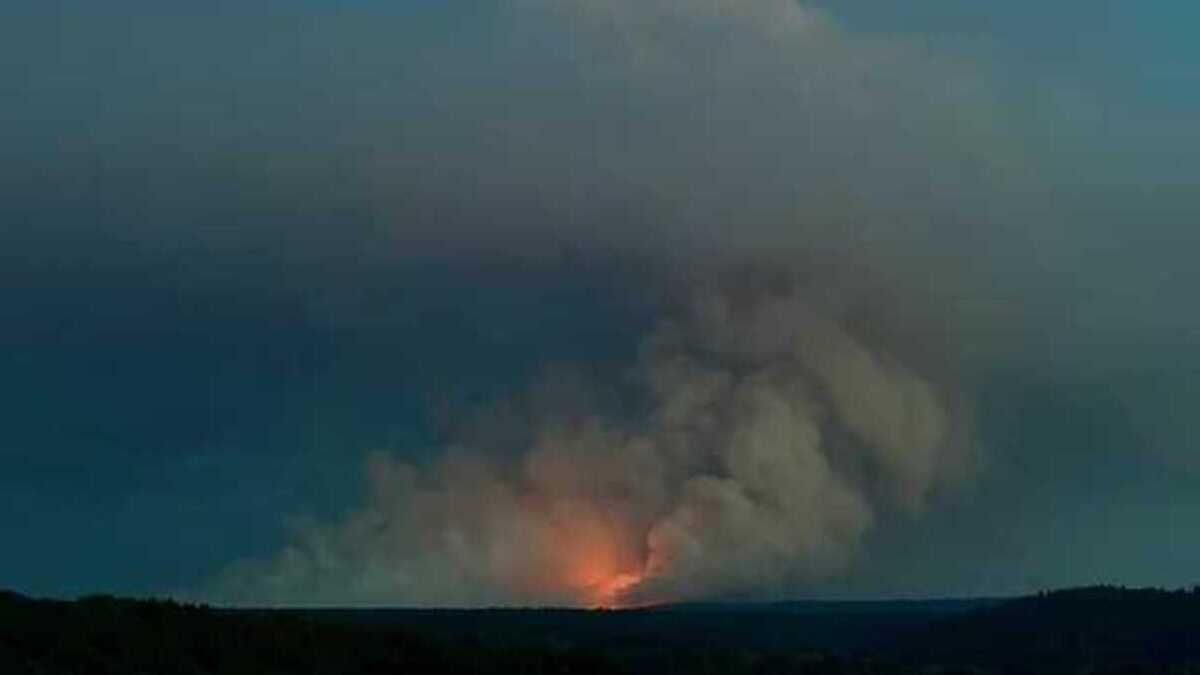
- Firefighters are working to establish a 600-metre containment line on the inaccessible eastern front.
- About 3,000 hectares of heathland and forest have burned since Friday.
- Low cloud and difficult terrain are restricting aerial and ground firefighting operations.

Firefighters in Belgium are facing a decisive day in efforts to contain a major wildfire in the High Fens nature reserve, where about 3,000 hectares have burned since Friday.
Authorities in Liège province said on Tuesday that crews were concentrating on the fire’s eastern front, where the terrain has prevented firefighters from reaching some of the areas still burning.
Tony Hosmans, crisis communications official for the Governor of Liège province, said the outcome of Tuesday’s operations would depend on whether the ground containment strategy succeeded.
“The outcome depends on whether the ground containment strategy works,” Hosmans said on Tuesday afternoon, according to The Brussels Times.
The wildfire has affected large areas of heathland and forest in the High Fens, a protected natural area in eastern Belgium near the German border.
Firefighters work to build 600-metre containment line
On the eastern front, firefighters cannot directly access the areas where the fire remains active. Instead, heavy machinery is being used to remove the upper layer of soil across strips several metres wide.
The objective is not to extinguish the flames directly, but to create access routes for firefighters, hoses and, where possible, smaller firefighting vehicles.
Crews are advancing metre by metre and are currently working to clear a 600-metre stretch in an effort to encircle the fire.
Hosmans said the operation was expected to occupy at least the whole of Tuesday, with marshy terrain making the work particularly difficult.
The eastern section is the only part of the fire that has not yet been contained, officials said. Fire crews have been able to control the fire front advancing towards Germany in areas accessible to them.
René Dahmen, head of the local district of the Department of Nature and Forests in Elsenborn, said on Monday that authorities hoped the fire could be brought under control by Monday, Tuesday or Wednesday.
Low cloud limits air operations
Air support, which has been used to assist crews since the fire began, has been severely restricted by weather conditions.
Low cloud cover on Tuesday prevented aircraft from operating because visibility was insufficient. Two Swedish water-bombing aircraft therefore remained grounded, while helicopter operations were also reduced.
A test flight was conducted and water drops subsequently began, Hosmans said.
The aircraft are particularly important in parts of the High Fens that are difficult for ground crews and fire engines to reach. However, authorities said they cannot operate safely when low cloud, strong winds or rain affect flying conditions.
On Monday, aerial operations were delayed until late afternoon because of low cloud.
The provincial governor’s office said aerial support would resume whenever conditions allowed.
Four lakes — Eupen, Gileppe, Robertville and Bütgenbach — remain closed to the public because they are being used as water-supply points for tanker lorries and firefighting aircraft.
The Governor of Liège has urged the public to comply with restrictions and stay away from the High Fens.
Hundreds of people mobilised
Around 500 people were involved in ground operations on Monday, including firefighters, farmers, Defence personnel and German crews sent as reinforcements.
Local and federal police were also deployed. Interior Minister Bernard Quintin said around 120 police officers were working on the ground each day, carrying out various tasks connected with the emergency response.
Germany and Norway each sent two helicopters on Monday. They joined two Belgian federal police aircraft, one Dutch helicopter and two Swedish planes deployed to support firefighting operations.
Despite the large-scale response, Quintin said the operation would continue for weeks.
He cited the difficulty of sending motorised equipment into parts of the High Fens and the unpredictable nature of the fire, whose development remains dependent on wind and other weather conditions.
Several major roads remained closed on Monday.
Fire could continue burning underground
Although the wildfire barely spread on Monday, it has not yet been declared under control.
Rain and wind helped restrict the fire’s advance, with officials reporting only limited development in the eastern area that remained inaccessible to ground crews.
VRT NWS reported that once the fire is contained, authorities will begin further groundwork because the fire could continue spreading through peat and tree stumps for months.
The firefighting operation has also been complicated by fallen trees blocking roads and damage to paths.
The fire front moving towards the German border is now under control in areas that can be reached by emergency crews.
King Philippe visits crisis centre
King Philippe visited the provincial crisis centre in Vottem on Monday morning to receive an update on the emergency response.
He was met by Walloon Minister-President Adrien Dolimont, Interior Minister Bernard Quintin, Deputy Prime Minister Jan Jambon and Liège Governor Hervé Jamar. Jambon was representing Prime Minister Bart De Wever, who was in Japan.
The King later travelled to Sourbrodt in the municipality of Waimes, where firefighters established a new command centre.
He praised emergency personnel for their work and the co-operation between the different services and levels of government.
The King described the wildfire as “a difficult moment for Belgium”, according to The Brussels Times.
Residents return to Sourbrodt
Improving conditions allowed nearly 500 residents of Sourbrodt who had been evacuated on Saturday to return home from 9pm on Monday.
The residents had spent two nights at a sports hall in Malmedy.
The municipality said emergency services and the relevant authorities had confirmed that conditions were sufficiently safe for people to return.
Air quality also improved on Monday. Malmedy’s nursery was able to reopen on Tuesday, while various other activities could resume.
FFP2 masks were also made available to local residents.
Thousands of offers of help
Public support for the emergency response has grown since the fire began.
The platform aidefagnes.be, established at the beginning of the wildfire, had received more than 3,300 offers of assistance.
The offers included food and drinks, animal cages, accommodation and specialised equipment from businesses.
A phone line established by the municipality of Baelen to co-ordinate donations and other assistance was closed at 8pm on Monday after authorities said sufficient support had been received for current needs.
Liège Governor Hervé Jamar thanked individuals, associations and companies for their solidarity, saying the level of assistance was sufficient for the needs identified so far and for developments in the situation.
Separately, the Federation of Young Farmers launched a fundraising campaign on Facebook to support farmers who have been mobilised to assist firefighters.
European support through Copernicus
European support has also been provided to the firefighting effort.
The European Union is supplying satellite imagery through the Copernicus Emergency Management Service to assist authorities responding to the wildfire.
The imagery is being used as part of the wider emergency response as firefighters work to monitor and contain the affected area.
The High Fens fire began on Friday and has already destroyed around 3,000 hectares of heathland and forest.
Authorities continue to focus on containing the eastern front, with ground crews working to establish a route around the fire while waiting for weather conditions to allow greater use of aircraft and helicopters.