Thousands protest in Delhi over examination reforms as clashes erupt near Parliament
Thousands of students and youth activists gathered in New Delhi on 20 July 2026 to demand examination reforms, accountability over alleged paper leaks, and changes to India's public recruitment system. Clashes broke out after protesters attempted to march towards Parliament.
- Thousands protested alleged examination paper leaks and demanded education and recruitment reforms.
- Clashes erupted after police blocked an unauthorised march towards Parliament.
- Organisers and police gave conflicting accounts of responsibility for the violence.

Thousands of students, job aspirants, youth activists, and supporters gathered at Jantar Mantar in New Delhi on 20 July 2026 for a nationwide protest demanding reforms to India's examination and public recruitment systems.
The demonstration, organised under the slogans "India Black Day" and "Sansad Chalo" (March to Parliament), coincided with the opening day of Parliament's Monsoon Session and became one of the country's largest youth-led protests in recent years.
The movement centred on allegations of repeated examination paper leaks, demands for accountability from authorities responsible for competitive examinations, and calls for broader reforms to recruitment processes affecting millions of students seeking university admission and government employment.
Organisers called on demonstrators to march from Jantar Mantar towards Parliament to submit a memorandum outlining their demands to lawmakers. Delhi Police, however, granted permission only for the gathering at Jantar Mantar and refused authorisation for a march, citing heightened security around Parliament during the opening day of the Monsoon Session.
Police erected multiple layers of barricades and deployed large numbers of officers and paramilitary personnel across central Delhi. Authorities repeatedly announced through loudspeakers that protesters should remain within the designated protest area and warned that attempts to move towards Parliament would violate the conditions under which the assembly had been permitted.
Crowds began assembling before sunrise, with many participants travelling overnight from neighbouring states. Protesters carried black flags, banners, and placards condemning alleged examination irregularities and demanding action against those responsible. Volunteers coordinated the gathering, distributed drinking water, and urged participants to maintain a peaceful demonstration.
Throughout the morning, speakers addressed the crowd, encouraging demonstrators to continue pressing for transparent examinations, stronger safeguards against cheating, and reforms to public recruitment systems.
The demonstration formed part of a broader movement that had developed over several months following a series of alleged examination paper leaks affecting competitive entrance and recruitment examinations. Student groups argued that repeated controversies had undermined confidence in the fairness of examinations determining access to higher education and government employment.
Among the movement's principal demands were action against those allegedly responsible for paper leak networks, independent investigations into examination irregularities, transparent recruitment processes, compensation for students affected by cancelled or compromised examinations, stronger anti-cheating safeguards, accountability for examination agencies, and structured dialogue between the government and student representatives.
Organisers also demanded the resignation of Union Education Minister Dharmendra Pradhan, whom they held politically responsible for the handling of examination controversies. The government rejected calls for his resignation but indicated that it was prepared to receive a memorandum from protest representatives through official channels.
The campaign adopted the name "India Black Day" to symbolise what organisers described as a loss of confidence in India's education and recruitment systems. Supporters wore black clothing and carried black flags as part of coordinated social media campaigns encouraging participation from across the country.
The demonstration was coordinated primarily by the Cockroach Janta Party (CJP), a youth-led movement founded earlier in 2026 by political communications strategist Abhijeet Dipke. Although styled as a satirical political movement rather than a registered political party, the CJP rapidly expanded from an online campaign into a nationwide protest movement focused on education reform, youth unemployment, and public accountability.
The movement's name originated from remarks made by Chief Justice Surya Kant during a Supreme Court hearing in May 2026, when comments referring to some unemployed young people as "cockroaches" generated widespread criticism. Although the Chief Justice later clarified that his remarks had been misunderstood and were not directed at India's youth generally, the controversy fuelled the rapid growth of the movement on social media.
According to NPR, the CJP attracted more than 20 million followers on Instagram within weeks and gained support from activists, educators, students, opposition politicians, and public figures. The movement's online campaigns combined satire with criticism of issues including examination administration, unemployment, rising living costs, and governance.
The protest also gained momentum after environmental activist Sonam Wangchuk joined the movement through a hunger strike supporting examination reforms. His detention and hospitalisation by police in the days before the demonstration became an additional rallying point for participants, who demanded his release alongside broader education reforms.
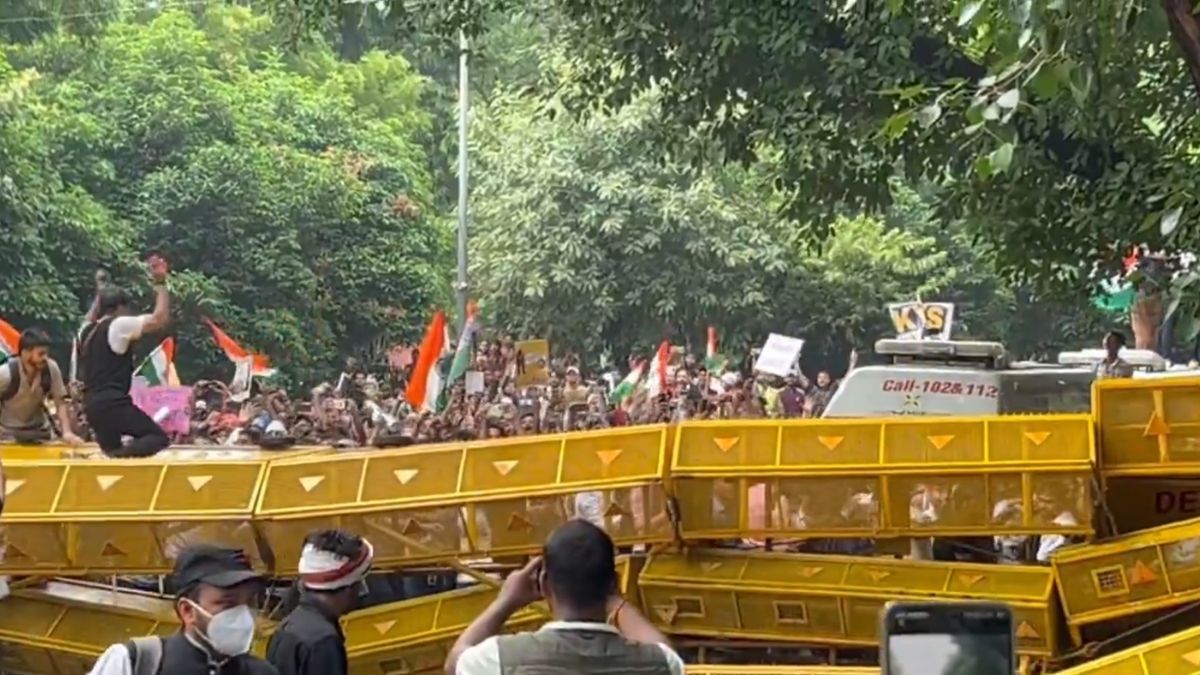
Late on the morning of 20 July, organisers instructed participants to begin the planned march towards Parliament. Large groups carrying banners and chanting slogans moved towards Parliament Street before being halted by police barricades.
Television footage and photographs showed thousands of demonstrators gathered behind metal barricades while protest representatives and police attempted negotiations. Tensions increased as more participants reached the front of the procession.
The confrontation escalated after sections of the crowd attempted to move beyond police barricades.
Video footage verified by multiple news organisations showed pushing and shoving between protesters and police as officers attempted to prevent demonstrators entering restricted areas surrounding Parliament.
Accounts of the violence differed
Protest organisers alleged that police used excessive force while dispersing demonstrators and called for an independent investigation into police conduct. Delhi Police rejected those allegations, stating officers acted only after protesters attempted to breach barricades despite repeated warnings.
NPR reported witnessing police deploy tear gas and strike demonstrators with wooden batons. Protesters interviewed by the broadcaster described tear gas being fired near crowds and alleged that some officers assaulted demonstrators. Police denied acting unlawfully and maintained that officers followed established security procedures.
NPR also reported that some protesters threw stones at police during the confrontation. Local media cited by the broadcaster reported that approximately 50 police officers were injured.
One World News reported that the organising movement claimed approximately 180 protesters were injured during the clashes. Delhi Police also confirmed injuries among officers deployed during the operation. However, no independently verified total for the number of injured people had been released at the time of reporting.
Ambulances and volunteer medical teams treated injured demonstrators, while video footage showed volunteers helping participants away from congested areas and providing first aid.
Police detained an unspecified number of demonstrators after the clashes. Authorities stated the detentions were necessary to restore order and prevent unauthorised entry into restricted security zones. Protest organisers argued that peaceful participants had also been taken into custody and called for transparency regarding those detained. Rights groups urged authorities to ensure detainees had access to legal assistance where required.
The events rapidly became a national political issue
Opposition leaders criticised the handling of the protest and questioned the police response, while the government defended the security measures implemented around Parliament during the opening day of the Monsoon Session.
According to Britannica, members of the Indian National Congress, including Leader of the Opposition Rahul Gandhi, protested outside Prime Minister Narendra Modi's official residence on 21 July, demanding accountability for the police response. Several participants were reportedly detained.
Social media amplified the protest throughout the day. Videos showing marches, confrontations, police barricades, and clashes were viewed millions of times across X, Instagram, Facebook, and YouTube.
News organisations verified several widely circulated videos using visual landmarks and timestamps. At the same time, fact-checkers warned that some viral posts recycled footage from unrelated demonstrations and were incorrectly presented as depicting events from 20 July.
According to NPR, the protests represented one of the most significant public demonstrations against Prime Minister Narendra Modi's government in recent years. Protesters linked examination reforms to broader concerns including youth unemployment, rising living costs, and confidence in public institutions.
Government representatives rejected suggestions that the movement reflected broader political dissatisfaction. Education Minister Dharmendra Pradhan declined to resign and described the protesters in an interview with NDTV as "a B-team of terrorists" seeking to divide the country. Movement founder Abhijeet Dipke rejected the accusation.
As of 21 July, demonstrators had returned to Jantar Mantar under heavy police deployment, although attendance was substantially lower than during the previous day's march. Reuters reported that approximately 150 to 200 protesters remained at the site.
Leaders of the Cockroach Janta Party said the movement would continue through peaceful demonstrations but would not immediately organise another march towards Parliament in order to avoid further injuries.
Delhi Police stated that investigations into the violence would continue and that legal action would be pursued against individuals accused of violating prohibitory orders, damaging public property, or attacking police personnel. Protest organisers disputed those allegations and continued to call for an independent investigation into the police response.