Sweden tops 2026 Global Passport Index; Singapore only Asian passport in top ten
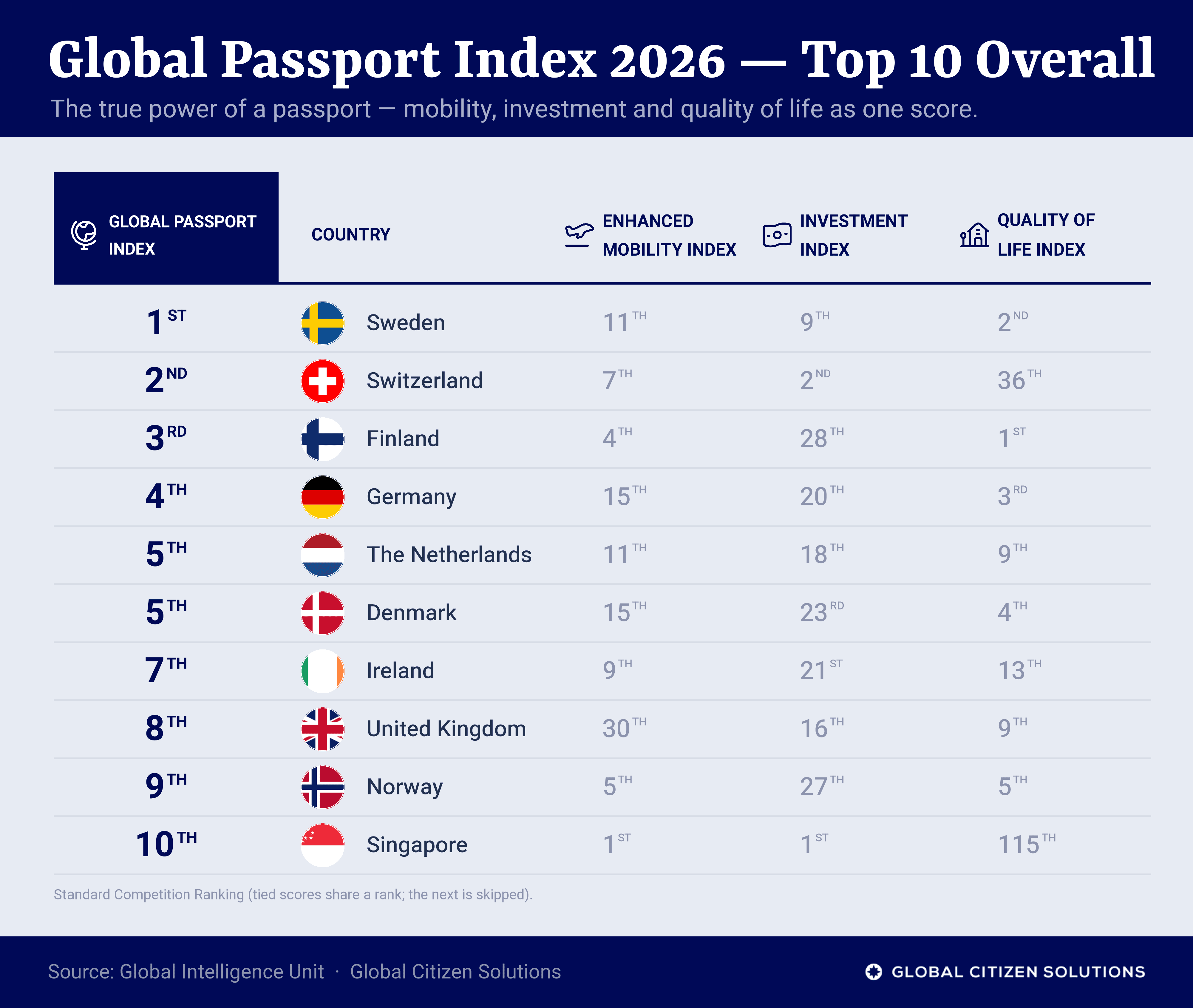
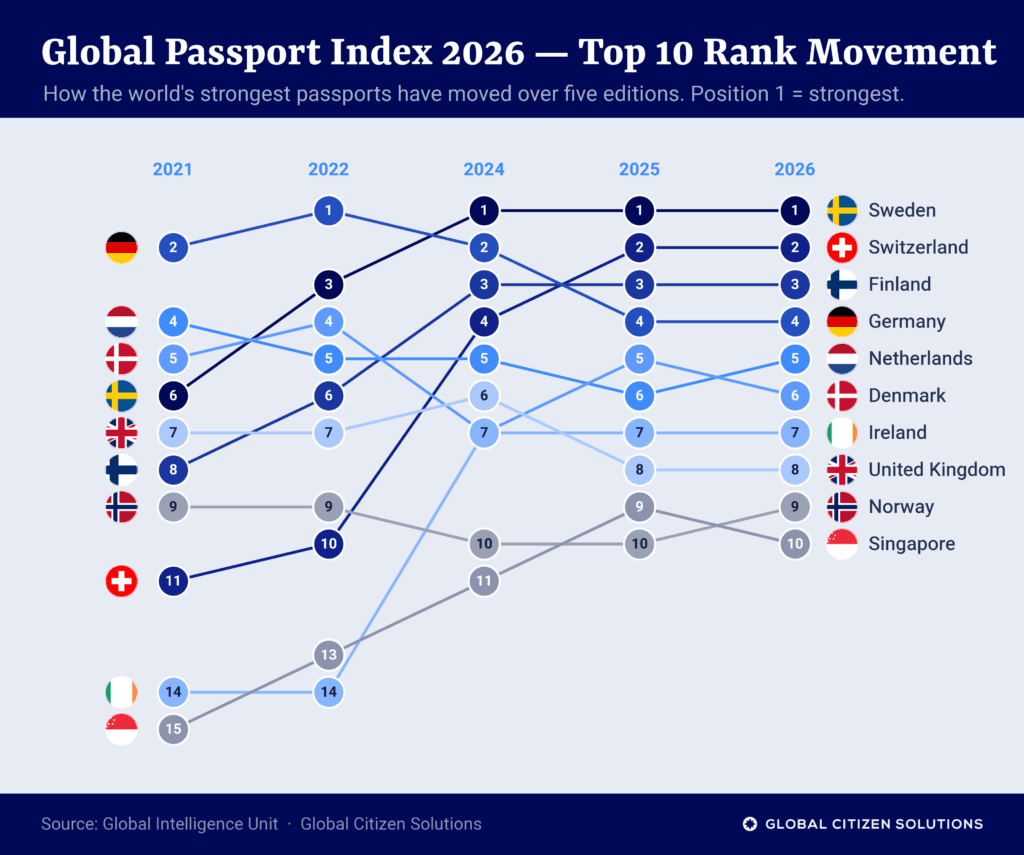
Sweden has claimed the top spot in the 2026 Global Passport Index, followed by Switzerland and Finland. Singapore places 10th, the sole non-European passport in the top ten, leading the world on Investment Index and Enhanced Mobility.
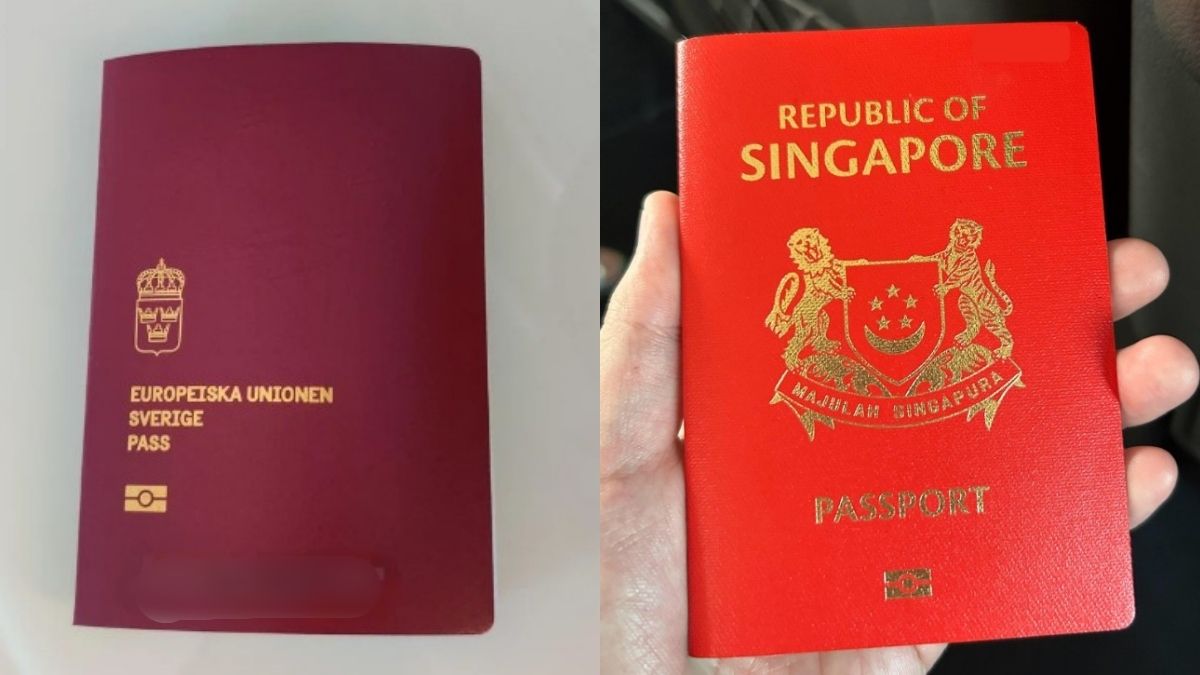
- Sweden ranks 1st globally at 96.05 points; Afghanistan ranks last at 23.10.
- The gap between top and bottom passports has widened every year since 2021.
- Singapore, ranked 10th, is the only Asian passport in the global top ten.

Sweden has retained the top position in the 2026 Global Passport Index (GPI), scoring 96.05 out of 100, according to Global Citizen Solutions (GCS), a global residency and citizenship planning advisory firm. Afghanistan ranks last, at 23.10.
The index, now in its sixth edition, synthesises fourteen indicators across three weighted pillars, Enhanced Mobility, Investment and Quality of Living, covering 197 countries and territories. Switzerland, Finland, Germany and the Netherlands round out the top five.
The 72.95-point gap between Sweden and Afghanistan has widened in every edition since 2021, GCS said.
The top of the ranking has gained incrementally each year, while the bottom has lost ground in absolute terms, a trend the report describes as a deepening structural condition rather than a pandemic-era anomaly.
Bilateral data underlying the index found that 61.5 per cent of visa relationships between countries are asymmetric, and that the direction of that imbalance tracks wealth and geopolitical alignment.
All twenty of the most privileged passports belong to OECD members or high-income economies, GCS said, while all twenty of the most generous belong to lower-income states.
The report also identified a nine-fold gap between the visa-free access African passport-holders receive in Europe and the access European passport-holders receive in Africa, describing it as the largest region-to-region inequality in the dataset.
GCS pointed to the United States as the sharpest illustration of that imbalance. The country is the world's largest net beneficiary of others' openness by reciprocity balance, yet ranks as the tenth most restrictive destination globally by inbound score, a contradiction the report said its 12th-place composite ranking does not capture.
The 2026 edition also tracks a divergence in border policy between wealthy democracies and parts of Asia. The UK's Electronic Travel Authorisation, the EU's Entry/Exit System and forthcoming ETIAS, and the long-established US ESTA have converged on digital pre-screening, adding friction even to destinations the index scores as highly open.
Asia has moved in the opposite direction, GCS said. China's unilateral visa-free expansion reached close to fifty countries by February 2026, a move the report characterised as calculated economic diplomacy rather than universal openness, with the United States pointedly excluded throughout.
Brazil's reinstatement of a visa requirement for American nationals in April 2025 was cited as a related sign of middle-income states reconsidering unconditional access for non-reciprocating partners.
Within this wider picture, Singapore placed 10th overall, with a composite score of roughly 92.8, the only Asian passport to reach the global top ten and the sole non-European entry in the group. Nine of the top ten passports belong to European states.
Singapore's position rests on mobility and financial strength rather than a broad sweep across all three pillars. It ranks 1st in the world on both Enhanced Mobility and the Investment Index, and 1st globally on national income per capita, at roughly US$92,270.
Its weaker point is Quality of Living, where it ranks 115th globally, by far its lowest score and a marked contrast with its financial and mobility rankings. GCS noted that Asia's leading passports, including the United Arab Emirates (UAE) and Japan, show a similar pattern of winning on financial freedom rather than lived comfort.
GCS said the overall findings point to a global mobility system opening and closing at once, unevenly, along lines of wealth and diplomacy rather than any uniform trend.
Passports that gained ground in 2026 did so through deliberate reform or bilateral agreement, while those that slipped were exposed to reciprocity risk that now touches even the strongest documents.