Chan Chun Sing rejects PSP's call for CCE lesson disclosure on Israeli-Hamas Conflict
NCMP Leong again expresses dismay at MOE's lack of transparency on CCE lessons about Gaza Conflict, questioning the introduction of such complex and controversial issues to children. Minister Chan assures MOE is "more than transparent," going beyond material disclosure.
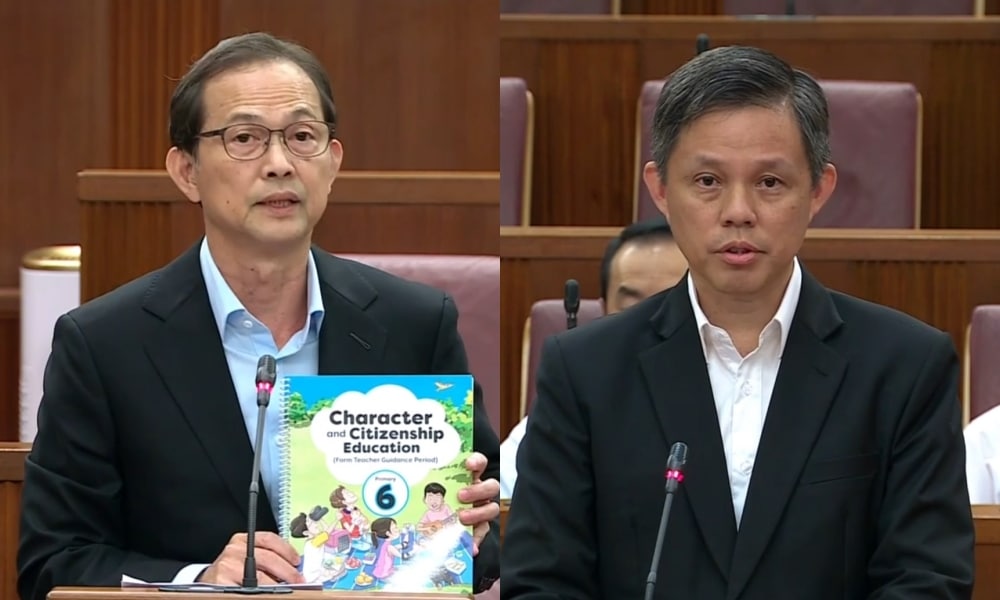

SINGAPORE: Once again, Mr Leong Mun Wai, Non-Constituency Member of Parliament (NCMP) has voiced his disappointment with the Ministry of Education's (MOE) approach to handling content related to the Israel-Palestinian conflict within the Character and Citizenship Education (CCE) curriculum.
During Tuesday's (2 April) parliamentary sitting, Mr Leong reiterated concerns regarding the transparency and clarity of the MOE's decision-making process for CCE lessons. He questioned why the specific CCE lesson slides in question had not been disclosed, but instead, parents were asked to come to school to seek clarification.
In response, MOE Minister Chan Chun Sing emphasized the Ministry is “being more than transparent”, assuring that they are going beyond mere disclosure of materials.
He assured that the MOE is ready not only to provide parents with access to the materials but also to explain how they are utilized in lessons.
PQs filed by PSP NCMPs related to CCE lesson deferred to 2 April, despite initially filed in March
Mr Leong and Ms Poa, both NCMPs from the Progress Singapore Party (PSP) initially filed PQs and anticipated clarification from Minister Chan on the 7 March parliamentary sitting.
At the time, Mr Leong demanded that the PQ times be reinstated to 1.5 hours instead of half an hour. However, Speaker Seah Kian Peng rejected Mr Leong’s request and preferred to maintain the originally allocated time.
Speaker Seah reiterated that the issues regarding the CCE lesson had been extensively discussed during the Ministry of Education’s COS debate on 4 March, despite Mr Leong expressing the importance of the issue which had garnered significant concern from Singaporeans.
Their PQs on the issue had deferred to the 2 April parliamentary sitting.
Mr Leong's PQ asked if primary school students are being taught about the conflict in the CCE lesson or otherwise. He also sought information on the levels at which students are taught about the conflict and how the content is differentiated based on students’ maturity levels.
Ms Poa inquired about making public the content of the CCE lesson on the Gaza conflict, whether any teacher has declined to deliver the lesson and how such situations are handled.
Meanwhile, PAP MP for Pasir Ris–Punggol GRC Mr Sharael Taha also filed a separate PQ, raising concerns about ensuring a safe space for students to share diverse views and form their conclusions on complex issues within the CCE framework, and ensure that students realise the importance of looking at such situations through the lens of Singapore’s national interests and the need to maintain harmony.
In response, Minister Chan said he had addressed questions on the CCE lesson extensively during the March COE debate, and his response can be found on the website of the MOE.
LMW expresses concern over teaching complex and controversial issues like the Israel-Hamas Conflict to children
In Mr Leong's supplementary question, he expressed disappointment that the teaching materials for the CCE class, particularly regarding the Israel-Hamas conflict, have not been released to the public despite being imparted to children.
He questioned the justification for withholding these materials and requested the government's commitment to making all CCE teaching materials available to the public in the future.
Mr Leong also mentioned that he acquired a textbook for CCE for Primary 6 students.
"From the content of the textbook, you cannot imagine that a complex and controversial current issue like the Israel-Hamas conflict will be taught to our children."
In response, Minister Chan reiterated his stance during the 4 March COS debate on the decision not to release lesson materials for CCE lessons and reiterated that the slides alone do not fully communicate how the subject is taught.
He encouraged concerned parents to visit the teachers who could explain how the lesson is conducted, emphasizing that this is better than merely looking at slides without context.
"This is how we intend to make available our teaching materials including explanations to parents who are concerned. "
PAP MP Sharel Taha then asked the Minister on how the Ministry would decide when to address different issues as part of CCE lessons, particularly considering the threat of worsening geopolitical tensions, such as China-US tensions or Taiwan issues; or regarding conflict against races and religion in other countries.
He asked whether discussing these topics before tensions significantly escalate would be beneficial.
Minister Chan responded by acknowledging that there would be many sensitive and emotive issues that students and the population would encounter in the future.
He emphasized the importance of conducting CCE lessons to help people understand their emotions, and diverse perspectives, verify information, understand national priorities, and take constructive actions for cohesion and harmony.
Minister Chan confirmed certain schools received requests from parents over CCE lessons concern
Ms Poa subsequently raised concerns regarding the Ministry's approach to addressing parental concerns about the CCE lessons.
She inquired about the number of schools that have organized dialogue sessions with parents regarding the CCE lessons and whether there have been consultations with community and religious leaders, as well as teachers responsible for delivering these lessons.
In response, Minister Chan admitted that some schools have indeed received such requests and engaged with parents accordingly.
Regarding the consultation process, Minister Chan clarified that while the Ministry does consult various stakeholders, the purpose of consultation should be understood.
He explained that consultation doesn't necessarily mean seeking permission or consensus on what to do but rather gathering diverse views on the content. He emphasized that ultimately, leadership responsibility lies with the Ministry to decide what is right and necessary for society and children.
In terms of content consultation, Minister Chan reiterated that the CCE lessons are not history lessons.
"We welcome suggestions from all members on how we can make the material more targeted, more suitable, " said Minister Chan.
"But I will be the first one to admit, that I think none of us, not even historians will be able to come up with what will be considered a fair Representation from everyone's perspective."
He emphasized that the goal is to understand and navigate through the differences and emotive reactions while maintaining peace and harmony.
In response, Mr Leong voiced dissatisfaction with the perception that he and his colleague, Hazel Poa were "always accused of being divisive" whenever they raise questions challenging the government's stance.
He questioned why there couldn't be a defined process for selecting topics and why the materials couldn't be transparently available to all parents without them having to request it from schools.
"We are not particularly against any topics to be raised actually, as long as there is a defined process," explained Mr Leong.
Minister Chan responded by refuting the accusation, “Please do not twist our words. I have never accused anyone in this House of being divisive.”
He reiterated that the CCE lesson intention is to help people understand and manage differences sensitively to work towards a more united future.
"MOE is being more than transparent. We are not only prepared to show the parents the material we are prepared to explain to the parents how the materials are used rather than to just give a deck of slides which can be taken out of contexts."
He justified this approach by citing instances where slides were taken out of context or selectively used, leading to misunderstandings.
"I think the correct perspective is that MOE has been more than transparent in allowing our students and children not only to see the materials but also to explain to the parents how the lessons are conducted."