Singapore crowned world's freest economy amidst global economic contraction, reveals 2024 index
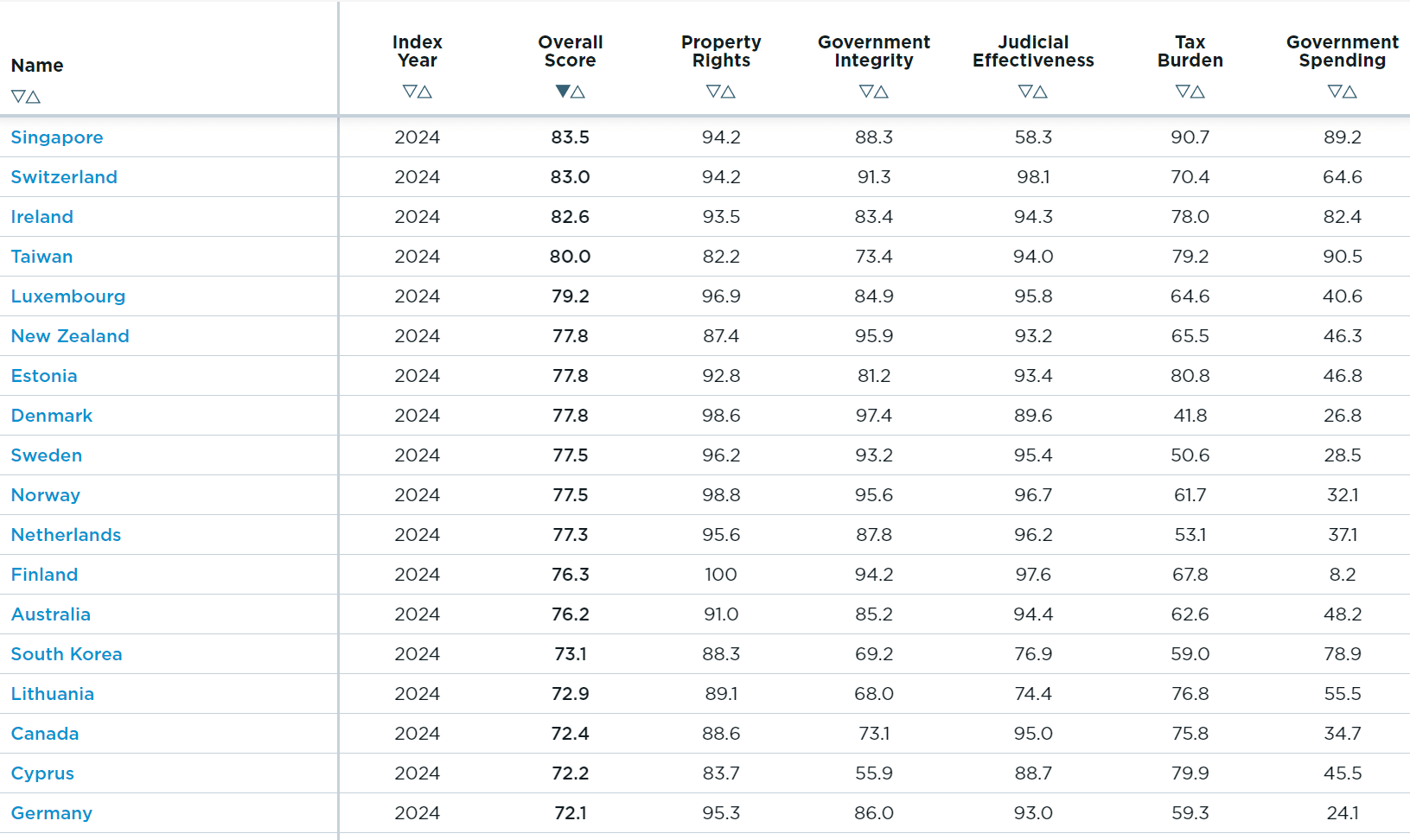
2024 Index of Economic Freedom names Singapore as the world's freest economy amidst global downturn, yet faces challenges with a decline in Judicial Effectiveness score to 58.3.


In the latest findings from the 2024 Index of Economic Freedom, Singapore has once again been named the world's freest economy, navigating through a period marked by widespread economic constraints and challenges.
The Index, created by The Heritage Foundation and The Wall Street Journal and evaluating economic policies and conditions across 184 sovereign nations from 1 July 2022 to 30 June 2023, paints a grim picture of the global economic landscape, declaring it "mostly unfree." The global average score, now standing at just 58.6, dips to its lowest since 2001.
The study highlights a concerning trend of deteriorating fiscal health worldwide, with rising deficits and surging public debt posing significant threats to productivity growth and economic vitality. Despite this backdrop, the Index underscores the undeniable link between economic freedom and improved economic dynamism and overall well-being, advocating for policies that lower taxes, streamline regulations, foster competition, and combat corruption.
Economically freer countries, as per the Index, not only exhibit higher standards of living, with incomes per capita significantly surpassing those in less free nations, but also correlate with greater overall well-being, encompassing health, education, environmental standards, innovation, societal progress, and democratic governance.
However, the landscape of economic freedom is not without its concerns. The 2024 Index reveals a contraction in the number of countries classified as "free," with only four nations scoring above 80, and a notable decline in the standings of previously high-ranking countries. The United States, in particular, has seen a dramatic fall, reaching its lowest position in the 30-year history of the Index as the 25th freest economy, primarily due to excessive government spending and the resulting financial imbalances.
Switzerland, Ireland, and Taiwan follow Singapore in the top rankings, with Taiwan achieving its highest-ever position. This reshuffling reflects significant movements within the global economic landscape, highlighting the varying degrees of resilience and adaptability among economies.
The report highlights that Singapore's economic freedom is underpinned by robust protection of property rights and effective enforcement of anti-corruption laws. Competitive tax rates and a transparent regulatory environment foster vibrant economic activity.
Furthermore, it notes Singapore's openness to global commerce as a key factor in enhancing productivity and fostering a dynamic and competitive financial sector. The process for starting a business is straightforward.
Additionally, the report mentions that although there is no statutory minimum wage, wage adjustments are guided by the National Wage Council. It also points out that inflation remains under control, despite the challenging external environment.
While Singapore's sustained leadership in economic freedom amidst a global downturn highlights its robust economic infrastructure, the city-state has encountered a significant challenge this year. Its Judicial Effectiveness score dramatically fell to an abysmal 58.3, markedly lower than any of the countries within the top ten.
This decline raises concerns about the judicial aspects of Singapore's economic environment and emphasizes the need for focused improvements to maintain its esteemed position on the global stage.