Lim Tean accuses MCI of ignoring 'Critical Spectator's' repeated interference in Singaporean politics
Lim Tean, leader of the People’s Voice party, criticized the Ministry of Communications and Information (MCI) for ignoring repeated interference by the Polish Blogger, 'Critical Spectator' in Singapore politics after It issued a warning to Mr. Dominic Ziegler, The Economist's Singapore bureau chief, for alleged "interference" in Singapore's domestic politics. \n \nHe raised concerns about a perceived double standard, suggesting favorable foreign voices faced no consequences.

SINGAPORE: On Friday (8 Sept), The Ministry of Communications and Information (MCI) issued a warning to Mr. Dominic Ziegler, The Economist's Singapore bureau chief, for alleged "interference" in Singapore's domestic politics.
The Ministry's announcement stemmed from an incident on 25 August when Ziegler publicly endorsed a local online publication called "Jom."
"He compared Singapore to an illiberal state, and encouraged Singaporeans to embrace an alternative vision, instead of what was being offered by the state and an allegedly captive media, " claimed MCI.
MCI claimed that Ziegler’s action "clearly crossed the line from reporting on Singapore to participating in Singapore’s domestic affairs."
The Ministry further criticized Ziegler for exploiting his status as a journalist affiliated with a prestigious international publication to advocate his viewpoint on Singaporean domestic politics, despite not being a citizen of the country.
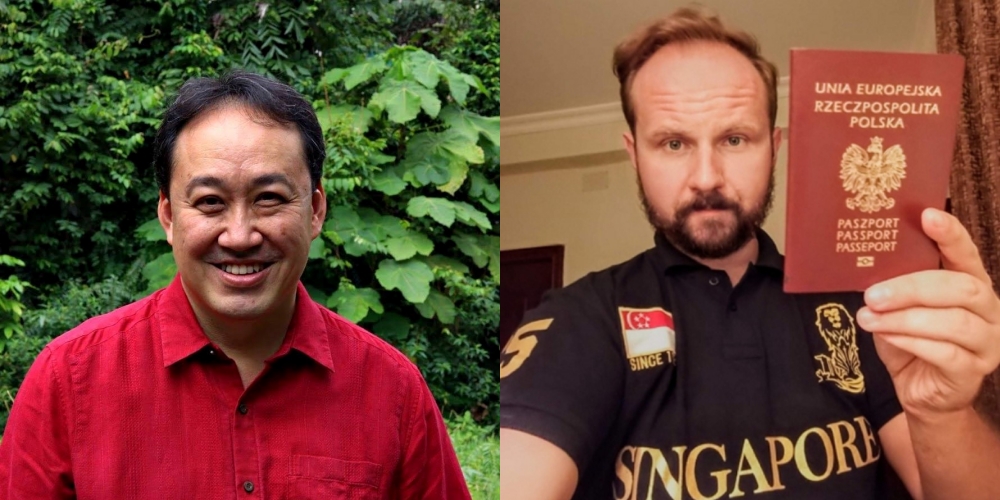
'Critical Spectator,' a foreign blogger and ardent supporter of PAP
The current leadership of MCI is under Minister Josephine Teo, with support from Senior Minister of State Dr Janil Puthucheary and Tan Kiat How. Minister Teo also holds the position of Second Minister for Home Affairs.
While MCI has issued a strong statement on Mr Ziegler, there has been no official statement from the Singaporean government regarding the posts and endorsements made by a foreign blogger Michael Patraeus, or better known as 'Critical Spectator' concerning the ruling party.
The Polish blogger frequently takes a hardline supportive stance on the Government and some of these posts are occasionally shared by Madam Ho Ching, the former CEO of Temasek and the spouse of Prime Minister Lee Hsien Loong.
Lim Tean calls out Critical Spectator's ongoing "interference" in Singapore's politics
In response to MCI's recent decision, Lim Tean, the leader of the alternative party, Peoples Voice (PV), criticized the Ministry, led by Minister Teo, for seemingly ignoring repeated instances of interference in domestic politics by the Polish Blogger.
He pointed out that during the 2023 Presidential Election, Critical Spectator had posted content suggesting that those who voted for Presidential candidate Tan Kin Lian were insane, and this post was shared by Ho Ching.
Lim Tean remarked that it seems if someone is a foreigner who supports the PAP or the establishment, they can freely engage in interference in our domestic politics without facing any consequences.
"FICA (Foreign Interference (Countermeasures) Act 2021) is an unknown acronym to the likes of the Critical Spectator. But if you happen to speak in favour of the opposition or civil society, you can expect a warning or even worse from the PAP!"
Lim Tean humorously wondered if the MCI might introduce a new category of warning known as a "Stern Warning" in the future.
The Foreign Interference (Countermeasures) Act 2021, also known as FICA, is a statute enacted by the Parliament of Singapore.
Introduced to Parliament on 13 September 2021 by the Minister for Home Affairs, K. Shanmugam, the act purportedly aims to "protect Singapore's public interest by counteracting acts of foreign interference."
The act empowers the Minister for Home Affairs to remove content considered part of a hostile information campaign.
Additionally, it authorizes the minister to delegate the responsibility to investigate individuals suspected of being foreign agents involved in "hostile information campaigns."
An independent panel, chaired by a judge—which is appointed under the advice of the Cabinet, will handle appeals against the minister's findings.
However, individuals labelled as "politically significant" might be excluded from lodging such appeals.
Furthermore, authorities will have the right to demand user data from social media platforms and website operators in certain situations without providing justification.
Of particular concern is that the offences under the Act are both arrestable and non-bailable. This makes it a more formidable version of the Internal Security Act, which does not necessitate the President's approval.