CNA Forum: Insights from Presidential contenders on reserves management and crisis response
The 2023 Presidential Election contenders, amidst discussions on safeguarding Singapore's reserves, underscored that crisis response must weigh crisis nature and duration. \n \nFormer PAP senior minister Mr Tharman Shanmugaratnam stressed reserve use when crises are protracted, advocating strategic spending for resilience. \n \nTan Kin Lian, former NTUC Income CEO prioritizes people's interests and prudent choices. \n \nNg Kok Song, ex-GIC chief investment officer, highlights intergenerational benefit and balanced expenditure, stressing economic understanding.
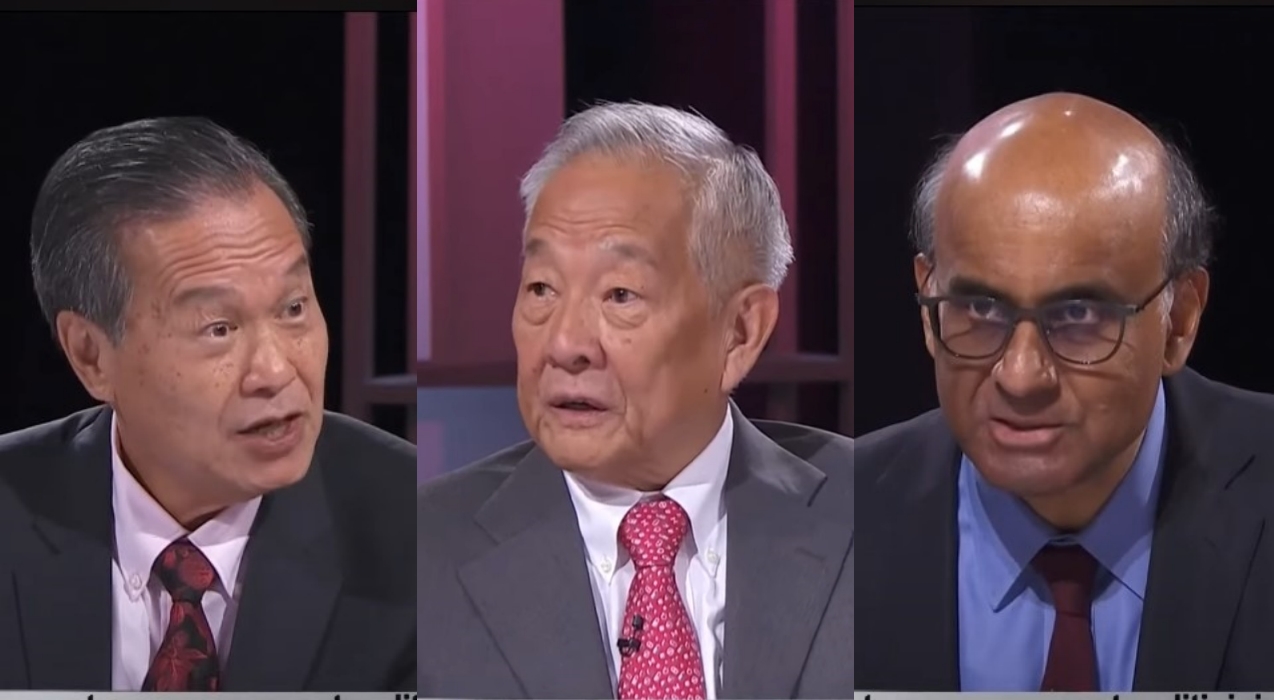

SINGAPORE: In relation to how they intend to fulfil their Presidential role as the "second key" to safeguard Singapore's past reserves, the three contenders for the 2023 Presidential Election (PE2023) highlighted the importance of the use of reserves should be guided by careful consideration of the crisis's nature and duration.
During the hour-long live Singapore Presidential Forum held on Monday (28 Aug) night, the three contenders engaged in a comprehensive discussion that encompassed a broad spectrum of topics, ranging from their suitability for the presidency to their strategies for fostering unity and nurturing a more compassionate society.
The trio of Presidential contenders comprises distinguished individuals: Mr Ng Kok Song, the former GIC investment chief; Mr Tharman Shanmugaratnam, a former senior minister of the People’s Action Party; and Mr Tan Kin Lian, the former NTUC Income chief.
Mr Tharman emphasised the need for utilization when the crisis lacks a clear endpoint, while also stressing wise expenditure and equitable distribution to enhance the nation's resilience.
Meanwhile, his contender, 75-year-old Tan Kin Lian emphasizes the importance of serving the people's best interests and making prudent decisions to avoid wasteful spending.
Mr Ng Kok Song underscores the significance of benefiting present and future generations, achieving a balance between saving and spending, and understanding various economic factors before tapping into the reserves.
Tharman's call for equitable crisis response
Mr Tharman underscored the unfortunate inevitability of periodic crises in Singapore, citing COVID-19 as an example and highlighting the possibility of imminent major crises.
He emphasized that the president's initial task is comprehending the crisis's nature—whether it's a short-term challenge or a crisis with an uncertain resolution.
He asserted that the "second key," allowing reserve usage, is particularly relevant when the crisis's conclusion remains uncertain, warranting prudent financial decisions even when the crisis's depths are unclear.
Additionally, he stressed the importance of strategic expenditure—beyond mere survival—to bolster the resilience of businesses, SMEs, and individuals during such turbulent times.
He further emphasized the critical role of harnessing a crisis to emerge stronger, indicating that this approach is essential for the judicious utilization of reserves.
"Thirdly, it's got to be fair. if you're using our reserves in a crisis, if we're going to spend monies on Singaporeans and firms, it's got to be distributed fairly."
"If your (objective) is saving jobs, you've got to make sure we help lower-income Singaporeans, middle-income Singaporeans, build up strengths for the recovery, build up new skills, keep new capabilities for the recovery."
He emphasized that this approach should also be carried out without exhibiting favoritism towards larger corporations or individuals who are already privileged; the actions must remain guided by the principle of fairness.
Tan Kin Liann want to ensure the use of reserves aligns with the people's interests
Tan Kin Lian, in contrast, emphasizes two pivotal considerations: firstly, whether the use of reserves aligns with the people's interests, and secondly, whether it qualifies as a suitable utilization of reserves.
For instance, he questions whether the funds are expended judiciously or imprudently – exemplified by the substantial use of reserves during the COVID pandemic.
He points out that a significant sum was earmarked, with a portion channelled into profitable banks receiving government subsidies – a scenario he deems unsuitable in terms of a reserves deployment.
While refraining from attributing his insights solely to hindsight, Mr Tan believes that the President should possess the acumen to discern between appropriate and inappropriate reserve use.
Hence, he expresses his intention to rigorously evaluate whether the proposed actions align with the greater good and meet the criteria of proper reserve utilization.
Ng Kok Song intended to probe the overall size of Singapore's reserves
Ng Kok Song brings attention to the critical considerations that should factor into government requests for drawing from our historical reserves.
He underscores that these reserves should ideally benefit both current and future generations of Singaporeans, making the decision of how much to save versus spend a pivotal one.
In this context, he expresses his intention to probe the government on two essential points: the overall size of Singapore's reserves, and how much are the government asking to spend out of the reserves.
Ng Kok Song said he would extend to uncovering the foundational assumptions underpinning the government's crisis characterization, encompassing the crisis's scope, whether it's international or domestic, and its projected duration.
Another crucial facet of his inquiry centres on the exploration of alternate revenue sources before resorting to the utilization of past reserves.
Ng Kok Song also emphasizes the significance of understanding the assumptions governing the government's projected returns on reserves for the future.
”I think we need to understand what are the assumptions that the government is using, in regard to what are the expected returns on reserves for the future, how does that compare with our historical rates of return on the reserves, so these are issues which I‘ve been quite familiar with while working in the GIC."