110 Chinese humanoid robots set world record with synchronised dance performance
Chinese robotics firm AgiBot has set a Guinness World Records title after 110 humanoid robots performed a synchronised dance routine in Jinan. The demonstration highlighted advances in multi-robot coordination as China seeks to expand the technology’s use in industry, public services and education.
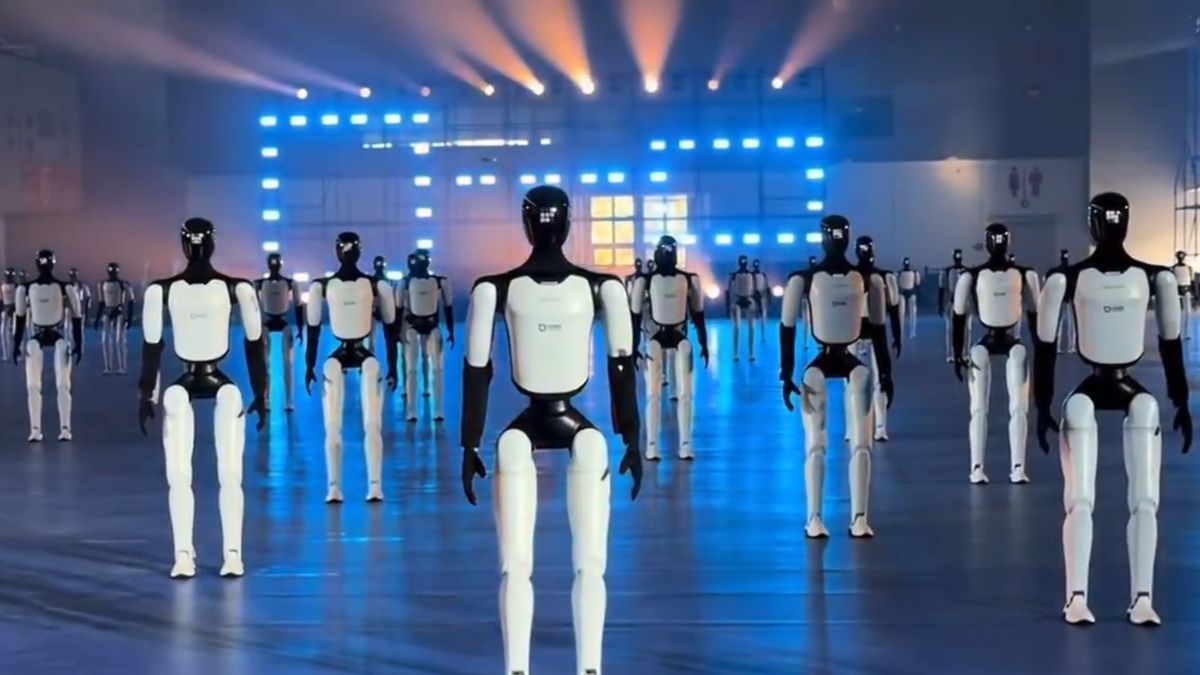
- AgiBot's 110 Expedition A3 humanoid robots completed a synchronised dance lasting five minutes and 43 seconds in Jinan.
- The LinkBots system coordinated robot movements, positioning and formation changes without manual control of individual machines.
- China is expanding humanoid robot applications, but reliability, adaptability and cost remain barriers to large-scale deployment.

A Chinese robotics company set a Guinness World Records title after 110 humanoid robots performed a synchronised dance routine in Jinan, eastern China's Shandong province on 24 October in a demonstration of technology that the industry hopes to deploy on a larger scale.
The Expedition A3 robots, developed by AgiBot, performed coordinated movements and formation changes at the Yellow River International Convention and Exhibition Centre.
The performance lasted five minutes and 43 seconds, with the robots moving in unison before changing formations and coordinating different movements. The Guinness World Records challenge was for the most humanoid robots dancing simultaneously for at least five minutes.
Guinness World Records adjudicator Hou Ying confirmed the achievement at the event.
The challenge tested more than the robots' ability to reproduce dance movements. It required stable coordination, accurate positioning and effective scheduling across a group of more than 100 machines.
Control system coordinates movements and formations
AgiBot used its LinkBots cluster-control system to coordinate the robots. The platform is designed to manage the movements and tasks of multiple robots operating together.
Wang Chuang, a partner and senior vice-president at AgiBot, said the system enabled the robots to operate with a high degree of autonomy throughout the challenge.
The robots could leave their packaging, calibrate their positions and arrange themselves before performing the routine in time with the music, without engineers manually controlling each machine with a handheld remote.
Wang said coordinating a large group of robots involved more than simply reproducing the same movements. It required a system combining real-time position awareness, coordinated decision-making and dynamic obstacle avoidance.
The LinkBots platform supports visual formation changes, allowing robots to adjust their arrangements according to preset tasks and their real-time positions. It can also coordinate navigation and movement while assigning different tasks to separate groups of robots.
The system uses ultra-wideband (UWB) positioning technology to help the machines navigate and maintain their relative positions. The technology enables positioning accuracy at the centimetre level and positioning precision of less than 10 centimetres.
Wang said these capabilities marked a key technical step in moving humanoid robots from demonstrations towards practical use.
Robots already being introduced into public services
The company said the robots would be used in cultural and tourism performances, public services, research and education, among other settings.
The machines had already been introduced at locations including Jinan Olympic Sports Centre and metro stations along Zhuanshan West Road. Their tasks included providing information and directions, assisting with passenger flow management, conducting security patrols and delivering cultural explanations.
The deployments reflect efforts to move humanoid robots beyond stage performances and into public-facing environments.
China's wider robotics industry is also exploring industrial applications. At the World Robot Conference in Beijing in August, Chinese robotics companies demonstrated humanoid machines sorting parcels, handling components and packing mobile phones.
Robotera had deployed more than 100 parcel-sorting robots across 15 warehouses. DexForce, meanwhile, said it had deployed robots at a Lens Technology factory to pack mobile devices on an assembly line.
China pushes to expand commercial applications
Chinese companies are working to bring humanoid robots into factories and service environments, although reliability, adaptability and cost remain challenges. Wang Peng of the Beijing Academy of Social Sciences said that large-scale coordination could reduce operating costs by allowing robots to share capabilities and learn from real-world applications.
China launched an initiative in June to promote humanoid robots and embodied AI in production and everyday settings, aiming to develop more than 100 high-value applications and enable the deployment of tens of thousands of robots by the end of 2026.
According to the State Council Information Office, an industry ministry official said on 19 October that China had developed more than 400 humanoid robot models and produced more than 40,000 units in the first half of 2026. Annual production is expected to exceed 100,000 units, with more than 300 priority scenarios targeted for real-world testing and deployment.
Humanoid robots still face reliability challenges in unpredictable environments.
Wang Peng said that changing lighting, uneven surfaces and unexpected obstacles can affect performance, while small errors may accumulate during complex tasks. The challenge is to ensure consistent performance beyond controlled demonstrations.