Malaysia faces backlash over red carpet welcome for Myanmar’s military-backed president Min Aung Hlaing
Malaysia faces international and civil society criticism for welcoming Myanmar President Min Aung Hlaing despite ongoing conflict, allegations of human rights abuses and plans to repatriate thousands of Myanmar nationals amid warnings about their safety.
- Malaysia faces criticism for welcoming Myanmar President Min Aung Hlaing, with rights groups warning that the visit could legitimise military rule.
- The diplomatic engagement coincides with plans to repatriate thousands of Myanmar nationals despite warnings about the dangers of returning them. Human rights organisations are urging Malaysia to suspend repatriations, assess the safety of returnees and press Myanmar’s authorities to end abuses.

Malaysia is facing criticism from international human rights organisations, pro-democracy advocates and members of the Myanmar diaspora after welcoming President Min Aung Hlaing for an official two-day visit that ended on 8 October 2026.
Critics argue that the reception risks giving international legitimacy to a military-backed government accused of widespread abuses, while Myanmar remains gripped by civil war.
They have also questioned Malaysia’s plans to repatriate thousands of Myanmar nationals despite warnings about the dangers they could face upon returning.
Min’s visit was his fifth to a regional country in 2026.
Since becoming president in April following an election widely regarded by critics as neither free nor fair, he has pursued diplomatic engagement with neighbouring countries and other international partners.
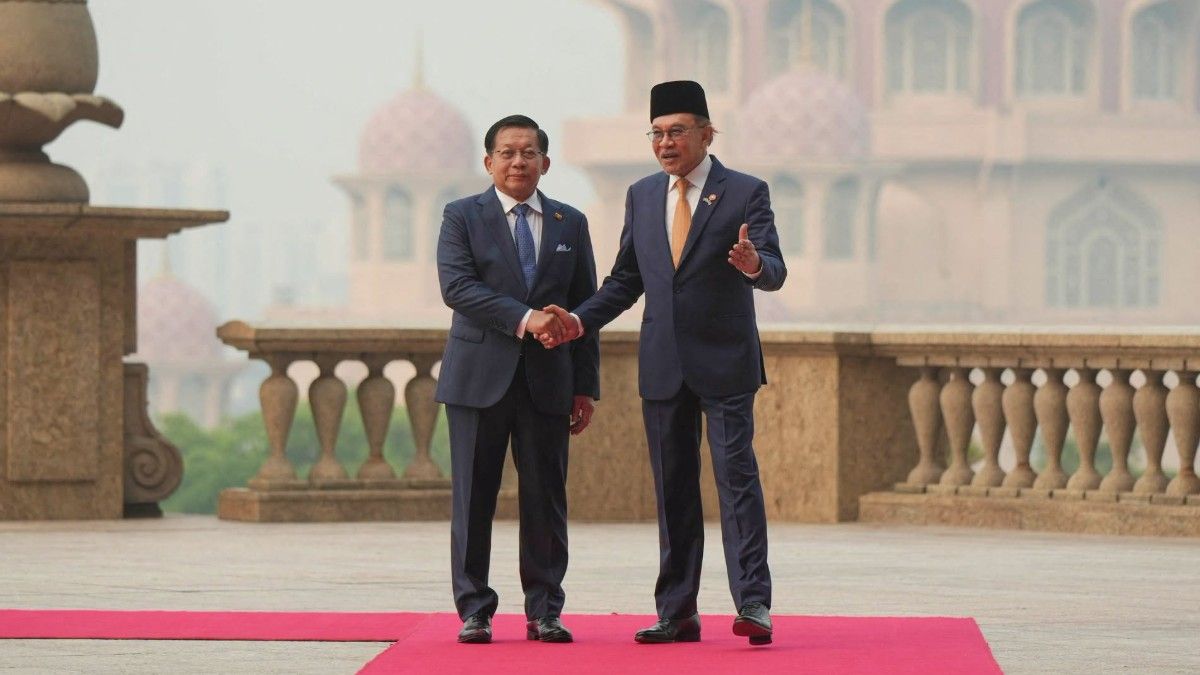
During his visit, Min met Malaysian Prime Minister Anwar Ibrahim.
Both leaders agreed to advance cooperation in areas including education, energy and healthcare, although no agreements were signed.
The Malaysian government said the visit provided Anwar with an opportunity to maintain direct engagement with Myanmar.
“The visit provides the prime minister with an opportunity to sustain his direct engagement with Myanmar,” the government said in a statement.
Human rights groups condemn official reception
ASEAN Parliamentarians for Human Rights (APHR) condemned Malaysia’s decision to host Min, arguing that a formal reception could signal acceptance of the 2021 military coup and the violence that followed.
APHR chairperson Mercy Chriesty Barends said the welcome sent a damaging message to people suffering under military rule.
“Every red carpet rolled out for him tells the people of Myanmar, who live under airstrikes and forced conscription, that the region has made its peace with what is being done to them,” she said.
On 8 October, members of the Myanmar diaspora and international pro-democracy supporters gathered at the Selangor Chinese Assembly Hall in Kuala Lumpur to protest against the visit.
Swam Saung, of the Myanmar Affairs Alliance, said supporters of democracy did not want regional governments to help Min strengthen his international standing.
“We do not want to see ASEAN nations help him gain his legitimacy,” Saung said.
Human Rights Watch (HRW) also criticised the visit, describing it as “an invitation for further abuse” in Myanmar.
Elaine Pearson, HRW’s Asia director, urged Anwar’s government to use its diplomatic engagement to press Myanmar’s military-backed authorities to stop abuses.
She also called on Malaysia to halt further returns of Myanmar nationals and urged other governments to expand resettlement opportunities and support for countries hosting refugees.
“Concerned governments should press Malaysia to halt the returns, and expand resettlement places and support for countries hosting refugees from Myanmar,” Pearson said.
She warned that repatriation arrangements made with Myanmar’s military-backed authorities should not be treated as evidence that the country was safe.
Repatriation plans raise safety concerns
The visit comes as Malaysia advances a policy to return thousands of Myanmar nationals, a move that has prompted concerns from the United Nations and human rights organisations.
Anwar has defended the policy as part of a diplomatic effort to find a longer-term solution to the refugee situation. He has argued that Malaysia cannot host refugees indefinitely and that Myanmar must take responsibility for its citizens.
According to APHR, Anwar extended the invitation to Min in return for Myanmar accepting nationals sent back from Malaysia.
Malaysia returned 1,476 Myanmar nationals on 29 September and plans to repatriate another 3,524. The government has said approximately 5,000 Myanmar nationals have agreed to return in stages.
However, the returns have drawn criticism because an airstrike in Kyauktaw, near Myanmar’s Rakhine State, reportedly killed at least 49 civilians shortly before the first group was sent back.
The attack also injured 58 people, many of them women and children, according to the information cited in reports on the incident.
The United Nations High Commissioner for Refugees (UNHCR) was not involved in the repatriation process. The agency has said conditions are not conducive to safe returns.
APHR argues that the repatriations breach the principle of non-refoulement, which prohibits returning people to places where they face a serious risk of persecution or other grave harm.
On 6 October, Anwar told Parliament that no Rohingya refugee was among those deported.
Malaysia’s Home Ministry reported that 11,804 Myanmar nationals were being held at immigration detention depots across the country as of the end of August.
Refugee protection and domestic pressures
Malaysia hosts approximately 215,600 refugees and asylum seekers registered with UNHCR, including about 126,000 Rohingya, a predominantly Muslim ethnic community from Myanmar.
Despite hosting a large refugee population, Malaysia is not a party to the UN Refugee Convention. Its authorities generally treat refugees as undocumented migrants rather than providing them with a formal refugee status under domestic law.
Rohingya refugees have faced growing public hostility in Malaysia, amid concerns about employment, public services and security.
An online campaign targeting the community has reportedly used artificial intelligence, fake accounts and bots to amplify hostile narratives.
The controversy marks a significant change in Malaysia’s longstanding approach to protecting Rohingya refugees, many of whom fled a military crackdown in Myanmar’s Rakhine State in 2017.
That campaign forced hundreds of thousands of Rohingya to flee to neighbouring Bangladesh. The community has also faced longstanding restrictions, including the loss of citizenship under Myanmar’s discriminatory policies.
Malaysia was previously among the strongest regional critics of the military’s treatment of the Rohingya.
Critics question Myanmar’s ability to guarantee safe returns
Nyein Chan Aye, a Burmese journalist based in Washington, DC, argued in an opinion article published by The Irrawaddy that Malaysia should not assume Min can resolve a refugee crisis linked to the military’s actions.
He acknowledged that Malaysia has carried a substantial refugee burden and that diplomatic engagement is not inherently wrong. However, he questioned whether the authorities responsible for creating the crisis could guarantee the safety of those returning.
“The problem is pretending that the military dictator can solve Myanmar’s refugee crisis when he is its principal architect,” he wrote.
Nyein also argued that Min could not guarantee safety in areas beyond his government’s control, pointing to the Arakan Army’s control of much of Rakhine State.
He drew comparisons with Myanmar’s admission to the Association of Southeast Asian Nations (ASEAN) in 1997, warning that renewed engagement could repeat earlier mistakes.
The National Unity Government of Myanmar, through the Steering Council for the Emergence of a Federal Democratic Union, also urged Malaysia not to confer state-level legitimacy on Min and his administration.
Wider regional implications
Myanmar has been in turmoil since Min led the military coup in 2021, which triggered a nationwide conflict that has killed an estimated 100,000 people and displaced more than 3.5 million, according to figures cited in the supplied material.
ASEAN has excluded Min and other senior military-backed officials from its summits since 2021 because of the failure to implement the bloc’s peace roadmap.
However, individual countries have continued to pursue bilateral engagement. Since becoming president, Min has visited Thailand, Laos, Cambodia and Vietnam, as well as China, India, Russia and Belarus.
Min was received with a guard of honour when he arrived at Kuala Lumpur International Airport on Wednesday afternoon.
Malaysia’s Trade Minister Johari Abdul Ghani greeted him, according to state news agency Bernama.
The International Criminal Court’s prosecutor requested an arrest warrant against Min in 2024 over alleged crimes against humanity.