Oil prices surge past US$100 a barrel as Houthi attacks widen Middle East conflict
Brent crude climbed back above US$100 after Houthi attacks on Saudi tankers in the Red Sea, while Donald Trump said he was weighing "a massive attack" on Iran and equity markets fell sharply.
- Brent crude passed US$100 a barrel after Houthi attacks on two Saudi oil tankers.
- Donald Trump said he was considering "a massive attack" on Iran, bigger than before.
- Wall Street fell as Alphabet dropped 6.9 per cent and Tesla sank 14.5 per cent.

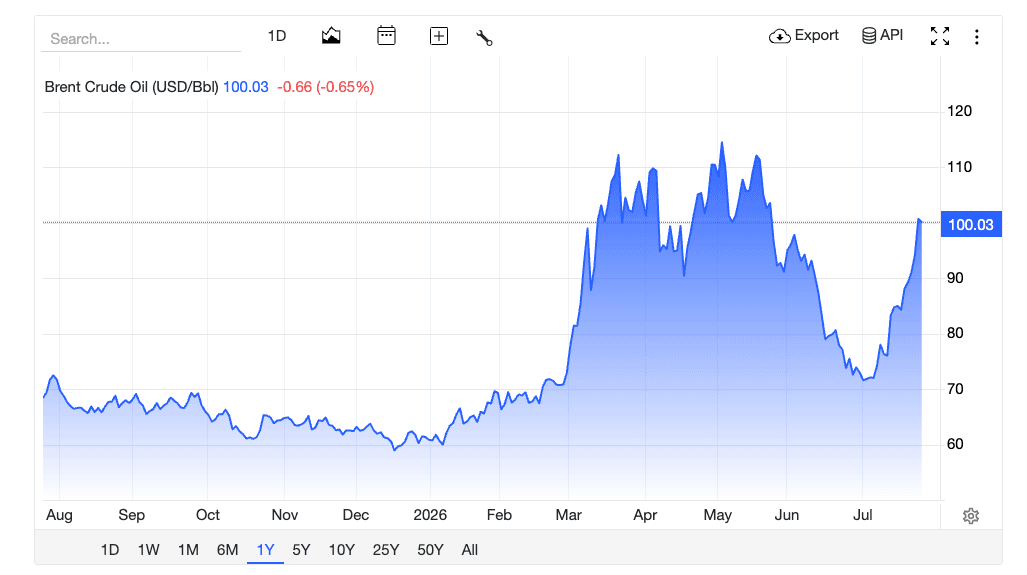
Oil prices surged past US$100 a barrel on Thursday, 23 July 2026, after Iran-backed Houthi rebels attacked shipping in the Red Sea and US President Donald Trump threatened to strike them in return, sending equity markets sharply lower.
Brent North Sea crude, the international benchmark, rose more than six per cent to clear the symbolic US$100 level. One report put the gain at seven per cent. The attacks potentially opened a new front in the Middle East war.
Trump threatened the Houthis with "major military punishment". Iran, in turn, vowed to continue striking the Gulf region for as long as it remains under attack from United States strikes.
Trump weighs a larger strike
Speaking to the Axios news site, Trump said he was close to deciding whether to launch a far larger assault on Iran than anything seen during the months-long conflict with Tehran.
"I am considering a massive attack. Bigger than ever before. I am close to making a decision. We are all set for it," he said.
He acknowledged such a decision would carry consequences but said no final determination had been made. Israel "would join in two minutes if I ask them to", he added, before saying: "We don't need anybody."
In a separate development, Trump clarified that an announced agreement for the United States to assist Saudi Arabia with its civilian nuclear programme would require the kingdom to normalise relations with Israel through the Abraham Accords.
Riyadh has long resisted normalisation in the absence of demonstrable movement on Palestinian rights and statehood. It later emerged that Trump had not spoken to Saudi Arabia about the new condition.
A second maritime route under threat
The Houthi attacks targeted two Saudi Arabian oil tankers and threatened the safety of a second major maritime route linking the Suez Canal to the Red Sea and the Gulf of Aden.
Saudi Arabia had been using the Red Sea to export millions of barrels of oil that would normally flow through the Strait of Hormuz. Closure of the channel would remove further supply from the market.
Ships began turning back from the narrow Bab el-Mandeb strait this week after the Houthis announced a blockade of Saudi ports, most notably the Red Sea port of Yanbu, which Riyadh has used to ship oil to Asia.
Reuters reported on Thursday, quoting four sources including two Iranians, that Iran had transferred Islamic Revolutionary Guard Corps personnel and military-related equipment on a flight from Tehran to Yemen on 13 July 2026.
The transfer came as Tehran was calling on the Houthis to blockade the Bab el-Mandeb strait.
Andy Lipow of Lipow Oil Associates said the disruption compounded an already strained market. "If Saudi Arabia is unable to move the additional quantities of crude oil that they redirected already from the Persian Gulf, it means that supply disruption is that much worse for the rest of the world at a time that we continue to draw down our commercial inventories," he said.
Warnings from the United Nations
United Nations Secretary-General António Guterres told the Security Council that the Middle East was being pushed towards the "edge of the unimaginable".
"The situation is getting out of control. It is teetering on the edge of the unimaginable. The region is being pulled into an ever-widening circle of confrontation. One crisis feeds another. One escalation triggers the next," he said.
"As this dynamic spreads, the political objectives are becoming increasingly obscured by the confrontation itself," he added.
The United Kingdom announced on Wednesday, 22 July 2026, that it was temporarily withdrawing diplomatic staff from Iran. The German military said on Thursday it would withdraw two vessels from the Red Sea.
Israeli cities opened bomb shelters, while the United States State Department warned Americans living in the region that flights might be cancelled.
Markets slump as tech earnings disappoint
Wall Street's main indices fell, with the technology-heavy Nasdaq Composite down more than two per cent in late morning trading. All of the so-called Magnificent Seven technology stocks declined.
Alphabet, the parent company of Google, finished down 6.9 per cent. Tesla sank 14.5 per cent. Both came under scrutiny over large capital spending drives.
Investors took fright after Alphabet raised its artificial intelligence capital expenditure estimate for the full year to as much as US$205 billion, far more than expected, and moved to negative cash flow during the quarter.
"The ability of Alphabet and its peers to generate mountains of cash was a key plank of the market rally, and now that plank is at risk of disappearing," said Chris Beauchamp, chief market analyst at the online trading platform IG.
"It feels like a watershed moment in the AI spending boom," he added, warning that during the summer, when trading volume is lower, swings in share prices "could get very ugly, very quickly".
Patrick O'Hare, an analyst at Briefing.com, said the declines were unsurprising "given what is going on with Alphabet, Tesla and the mega-cap stocks, oil prices and bond yields".
Art Hogan of B Riley Wealth Management pointed to seasonal weakness. "The calendar is not great," he said, adding that "the tensions with Iran are getting worse, not better".
Results next week from Microsoft, Meta and Amazon will be examined closely for their capital spending plans. All three finished sharply lower on Thursday.
Energy was among the sectors that advanced. Defence also performed strongly, with RTX gaining 7.3 per cent and Lockheed Martin surging 10.5 per cent after both reported results reflecting heavy Pentagon spending during the United States-Iran war.
Rates, bonds and currencies
Susannah Streeter, chief investment strategist at Wealth Club, said investors were "in a wary mood... as fresh jitters of worry about the ongoing energy crunch hit sentiment".
"With both the Strait of Hormuz and the Red Sea now under increasing pressure, markets are bracing for the possibility that the conflict could disrupt key energy routes (and) keep oil prices elevated," she added.
Analysts said higher oil prices raised the prospect of higher inflation and interest rate increases. Sovereign bond yields also rose, placing pressure on government spending worldwide.
European Central Bank President Christine Lagarde said reports of the Houthi attacks were "alarming" but had come too late to factor into the bank's decision on Thursday to hold interest rates steady. She indicated some policymakers had considered an increase before all voted to hold.
The situation in the Red Sea "is clearly going to have an impact and is having an impact", she said. "We can see that on the price of Brent as it evolves almost by the hour."
The dollar firmed against its main rivals, supported by the high oil price, as buyers holding other currencies must purchase more dollars to buy crude.
Most Asian markets were buoyed by a bounce in regional technology firms. European markets finished lower.
Attention has turned to Tokyo, where the yen hit a fresh four-decade low against the dollar amid concern over the gap between the Bank of Japan's low interest rates and those in the United States and other large economies. Rising oil prices and worries over Japan's economy have added to pressure on the currency.