Indonesia advances renewable electricity exports to Singapore amid domestic power debate
Indonesia and Singapore have advanced plans for cross-border renewable electricity trade after Danantara signed agreements with Keppel and Sembcorp, although pricing negotiations continue and recent domestic blackouts have fuelled public debate.
- Danantara signed agreements with Keppel and Sembcorp to advance renewable electricity exports to Singapore.
- A proposed 3.4GW renewable energy project is planned for Batam, Bintan and Karimun.
- Recent domestic blackouts have prompted public debate over Indonesia's export ambitions.

Indonesia has moved a step closer to exporting renewable electricity to Singapore after state investment fund Danantara signed agreements with Singapore energy companies Keppel and Sembcorp, marking a significant development in a project that has been under discussion for more than four years.
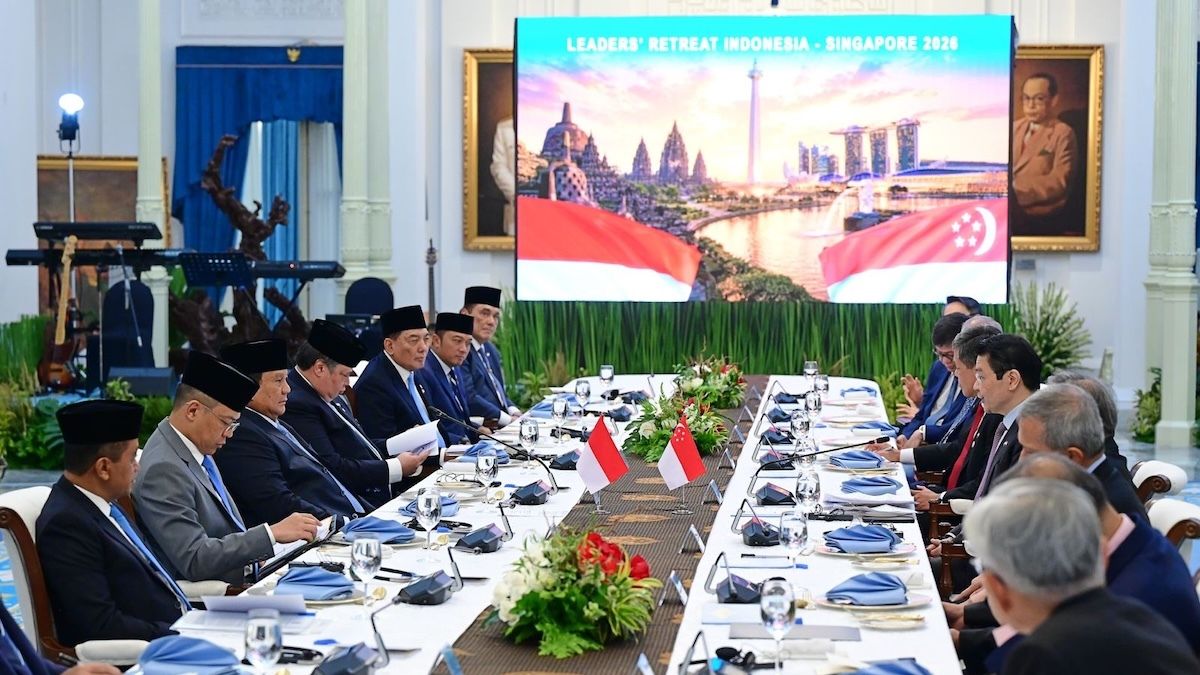
The initiative was among 26 agreements announced during Singapore Prime Minister Lawrence Wong’s visit to Jakarta on Monday (6 July), reflecting expanding bilateral cooperation in areas ranging from energy and investment to digital infrastructure and environmental initiatives.
Indonesian Investment and Downstreaming Minister Rosan Perkasa Roeslani, who also serves as chief executive of Danantara, said the project would involve the construction of new renewable energy facilities in Indonesia to supply electricity to Singapore over the long term.
“This is a long-term project and we will ensure that it delivers mutually beneficial outcomes for both countries,” Rosan told reporters after accompanying President Prabowo Subianto during talks with Wong at Merdeka Palace.
The memorandums of understanding were signed between Danantara and Singapore-based companies Keppel and Sembcorp, both linked to Temasek Holdings. They form part of a broader roadmap agreed by Indonesia and Singapore to accelerate cross-border electricity trade.
Renewable energy facilities planned in Batam, Bintan and Karimun
According to Rosan, the electricity exported to Singapore will come from new renewable energy power plants to be developed in Indonesia.
The projects are expected to be located in the Batam, Bintan and Karimun (BBK) region of the Riau Islands, an area that Indonesian authorities are positioning as a future green energy and industrial hub.
The planned facilities will have a combined capacity of 3.4 gigawatts (GW), with the first phase expected to deliver between 600 megawatts and 1.2GW.
“One of the locations will be there [Batam]. The project will also support the development of the BBK area — Batam, Bintan and Karimun,” Rosan said.
He added that Keppel and Sembcorp are expected to act as off-takers, purchasing the electricity generated by the Indonesian facilities.
In addition to power generation infrastructure, the project will require transmission links capable of delivering electricity from Indonesia to Singapore.
Rosan emphasised that the electricity intended for export would be generated entirely from renewable sources.
“This project is entirely focused on renewable energy,” he said.
Pricing negotiations continue
While agreements on project development have been signed, Indonesia and Singapore have yet to finalise electricity pricing arrangements.
Indonesian Energy and Mineral Resources Minister Bahlil Lahadalia said negotiations were continuing and remained the final major issue before implementation.
The discussions build on three energy cooperation agreements signed by both countries last year covering renewable electricity exports, green industrial estates and carbon capture and storage (CCS).
“Last year we signed three MoUs. The first concerns green electricity exports to Singapore, the second the development of green industrial estates, and the third carbon capture and storage. These three agreements form a single integrated package that we signed last year,” Bahlil said.
He said Indonesia was seeking a pricing formula that would provide balanced economic benefits to both countries.
“The process is progressing, but we are still negotiating the electricity price. Under our regulations, pricing authority rests with the government. We want a mutually beneficial arrangement,” he said.
Domestic blackouts spark public debate
The announcement has attracted considerable attention in Indonesia, coming just weeks after a series of power outages affected parts of the country.
In June, blackouts were reported in Sumatra, parts of Kalimantan, Central Java, East Java and sections of the Greater Jakarta area. Residents in parts of West Java also experienced rolling outages lasting several weeks, with some interruptions reportedly exceeding five hours.
Separately, Indonesia's National Police Anti-Corruption Directorate announced on Monday that it had launched a formal investigation into alleged corruption and money laundering linked to coal procurement and supply for several coal-fired power plants between 2018 and 2026.
Investigators said suspected irregularities in coal procurement and distribution may have disrupted fuel supplies to a number of power stations and contributed to widespread blackouts.
Authorities estimate potential state financial and economic losses at approximately Rp5 trillion (S$400 million).
However, Energy Minister Bahlil previously stated that the outages were not caused by a nationwide shortage of coal supplies, saying Indonesia's overall coal availability for power generation remained adequate.
According to Bahlil, the disruptions were linked to operational and maintenance issues as well as shortages of specific grades of coal required by some generating units.
Netizens question export plans
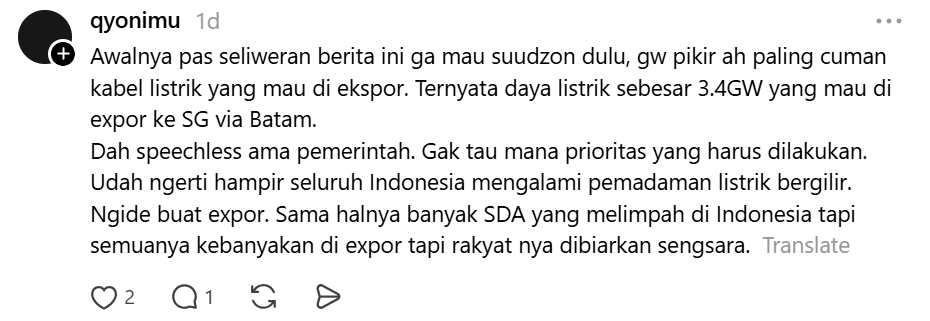
The electricity export proposal has also triggered debate on Indonesian social media platforms, particularly Threads, where many users questioned the timing of the initiative amid recent domestic power disruptions.
One user wrote: “Export electricity? There are still so many places from Sabang to Merauke that remain in the dark.”

Another user questioned why electricity exports were being pursued while parts of Indonesia had recently experienced rolling blackouts.
“Exports are usually done when there is excess supply, but here we are with rolling blackouts across Indonesia,” the user wrote.

A third user said the reported 3.4GW export capacity was difficult to reconcile with recent power interruptions affecting large parts of the country.
“Almost the entire country has experienced rolling blackouts, yet they are talking about exports,” the post said.
Others raised concerns about governance and project oversight.
A user argued that large-scale infrastructure projects linked to electricity exports could create opportunities for corruption, reflecting wider public scepticism that often accompanies major state-backed projects in Indonesia.

The comments reflect a broader public discussion in Indonesia over how the country should balance domestic energy needs, industrial development and export ambitions as it seeks to position itself as a regional renewable energy supplier.
Part of broader Singapore-Indonesia cooperation
The electricity export initiative was one of 26 agreements announced during Wong’s visit to Jakarta.
The agreements included cooperation on carbon credits under Article 6 of the Paris Agreement, digital infrastructure development, financial technology, environmental protection, research and innovation, youth programmes and investment partnerships in renewable energy projects.
According to Indonesian officials, 18 of the agreements were government-to-government arrangements while eight involved business-to-business partnerships.
If implemented, the renewable electricity export project would become one of the most significant energy links between Singapore and Indonesia, with the planned 3.4GW capacity representing a major addition to regional clean energy connectivity.