Albanian opposition sets off flares in parliament as anti-government protests intensify
Albanian opposition lawmakers disrupted a parliamentary vote with flares and smoke bombs as student-led protests over corruption, education and economic conditions intensified, with demonstrators demanding Prime Minister Edi Rama’s resignation.
- Opposition lawmakers disrupted a parliamentary vote with flares, smoke bombs and protests against Prime Minister Edi Rama.
- Student-led demonstrations have expanded into a wider movement over alleged corruption, education funding, unemployment and economic hardship.
- Rama has accused foreign actors of exploiting the unrest, while the government has introduced fines for participation in violent demonstrations.

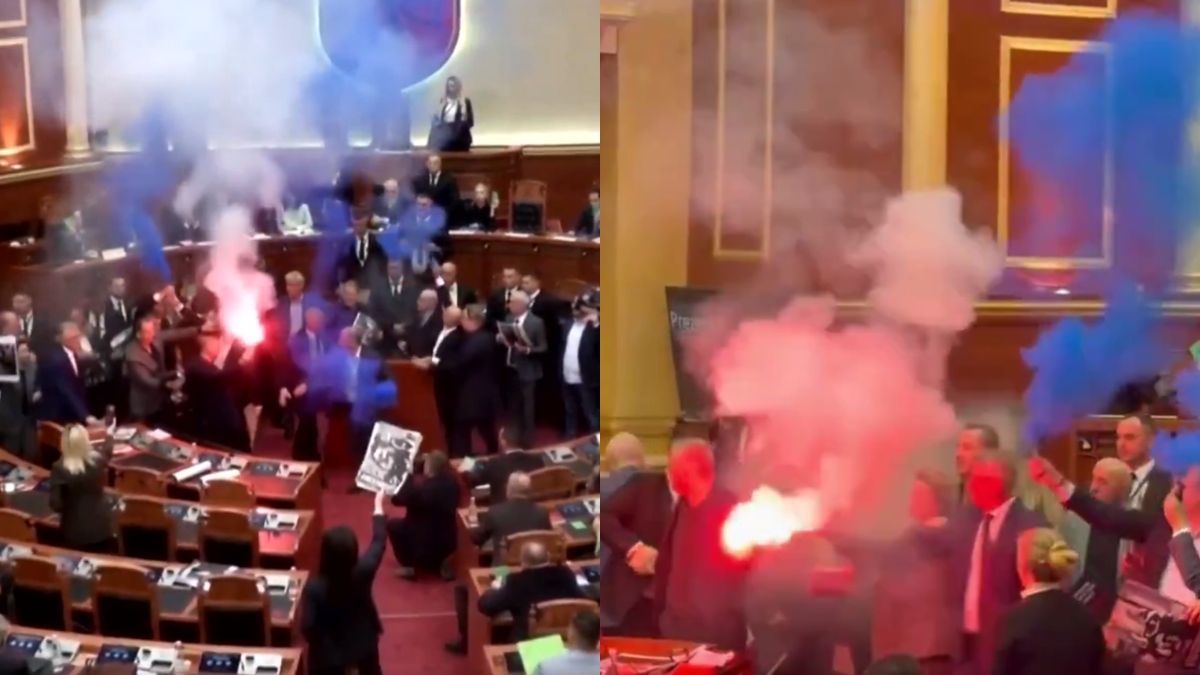
Albanian opposition lawmakers set off flares and smoke bombs inside parliament on Thursday, 29 October 2026, disrupting a vote attended by Prime Minister Edi Rama as anti-government protests over corruption, education and economic conditions continued to intensify.
Members of the main opposition Democratic Party blocked access to the podium during a vote on a central bank bill. Lawmakers banged on desks, threw objects including water bottles towards the prime minister and gathered near the podium holding photographs of protesters allegedly injured by police.
Blue flares, the Democratic Party’s official colour, filled the chamber with coloured smoke as opposition lawmakers displayed images of demonstrators injured by police rubber bullets.
“Rama resign!” opposition lawmakers chanted.
Opposition leader Sali Berisha also criticised the government during a speech before his microphone was cut off.
“These ruling lawmakers are criminals, and they deserve tear gas, rubber bullets, cracked skulls, and broken bones—not the young people,” Berisha said.
The confrontation followed similar scenes in parliament the previous week, when opposition lawmakers attempted to disrupt a vote and a scuffle broke out. Flares have also been set off inside the chamber on previous occasions.
Student demonstrations expand beyond education demands
The parliamentary disruption came amid weeks of student-led demonstrations in the capital, Tirana, calling for greater government support for education and Rama’s resignation.
The protests began on 13 October and have drawn attention to alleged government corruption, underfunded schools, unemployment and a lack of economic opportunities.
High school and university students have demanded lower tuition fees, greater state investment in education and action against corruption in the education system. Their demonstrations have become part of a broader movement challenging Rama’s government.
The unrest has also spread to other cities across Albania. Demonstrators have clashed with police, while government buildings and the ruling Socialist Party’s headquarters in Tirana have been targeted.
Police have used tear gas, water cannons and batons to disperse protesters, who have thrown rocks, flares, firebombs and fireworks during confrontations.
More than 350 people, including numerous police officers, have been injured in clashes between protesters and security forces. Dozens of demonstrators have also been detained.
Protests trace back to controversial coastal development
The latest wave of unrest follows months of demonstrations against a controversial luxury tourism development on Albania’s southern coast linked to an investment firm founded by Jared Kushner, the son-in-law of US President Donald Trump.
The project prompted largely peaceful demonstrations over the summer, with protesters organising under the so-called Flamingo movement. The campaign has since broadened into a wider anti-corruption movement.
Demonstrators have sought to distance themselves from established political parties, carrying signs accusing both Rama and Berisha of corruption.
The protests have also reflected wider public concerns about the cost of living, housing, public services and future economic opportunities.
Albania is among several European countries experiencing demonstrations over economic pressures and declining public services. The Associated Press, cited by The Washington Post, has reported protests over fuel costs, school conditions and housing affordability in countries including France, Italy, Spain and Portugal.
In Spain and Portugal, tent camps have emerged as part of protests over unaffordable housing, while rallies and demonstrations have also been planned in Greece.
Rama accuses foreign actors of exploiting unrest
Rama has rejected attempts to use the demonstrations to force a change of government, arguing that legitimate public concerns are being exploited by people deliberately provoking violence.
After a meeting with teachers and representatives of Tirana’s schools on Tuesday, he described the unrest as an attempt to overthrow the government through violence.
“A wave of stones, an attempt to overthrow the government and change those in power through the imposition of violence — something that will never be allowed to happen, in any form or for any reason,” Rama said.
He also described the unrest as a “hybrid war”, arguing that it drew strength from genuine public grievances.
“This is a hybrid war that naturally works to the extent that it does because it is based on real concerns, not fantasies. Concerns about the cost of living are certainly real. Concerns about a secure future, housing, and greater opportunities to get ahead are also real,” he said.
Rama accused protesters of “hold(ing) the city under a climate of terror” and said students involved in the demonstrations “belong to emerging currents of political extremism”.
He has also blamed foreign actors for the unrest, saying outside forces do not want Albania to join the European Union. He has separately accused Russia and Iran of spreading misinformation online and attempting to manipulate the movement.
Government introduces fines for violent demonstrations
The government has introduced fines of up to 500,000 Albanian leks, equivalent to about 5,500 euros or $6,000, for people participating in demonstrations that turn violent, even if they do not personally engage in violence.
The penalty is substantial compared with Albania’s average monthly pre-tax salary of 930 euros.
The measures are intended to curb violence during demonstrations, although the protests have continued amid confrontations between demonstrators and police.
Rama has governed Albania since 2013 and secured a fourth term in office last year. What began as opposition to a controversial coastal development has evolved into a broader challenge to his government, with demonstrators demanding action against corruption and his resignation.
A further demonstration was scheduled for Saturday.