Indonesia responds to Greenpeace protests with fire funding and economic stimulus
Indonesia has pledged additional funding for forest-fire response and announced a Rp26.34 trillion (about US$1.46 billion) stimulus package following Greenpeace protests over the climate crisis and rising living costs.
- Indonesia allocated Rp760 billion for fire response across seven provinces and 35 regencies and cities.
- A Rp26.34 trillion stimulus package includes rice assistance, stable fuel prices and additional rice supplies.
- The government proposed tougher penalties for deliberate burning but did not declare the fires a national disaster.

Indonesia’s government has pledged additional funding for forest-fire response and announced a Rp26.34 trillion (about US$1.46 billion) economic stimulus package after Greenpeace activists protested against the government’s handling of the climate crisis and rising living costs.
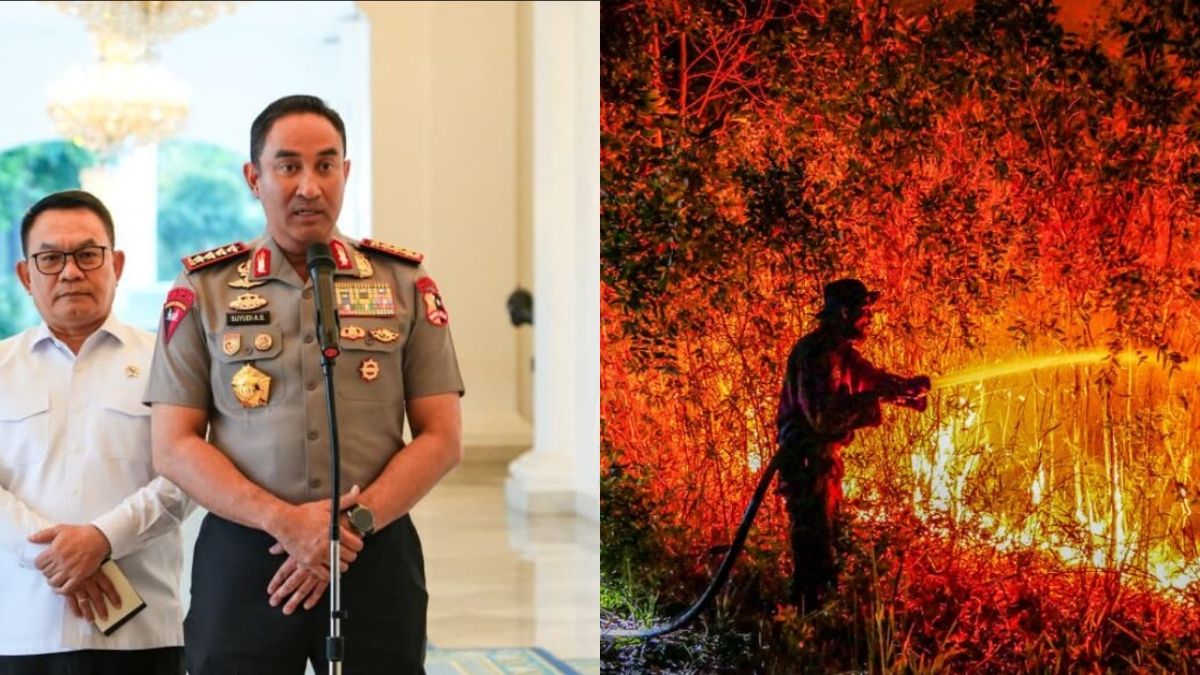
Syahganda Nainggolan, head of the Government Communication Agency (Bakom), said on 20 October that President Prabowo Subianto shared the protesters’ concerns and that the government respected their right to freedom of expression.
“The government respects Greenpeace Indonesia’s protest this morning as a form of freedom of expression. The effects of the climate crisis and rising living costs are also among the president’s concerns,” Syahganda said in a statement reported by Indonesia’s national news agency ANTARA.
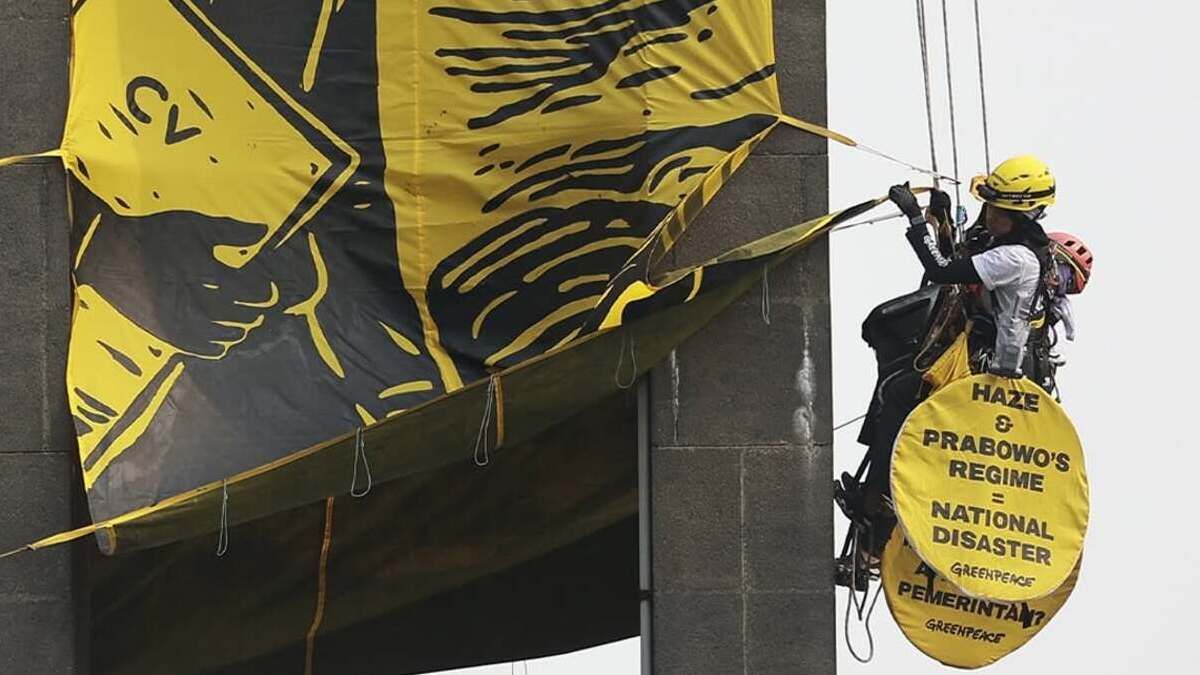
The statement came as Greenpeace Indonesia activists unfurled two large banners from the Welcome Statue at Bundaran HI in central Jakarta on 20 October, the second anniversary of Prabowo and Vice-President Gibran Rakabuming Raka taking office.
One banner read, “Take Action on the Climate Crisis, Bring Down the Cost of Living”, while another asked, “Disasters Are Getting Worse, the People Are Struggling, What Is the Government Doing?”
The protest came amid ongoing forest and land fires in Indonesia that have contributed to haze across Southeast Asia. It also highlighted concerns about the cost of basic necessities and the effects of environmental damage on people’s livelihoods.
In response, Bakom outlined the government’s existing measures to tackle forest fires, strengthen enforcement against those responsible for burning, support household purchasing power and stabilise food prices.
Government allocates Rp760 billion to fire-affected regions
Syahganda said the government was strengthening efforts to tackle forest and land fires, known in Indonesia as karhutla, with Prabowo directly leading the response.
According to Bakom, the President had directed an additional Rp760 billion (about US$42.2 million) in unexpected expenditure funding for seven affected provinces and 35 regencies and cities.
The funding is intended to support regional authorities responding to the fires, which have damaged land and forests and contributed to the haze affecting communities in Indonesia and neighbouring countries.
The government also said it was pursuing tougher law enforcement against those responsible for deliberately setting fires.
Syahganda said Prabowo had called for heavier penalties, with the President directing that forest and land burning should be considered for classification as “ecological terrorism”.
The statement did not provide details of proposed legislative changes, identify specific suspects or set out a timetable for implementing the tougher penalties.
The funding and enforcement measures form the government’s stated response to the environmental concerns raised by Greenpeace. However, the announcement did not include a declaration that the ongoing fires constituted a national disaster, one of the demands raised by protesters.
Rp26.34 trillion stimulus package targets living costs
The government also highlighted measures intended to ease pressure on household budgets amid global economic uncertainty and fluctuations in the prices of essential goods.
Bakom said the government had prepared a Rp26.34 trillion economic stimulus package (about US$1.46 billion) for the second half of 2026.
The package includes the following measures:
-
Rice assistance: Distribution of 10kg of rice to 33.24 million beneficiaries to help households meet their food needs.
-
Fuel prices: A commitment to keep fuel prices unchanged through the end of 2026.
-
Food-price stabilisation: An additional one million tonnes of rice through the Food Supply and Price Stabilisation programme, known as SPHP, to help contain price fluctuations.
Syahganda said the measures were intended to maintain purchasing power and provide greater certainty for households facing pressure from essential expenses.
The government said the additional rice supply would help stabilise food prices, while the fuel-price commitment was intended to reduce uncertainty over transport and other household costs.
Bakom presented the economic measures alongside its forest-fire response as evidence that the government was addressing both issues raised by Greenpeace: the climate crisis and the cost of living.
The announcement did not provide a breakdown of how the Rp26.34 trillion stimulus would be distributed among the individual measures.
Government invites Greenpeace to submit recommendations
Syahganda said the government recognised that addressing the climate crisis and protecting household purchasing power required sustained action.
He invited Greenpeace Indonesia to submit data and recommendations to the relevant ministries so that they could be considered in future policy evaluations.
“Our work to address these issues is not yet finished. We encourage Greenpeace to submit its data and recommendations to the relevant ministries as input for further improvements,” he said, according to ANTARA.
The response acknowledged the protesters’ concerns but did not announce a new policy specifically arising from the demonstration. Instead, Bakom pointed to existing funding, law-enforcement directives and economic support measures.
Greenpeace said its protest was intended to urge the Prabowo-Gibran administration to take the climate crisis more seriously as its effects increasingly threaten public health, livelihoods and household finances.
In a statement published on 20 October, the organisation also highlighted research into how climate-related impacts affect workers and low- and middle-income households.
Jakarta governor backs freedom of expression while urging public order
Jakarta Governor Pramono Anung also responded to the Greenpeace demonstration, saying the activists had the right to express their concerns in a democratic country.
Pramono said he respected the activists’ aspirations but stressed that demonstrations should not disrupt public order or compromise safety.
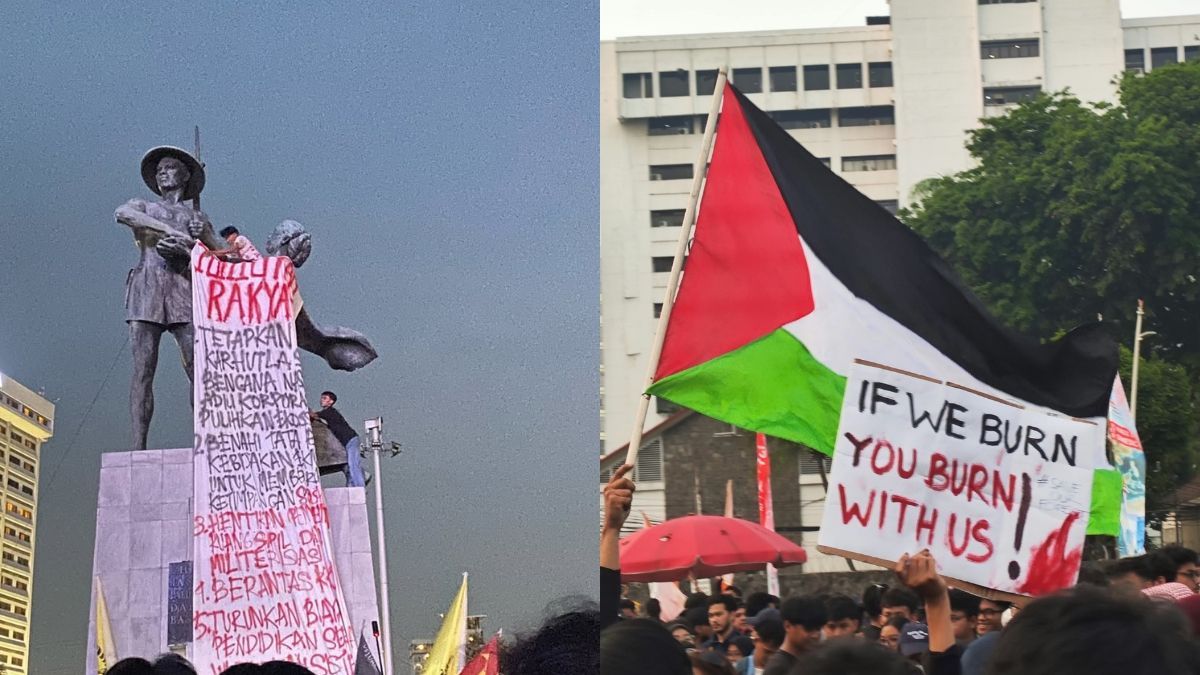
Police and firefighters removed the banners from the Welcome Statue at around 8am. The demonstration coincided with student-led protests elsewhere in Jakarta, where participants also raised concerns about environmental damage, government accountability and the cost of living.
Pramono’s response focused on the right to protest and the need to maintain public order, while Bakom’s statement set out the national government’s funding and economic measures.
Singapore welcomes Prabowo’s response but demands accountability
Indonesia’s response is being watched by neighbouring countries affected by smoke from fires across Sumatra and Kalimantan.
Singapore Senior Minister K. Shanmugam said on 19 October that Singapore appreciated Prabowo’s efforts to address the haze, including measures to strengthen fire prevention and cooperation with neighbouring countries.
At the same time, Singapore has stepped up enforcement under its Transboundary Haze Pollution Act.
The National Environment Agency announced on 19 October that it would issue preventive measure notices to three additional Indonesian companies whose concession areas in Kalimantan were associated with fires from which smoke could have travelled to Singapore. The action followed notices issued to seven companies on 16 October.
The notices require the companies to deploy firefighting personnel, stop burning activities and submit plans to extinguish fires and prevent them from recurring.
Singapore has said it will continue to use the legal powers available under its transboundary haze legislation against companies found responsible for pollution affecting the country.
Malaysia’s schools and communities affected by haze
Malaysia has also experienced deteriorating air quality as smoke from Indonesian fires spread across the region.
On 8 October, Malaysia’s Department of Environment reported unhealthy Air Pollutant Index readings in 38 areas of Peninsular Malaysia. Segamat in Johor recorded the highest reading at 190, followed by Seremban at 186 and Nilai at 185, both in Negeri Sembilan.
The department said regional monitoring had detected 210 hotspots in Sumatra and 94 in Kalimantan, with medium to thick transboundary haze affecting parts of southern Peninsular Malaysia.
Malaysia’s Education Ministry subsequently ordered schools in affected areas to close under its air-pollution response measures.
The disruption has added to pressure on Indonesia to contain the fires and improve cooperation with neighbouring countries.
Government response focuses on funding, enforcement and economic relief
In its response to Greenpeace, the Prabowo administration highlighted three main areas of action: additional funding for fire-affected regions, tougher penalties for those responsible for burning, and economic assistance intended to ease household expenses.
The government also acknowledged the protesters’ concerns and invited Greenpeace to submit evidence and recommendations to relevant ministries.
However, the statement did not announce a new deadline for ending the fires or a decision to declare them a national disaster.
The government’s next steps on firefighting, enforcement and economic support will determine how the measures outlined by Bakom are implemented as Indonesia continues to face pressure over the fires and their effects across Southeast Asia.