Ukraine carries out first reported battlefield evacuation of wounded soldier by drone
Ukrainian forces say they have evacuated a wounded soldier from a front-line position using a heavy-lift drone after nearly 500 days at the post. The mission highlights new battlefield rescue capabilities and the risks of aerial evacuation.
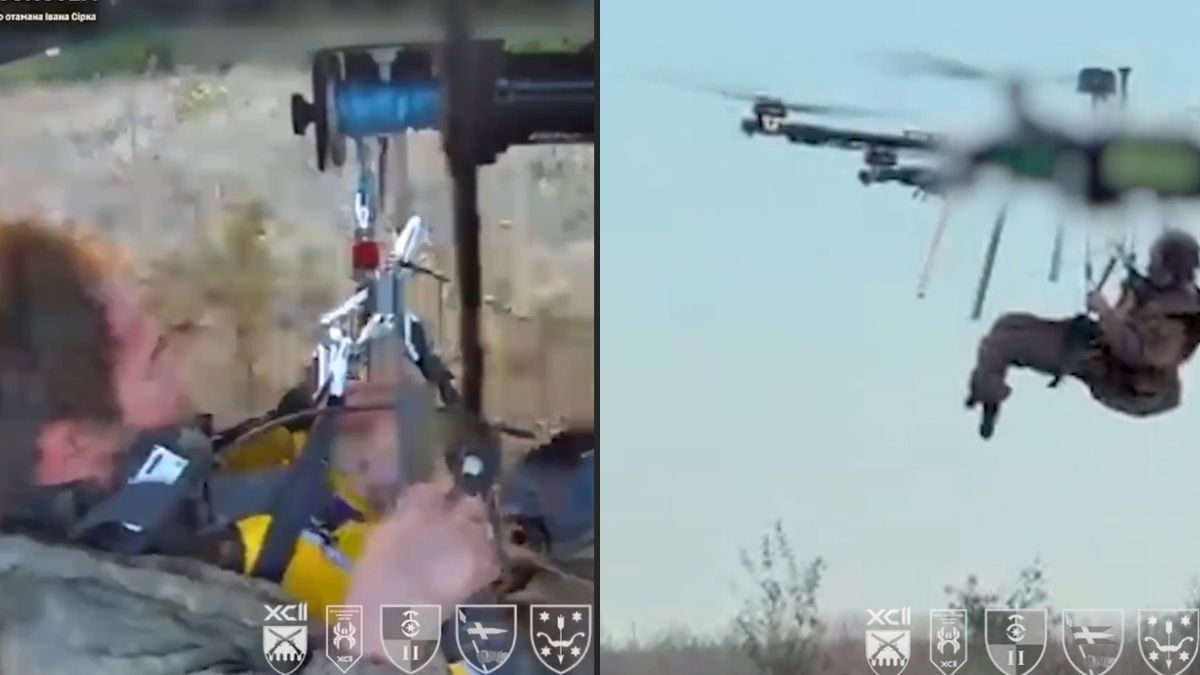
- Ukrainian forces used a heavy-lift drone to evacuate a wounded soldier after ground rescue attempts proved too dangerous.
- The mission covered 62 kilometres in one hour, 14 minutes and 36 seconds, according to Gurzuf Defence.
- Military officials described the operation as a first but cautioned that aerial evacuation remains risky and requires individual planning.

Ukrainian forces say they have evacuated a wounded infantryman from a front-line position using a heavy-lift drone, in an operation announced on Monday, 19 October 2026, that the military and the aircraft’s manufacturer described as the first of its kind.
The mission involved Ukraine’s 92nd Separate Assault Brigade, 30th Separate Mechanised Brigade and 10th Army Corps, alongside drone manufacturer Gurzuf Defence. The Ukrainian military did not disclose the date or exact location of the evacuation.
The soldier, who served with the 30th Separate Mechanised Brigade, had been stationed at the position for nearly 500 days under constant threat, according to Gurzuf Defence. His fellow soldiers maintained contact with him and delivered food, water, ammunition and medicine by drone.
After he suffered a severe injury, rescuing him by ground became impossible because of Russian drone activity and mined terrain. Attempts to reach him on foot or using unmanned ground vehicles would have exposed the rescue team to further danger.
The forces instead used the Heavy Shot Ayudag-6, a six-rotor drone designed by the Ukrainian company.
Rescue team adapted aircraft for aerial evacuation
According to the 92nd Brigade’s Unmanned Ground Systems Company, specialists worked closely with Gurzuf Defence to develop technical solutions that would allow the aircraft to carry a person while remaining stable in flight.
The team conducted preliminary tests at sites provided by the manufacturer and coordinated the mission with other military units. Gurzuf Defence supplied the drone free of charge, according to Ukrainska Pravda.
Before the aircraft arrived, the team delivered special equipment fitted with carabiners to the wounded soldier. The drone then approached with a winch, allowing him to attach himself to the evacuation system while remaining in contact with fellow soldiers who guided him remotely.
A drone operator from the 30th Brigade, identified by the callsign “Chornyi”, piloted the aircraft. He said he was “very pleased” that the operation had gone well, according to the 92nd Brigade’s account.
The drone transported the soldier to a safer position, where other troops met him and arranged his onward evacuation to hospital.
Gurzuf Defence said the mission lasted one hour, 14 minutes and 36 seconds, covering 62 kilometres (39 miles).
Soldier recovering as military describes operation as a first
The 30th Separate Mechanised Brigade said the soldier was receiving treatment and rehabilitation and that his life was no longer in danger.
The military and Gurzuf Defence described the mission as the world’s first evacuation of a wounded soldier from a battlefield using an aerial drone. That claim has not been independently verified.
A hospital in Kharkiv, identified the soldier as Kostiantyn, 49, and reported that the evacuation took place in the Kupiansk sector. The outlet said he had lost both legs and remained at his position after a fellow soldier was killed.
His unit had supplied him with food, water and medicine by drone while repeated evacuation attempts failed, according to the report. Before the rescue, the drone pilot recorded a video explaining how to attach himself to the evacuation equipment. The pilot reportedly said the aircraft’s onboard camera showed the soldier following the instructions and making a heart gesture with his fingers.
Kostiantyn faces rehabilitation and the fitting of prosthetic legs, according to the hospital account cited by Gwara Media.
A separate account quoting 10th Army Corps commander Artem Bohomolov said he could confirm that the operation was a first for Ukraine, but could not establish whether similar evacuations had been carried out elsewhere.
Military officials warn against routine use
“An extremely complex operation, but a successful one. This is a historic event,” said “Napalm”, a programmer from the 92nd Brigade who helped prepare the mission, according to the brigade’s account.
“It marks the next stage in the evacuation of the wounded, which we will all eventually reach. Now the serious, systematic work begins to ensure that such missions take place on a regular basis,” he added.
However, Gurzuf Defence co-founder Pavlo Feldblium cautioned against treating the successful mission as evidence that aerial evacuation could become routine.
He said the risks to wounded soldiers during flight remained high and that every mission would need to be planned individually according to the location and circumstances.
“Air rescue is a last resort when there is no other way to save a person,” Feldblium said.
Heavy drones have mainly carried supplies
The Heavy Shot Ayudag-6 platform has a stated flight range of up to 25 kilometres (15.5 miles) and an operational altitude of 150 to 300 metres (500 to 1,000 feet). The aircraft weighs about 98 kilograms (215 pounds) and can carry a payload of 70 to 90 kilograms (150 to 200 pounds).
Its name refers to its six motors and Mount Ayudag near Gurzuf, a resort town in Russian-occupied Crimea.
Heavy drones have primarily been used to deliver ammunition and other supplies to front-line positions.
Unmanned aircraft have also been used in previous casualty-evacuation demonstrations. Lockheed Martin announced a rescue demonstration using an unmanned K-MAX helicopter in 2015, while the US Army documented another demonstration involving a simulated casualty in 2016.