Pakistan remote-controlled car crashes into police vehicle after internet disruption during test
A remotely operated car crashed into a police vehicle at D-Chowk in Islamabad after an internet disruption caused its control system to malfunction, prompting a journalist inside the car to call for further safety testing.
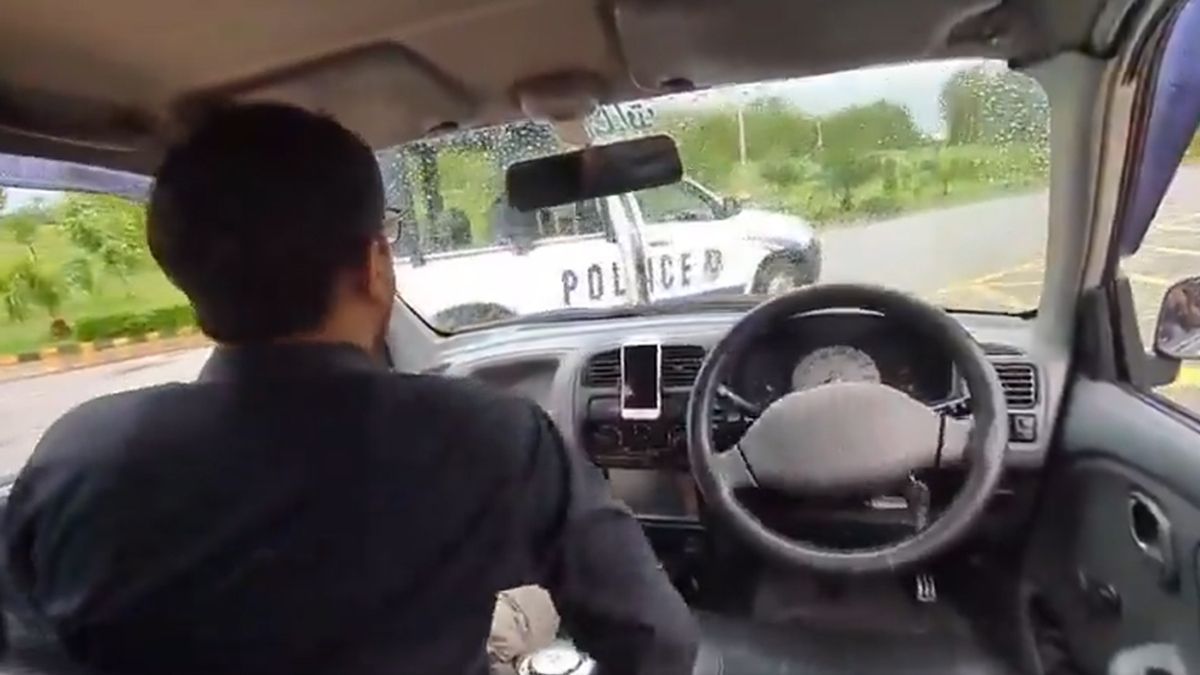
- A remotely operated car crashed into a police vehicle at D-Chowk after an internet disruption affected its control system.
- Journalist Muhammad Aalijah was inside the car and pulled the handbrake but could not prevent the collision.
- Aalijah called for further testing and safety measures before people ride in the vehicle during experiments.

A remotely operated car crashed into a police vehicle during a demonstration at D-Chowk in Pakistan's capital Islamabad after an internet disruption caused it to lose control, according to journalist Muhammad Aalijah, who was inside the car at the time.
The incident was recorded on video and shared by Aalijah on his official social media account, where the footage showed the experimental vehicle being operated remotely through satellite and internet connections.
How the crash happened
The video shows Aalijah seated in the front passenger seat as the car moves forward under remote control. Its steering wheel is operated by a person remotely, but the system suddenly malfunctions and the vehicle begins moving towards a police van parked beside the road.
Aalijah pulls the handbrake in an attempt to stop the car, but is unable to prevent it from hitting the police vehicle.
D-Chowk, where the incident took place, is described by Aalijah as a high-security area with very little traffic. He said the relatively quiet setting meant the incident did not occur amid heavy road traffic.
He warned that a similar loss of control in a busier location could have resulted in far more serious consequences.
“If the same situation had occurred on a busy road, the consequences could have been extremely dangerous, even fatal,” he said.
Technology demonstration goes wrong
Aalijah told Pakistani newspaper Dawn that he had been asked by technology enthusiast Ehsan Zafar, from Abbottabad, to report on Zafar's technology-based automated-driving innovation.
The vehicle was being controlled remotely over the internet, Aalijah said. The system functioned normally until the connection was disrupted.
“Everything was fine until a technical fault occurred due to an internet disruption, causing the car to go out of control and crash into a police vehicle,” he told Dawn.
In a social media post, Aalijah described the system as not yet “completely safe and reliable”.
“The vehicle was being operated through satellite and internet connections, but during external control, it went out of control as soon as the internet connection was disconnected and collided with a police vehicle,” he wrote.
Journalist calls for further testing
Aalijah's warning came after the remote-controlled vehicle had been presented on various television channels as a major technological achievement.
He stressed that his decision to publish the footage was not intended to discredit Zafar or his work.
“My intention was never to defame or target this young man,” Aalijah said.
He said the purpose was to encourage caution until new technology and experiments had undergone sufficient testing and had been proven safe and reliable.
“The sole purpose was to raise awareness and urge people to remain cautious until any new experiment or technology has been thoroughly tested, proven safe and established as a complete success,” he said.
“This was a message of caution, not an attempt to discredit anyone.”
Aalijah said technological innovation was commendable but should not come at the cost of human safety. He called for further improvements, testing and safety measures and said people should not sit inside the vehicle while it was being tested until the system was completely safe and reliable.
Footage spreads across social media
The video has since been widely circulated online, with social media users adding witty captions and humorous remarks to the footage.
While some users praised Aalijah's efforts to highlight local technological talent, others responded to the unexpected crash with amusement.
Aalijah maintained that the footage was intended as a safety warning rather than criticism of the technology or its creator.
“This video is not criticism; it is a responsible effort to raise awareness and issue a warning — by all means, experiment, but ensure safety first,” he added.