Russian strike on ammunition store near Kyiv kills at least 37 in Bucha district
At least 37 people were killed when a Russian drone strike hit an ammunition storage site in Myla, near Kyiv, on Saturday, 29 August 2026, setting off hours of detonations. President Volodymyr Zelensky ordered a criminal investigation into why explosives were stored beside homes.
- At least 37 killed near Kyiv after Russian strike ignites ammunition store in Myla
- Zelensky orders criminal investigation into storage of munitions beside civilian homes
- Attack follows days of near-continuous Russian drone raids across Ukrainian regions

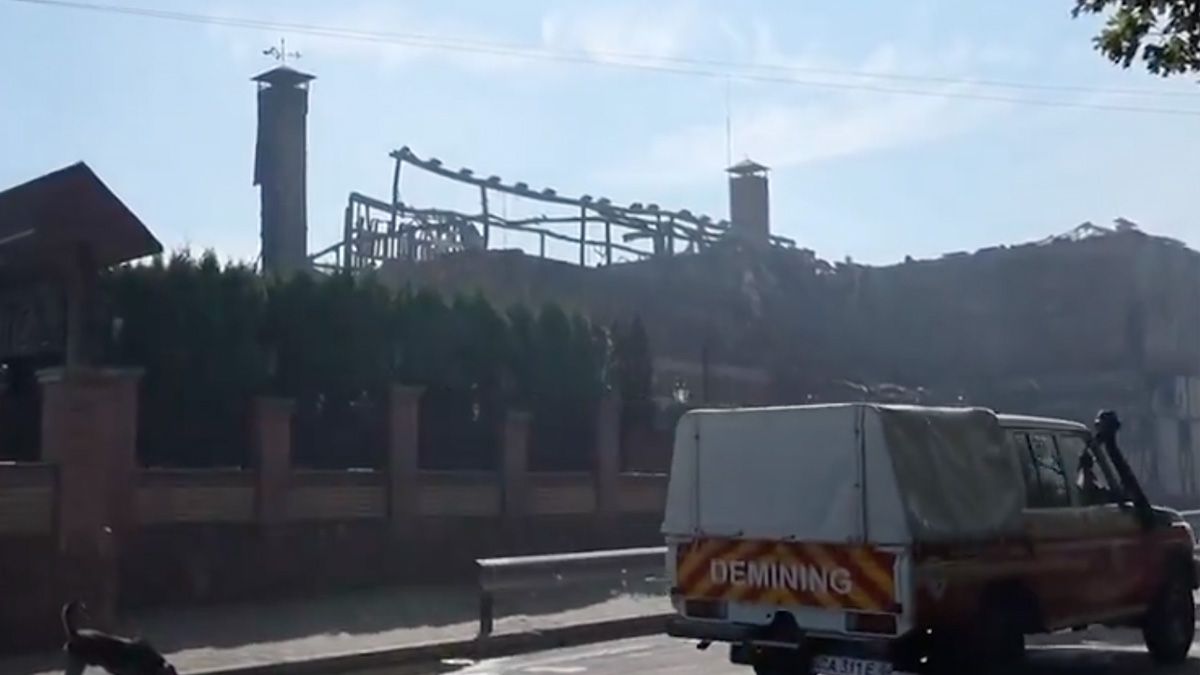
At least 37 people were killed and dozens wounded after a Russian drone strike hit an ammunition storage site in the village of Myla, in the Bucha district west of Kyiv, on Saturday, 29 August 2026.
The strike set off a fire and hours of secondary detonations that swept through a residential area. Tymur Tkachenko, head of the local regional military administration, said at least 50 residential buildings were damaged.
Casualty figures reported on the day varied. Officials initially confirmed at least 37 deaths, while a subsequent count placed the toll at 38, with dozens more wounded.
Tkachenko was later cited by Ukrainian media as saying that 34 of those killed were residents of a care facility for elderly people and people with disabilities.
President Volodymyr Zelensky said a warehouse had been struck, "followed by a detonation", and that shells, mines, other munitions and drones stored at the site had exploded.
He said the facility should not have been located there. Zelensky described the incident as a horrific situation caused by what he called "terrible negligence on the part of those who stored explosives right next to people".
Investigation into storage of munitions
Zelensky said Ukrainian law forbids the storage of ammunition close to civilian homes, and that criminal proceedings had been opened. He said those who allowed the storage must be held accountable.
The office of Ukraine's Prosecutor General said in a statement that "explosive objects and materials" had been kept on the premises. It said an investigation would examine the circumstances of the explosion and the conduct of the officials responsible.
Zelensky said a care home for elderly citizens and people with disabilities was among the buildings damaged, and that an evacuation from the area was under way. More than 300 emergency services personnel were deployed to the scene.
Ukrainian authorities said Taras Didych, the long-serving head of the local municipality, was among those killed after arriving at the site to assist.
Mykola Kalashnyk, Ukraine's Minister for Recovery, Infrastructure and Transport, said in a statement that Didych had remained with his community throughout the Russian occupation and had continued to support residents during that period.
Russia's Ministry of Defence said it had struck a warehouse in Myla storing components and launch boosters for long-range drones. It also said it had attacked the ports of Mykolaiv and Izmail, along with a logistics centre and warehouses holding parts for Ukraine's Flamingo cruise missiles in the Kyiv region.
Earlier warehouse strike cited as precedent
Prime Minister Serhii Koretskyi drew a comparison with an earlier strike on an ammunition depot in Vyshneve, a Kyiv suburb roughly 20 kilometres from Myla, which triggered large detonations and fires in nearby homes.
Accounts of that earlier incident differ. One report placed the death toll at 22 and dated the strike to early July, while another said seven people died and described it as having occurred weeks before the Myla attack.
Koretskyi said the Vyshneve tragedy had not been treated as a lesson, and that repeating the same mistakes in the fifth year of the full-scale invasion amounted to criminal negligence. He called for all those responsible to be punished.
Zelensky said two officials from state-owned companies, including Ukraine's largest arms producer Ukroboronprom, had unlawfully permitted the storage of weapons at the Vyshneve site and would be held accountable.
Third day of near-continuous attacks
The blast came as Kyiv endured more than two days of almost uninterrupted Russian air raids. One tally recorded 28 air raid alerts between midnight on Thursday and midday on Saturday, totalling more than 28 hours.
Kyiv Mayor Vitali Klitschko said a two-year-old girl who was seriously wounded in one of the attacks on Saturday later died of her injuries. Five other people were injured across the city.
Strikes were also reported overnight into Saturday in the Odesa, Dnipro, Zaporizhzhia, Sumy, Kherson, Kharkiv, Mykolaiv, Donetsk and Chernihiv regions. Zelensky said more than 260 attack drones were involved, along with Banderol drones.
In the southern Kherson region, Russian strikes on Saturday killed two people and wounded 27 more, according to regional administration head Oleksandr Prokudin. He said homes and apartment blocks were damaged and that one child was among the injured.
Prokudin said earlier in the week that Russia had intensified attacks on critical infrastructure in the region, about 70 per cent of which is under Russian control. He urged tens of thousands of residents to relocate ahead of possible prolonged power and heating outages this winter.
Jet-powered drones outpacing defences
Most of the recent attacks were carried out with jet-powered drones, a relatively new addition to Russia's arsenal first identified around the start of the year.
Serhiy Beskrestnov, an adviser to Zelensky, said Ukraine faced around 1,500 jet-powered Shahed drones last month, while the figure for the current month had already exceeded 2,500.
The drones travel at speeds of up to 500 kilometres per hour, evading Ukrainian air defences and outpacing mobile fire groups. Ground-to-air missiles and fighter jets remain the principal countermeasures, and both are in limited supply.
Pavlo Palisa, deputy head of the Presidential Office, said Russia had significantly increased its use of jet-powered drones and that numbers would continue to rise. He said means of attack always outpace means of defence, and that adaptation would take time.
Palisa said interceptor drones currently available to Ukraine had not yet demonstrated the expected effectiveness. Defence Minister Evgeniy Khmara said field trials of interceptors capable of downing jet-powered drones had been conducted, with the aim of scaling production to thousands of units.
Ukraine expands long-range campaign
Ukraine has intensified long-range strikes on Russian military industry and energy facilities in recent months using domestically produced drones, seeking to reduce Moscow's revenues.
In an address on Friday, Zelensky said Kyiv aimed to reach 1,000 long-range drone launches a day, up from a current average of more than 300.
Russia's Ministry of Defence said on Saturday that its forces had destroyed 313 Ukrainian drones overnight. In the Rostov region, Governor Yuri Slyusar said drone attacks wounded 11 people, with nine hospitalised, including four children.
Drone attacks on Moscow and Yaroslavl Oblast
On the morning of Thursday, 28 August 2026, drones attacked the city of Moscow and Yaroslavl Oblast, according to Russian officials and the Russian media outlet Astra.
Yaroslavl Oblast Governor Mikhail Yevrayev reported a drone threat and said Defence Ministry units and security agencies were working to repel the attack. He did not identify the facilities targeted.
A section of the M8 motorway towards Moscow was closed to traffic, and some public transport services in Yaroslavl were rerouted or shortened. Yevrayev said intercity buses using the closed section were temporarily suspended.
Moscow Mayor Sergei Sobyanin said air defences destroyed two unmanned aerial vehicles heading towards the capital, and that emergency services were working at the site where debris fell.
Astra reported that black smoke had risen over Pavlovsky Posad in Moscow Oblast, with the cause not established, and that photographs circulating on social media appeared to show smashed windows in some buildings. A red alert level was issued in the Vladimir and Ivanovo oblasts and in south-eastern Moscow Oblast.