US lifts nationwide flight ground stop as Duffy blames overloaded analogue telecoms system
The FAA lifted a rare nationwide ground stop after more than four hours. US Transportation Secretary Sean Duffy blamed ageing analogue telecoms hardware that became overloaded with data. Thousands of flights were cancelled, and officials said there was no sign of a cyberattack.
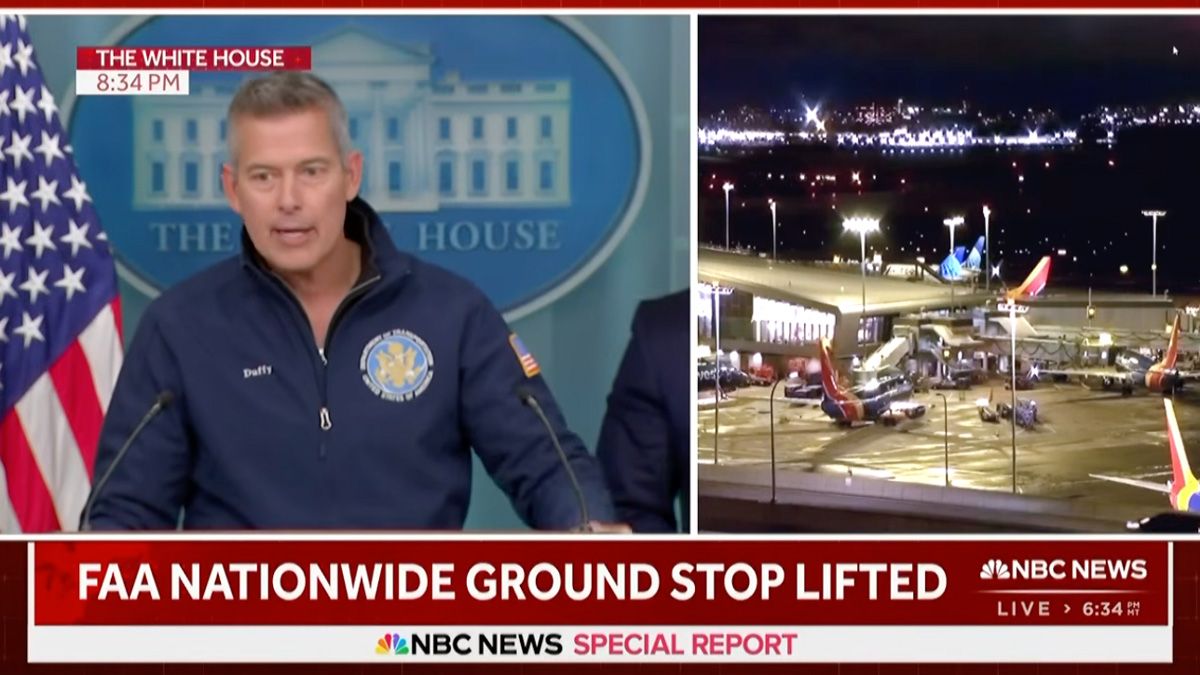
- The FAA halted all US departures for over four hours after communications instability hit air traffic control centres.
- Duffy blamed overloaded legacy analogue telecoms routers. DHS said there was no sign of a cyberattack.
- Thousands of flights were cancelled, and airlines warned that disruption would continue into the weekend.

The United States Federal Aviation Administration (FAA) lifted a nationwide ground stop on the evening of Friday, 13 November 2026. The stop had halted every departing flight across the country for more than four hours.
US Transportation Secretary Sean Duffy said the airspace reopened at 8.15pm Eastern Standard Time (EST). He warned that it would take time for the stalled airline system to return to normal.
Speaking at a White House briefing, Duffy blamed old telecommunications hardware in the air traffic control system. He said its switches and routers “actually got overloaded with data”.
Homeland Security Secretary Markwayne Mullin told the same briefing that investigators had so far found no sign of a cyberattack. He said the public had never been in danger.
How the ground stop unfolded
According to Duffy, the ground stop was called at 3.36pm EST. He announced it publicly on X at 4.16pm.
In that post, he said the FAA had issued the stop for all US airports. He said this followed a communication issue affecting all Air Route Traffic Control Centres, which direct aircraft travelling between airports.
The Associated Press (AP) reported that there are 22 such regional centres nationwide. The FAA cited “extraordinary circumstances” and safety concerns for the decision.
The FAA later said on X that a temporary telecommunications outage had occurred. It said all flights were halted out of an abundance of caution and that every flight had been accounted for.
Duffy said about 3,500 aircraft were in the air when the stop was called. When he last checked that evening, about 400 remained airborne.
Flights already in the air continued to their destinations. International flights were handled case by case, and some departed on Friday evening, according to Mullin.
San Francisco International Airport said Pacific-bound flights, including those to Hawaii and Asia, were cleared to leave from 6pm EST. Alaska Airlines said some flights within Alaska and Hawaii were not affected.
Duffy’s explanation: ageing analogue equipment
At the White House briefing, Duffy said the trouble began with “instability” in radar and communications across air traffic control centres and Terminal Radar Approach Control (TRACON) facilities nationwide.
“We didn’t lose all telecom, we didn’t lose all radar,” Duffy said. He said the instability was enough for the FAA to halt departures as a precaution.
Duffy described the network as “an incredibly old air traffic control system”. He said it still relies on time-division multiplexing (TDM) telecoms, which he called analogue technology.
He said the routers began producing inconsistent data after they were overloaded. Newer switches kept working, he said, but the older hardware failed.
Duffy said the FAA had procedures for such events. Earlier in the afternoon, Mullin told reporters that communication with aircraft was still possible, though at reduced levels and clarity, because of redundancies.
Cyberattack ruled out for now
From the start, officials said there was no evidence of malicious activity. Speaking in the afternoon, Mullin said there was “no indication as of yet” of anything “nefarious”.
According to NBC News, officials from several agencies said at that early stage that they had seen no activity typical of a cyberattack. They cautioned that findings could change as the investigation went on.
At the evening briefing, Mullin said no cyberattack had been found so far and that teams were still working through the process.
Microsoft, which had a separate global service outage that day, said it had no indication of any link to the ground stop. Three senior officials told NBC News they had seen nothing connecting the two incidents.
Questions over AI traffic management system
The ground stop came weeks after the FAA rolled out an artificial intelligence-assisted system called Strategic Management of Airspace, Routes and Trajectories (SMART).
Duffy unveiled SMART in September. NBC News reported that he said it brings 200 data streams together into a single platform.
The National Air Traffic Controllers Association (NATCA) said in September that it had not been involved in the system’s design, testing or implementation. NBC News reported that Democratic lawmakers asked the FAA in a letter dated 9 October to pause the changes.
Air Space Intelligence (ASI), the Boston-based start-up that supplies SMART, said on X that the ground stop was not caused by its software or its integration with the FAA.
According to the AP, Mullin said investigators would examine any possible link. The AP noted that SMART runs from a single location near Washington DC and only sends recommendations to air traffic control centres.
Scale of the disruption
At 7.30pm EST, the flight-tracking website FlightAware showed 10,079 US-related delays and 4,238 US-related cancellations, according to NBC News.
That compared with about 6,800 delays and 1,024 cancellations the day before. Wednesday saw 3,424 delays and 99 cancellations.
By 8.20pm, NBC News’s own analysis found that more than 5,300 flights had been cancelled. Most days that week had seen about 100.
Aviation analytics firm Cirium said at least 827 flights had been diverted by 7.05pm EST, according to the AP. Of these, 670 returned to their departure airports and 157 went to other airports.
The AP reported that about 11,000 flights carrying more than 1.5 million passengers had been due to depart US airports after 4pm EST.
With departures frozen, some airports ran short of parking space for aircraft. A source told NBC News that Reagan National Airport had reached capacity and that Chicago O’Hare was close to it.
The stop also affected cargo flights. FedEx said it was ready to activate contingency plans. It also disrupted travel for professional and college sports teams heading to weekend fixtures.
Restoration and a slow recovery
Duffy said recovery would depend on whether pilots and flight attendants were available to operate flights.
“It’s going to be slow,” he said. He added that as many flights as possible would move overnight, with airlines repositioning aircraft from the following morning.
Delta Air Lines said it was safely resuming operations. It warned that resetting its operation, including repositioning aircraft and crews, would take time.
United Airlines said it was resuming operations, including some Friday night flights, and urged travellers to check their flight status before going to the airport.
Shortly before the stop was lifted, JetBlue cancelled the rest of its Friday night flights. The exceptions were Europe-bound departures from JFK and Boston. The airline said it expected disruptions and further cancellations on Saturday.
Car rental firm Hertz said it was seeing more one-way rentals from stranded travellers. Amtrak said it was receiving higher-than-normal call volumes.
Call for US$50 billion to fix air traffic control
Duffy used the briefing to press Congress for more money to modernise air traffic control.
He said President Donald Trump had asked Congress for US$30 billion, but that he himself wanted US$50 billion. He argued against what he called “a patchwork fix”.
According to the AP, Congress approved US$12.5 billion for the overhaul last year. Miles of copper wiring have since been replaced with fibre optic lines, and old radio systems are gradually being replaced at airports.
Duffy also pointed to earlier air traffic control failures, including outages that disrupted flights at Newark. “This is a continual problem that we have, and it should be fixed,” he said.
Aviation safety expert Steve Arroyo, a former United Airlines pilot, told the AP the incident looked similar to a regional outage in September that disrupted hundreds of flights across the Northeast. This time, he said, it happened on a national scale.
A rare event
According to the AP, this was the first nationwide ground stop since January 2023, and only the second since the aftermath of the 11 September 2001 attacks.
The January 2023 stop followed a failure of the Notice to Air Missions (NOTAM) system, which alerts pilots to potential hazards. US officials blamed contract personnel who accidentally deleted files while fixing a database synchronisation problem.