Taiwan's legislature rejects Cabinet drone budget and passes opposition six-year plan
Taiwan's Legislative Yuan rejected the Cabinet's NT$210 billion special budget for military drones on 27 August 2026, passing an opposition bill that sets NT$40 billion in annual spending over six years. The defence ministry said it regretted the outcome.
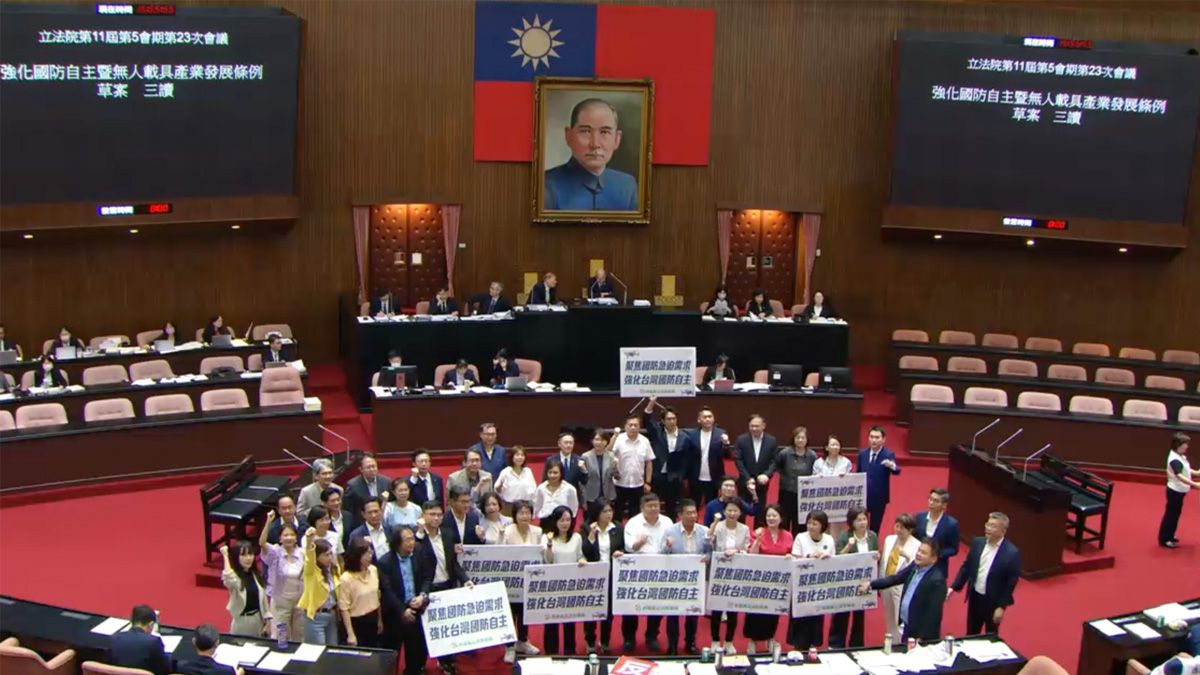

Taiwan's Legislative Yuan on Thursday, 27 August 2026, rejected the Executive Yuan's NT$210 billion (US$6.62 billion) special budget proposal for military uncrewed systems, passing instead an opposition-drafted act that funds drone procurement through annual budgets.
The Act on Strengthening Defense Autonomy and Developing the Unmanned Vehicles Industry was passed by 60 votes to 50 in the 113-seat legislature, with the Kuomintang (KMT) and Taiwan People's Party (TPP) using their combined majority to carry the measure.
The act sets a spending ceiling of NT$240 billion (US$7.56 billion) in principle, requiring the central government to earmark NT$40 billion each year for six consecutive years from the general budget. Additional funding is permitted subject to legislative approval.
The Executive Yuan had argued that its plan to acquire about 210,000 drones by 2031 could not wait, citing the wars in Ukraine and Iran as evidence of the decisive role of uncrewed systems in modern warfare amid a rising threat from China.
Ministry statement
In a press statement issued at 6pm on 27 August by its Political Warfare Bureau, the Ministry of National Defense (MND) said the equipment items, quantities and timelines set out in the Executive Yuan version had been determined through a comprehensive assessment of enemy threat and combat power requirements.
The ministry said the rejected bill would have allowed three uncrewed vehicle procurement cases to be completed in the shortest possible time, while balancing technological iteration, the formation of combat capability and the establishment of domestic production capacity.
According to the statement, the Executive Yuan version was intended to make up for items deleted from the original NT$1.25 trillion special budget, using a special budget to build urgently needed combat strength.
All procurement items had been examined in depth by the joint staff departments against the requirements of each phase of defensive operations, and evaluated jointly with allied partners in order to complete an overall acquisition strategy for uncrewed systems, the ministry said.
The MND added that, given the importance and urgency of acquiring uncrewed systems, it would follow the Executive Yuan's direction and draw up the budget required to build uncrewed combat capability as quickly as possible.
The statement closed by urging opposition caucuses in the legislature to respect defence professionalism, and calling for the military and the public to safeguard national security together. In a separate statement, the ministry said the outcome would hamper efforts to acquire key combat capabilities.
Scope of the act
Under the act's definition, uncrewed vehicles are autonomous or remotely controlled systems capable of operating in the air, under the sea, on the sea surface, on land or in other unspecified environments.
Such systems may be used for attack, reconnaissance, logistics, communications, decoy operations, electronic warfare, mine-sweeping and mine-laying. The act directs the MND to prioritise the procurement of domestically produced low-cost, high-performance systems.
The legislation covers three categories of uncrewed system requested by the MND that had previously been excluded from KMT and TPP proposals: coastal attack drones, coastal reconnaissance drones and small suicide uncrewed surface vehicles.
According to a report by the Central News Agency, the late addition of those categories followed repeated calls by Democratic Progressive Party (DPP) lawmakers and represented a rare compromise between the ruling and opposition camps.
Industrial provisions
The Ministry of Economic Affairs (MOEA) is designated the competent authority under the act, except for military procurement, which falls to the MND. The MOEA is to define what constitutes an indigenous system and a trustworthy supply chain.
Within one year of enactment, the MOEA must establish at least three test sites where military and private manufacturers can evaluate flight controls, anti-jamming systems and combat readiness. It will also accredit manufacturers meeting domestic production and supply chain requirements.
Accredited manufacturers are to be listed on an official website to promote international partnerships. Both ministries must brief the Cabinet and the legislature annually on procurement progress, mass production targets and accreditation.
The act further directs the establishment of a Cabinet-level national committee to oversee industry policy, with members selected by the Cabinet from nominees recommended by legislative caucuses.
Political reaction
Asked whether he would countersign the legislation, Premier Cho Jung-tai (卓榮泰) said the bill required careful review. "We will carefully consider this matter with regard to national needs and national security," he said.
KMT Legislator Hsu Chiao-hsin (徐巧芯) told the chamber before the vote that the government "cannot simply come asking for money every time without any oversight", adding that the opposition proposals would ensure proper supervision of drone spending.
KMT caucus whip Fu Kun-chi (傅崐萁) said his party's support for national defence and the drone sector was unwavering, and that the act reflected a resolve to make Taiwan a significant global drone manufacturing hub.
The TPP caucus said in a statement that the KMT had insisted on limiting the annual budget to NT$40 billion.
Minister of National Defense Wellington Koo (顧立雄) has previously said an annual cap of that size would prevent Taiwan from effectively building drone combat capabilities, as the ministry already planned to spend NT$42.1 billion on drones next year alone.
DPP Legislator Fan Yun (范雲) said the opposition had delayed passage of this year's general budget by months, leaving no guarantee that next year's process would be smoother.
"If the total budget review gets delayed again, I think this creates enormous uncertainty not only for industry development but, more importantly, for urgent national defence needs," she said.
DPP caucus chief executive Chuang Jui-hsiung (莊瑞雄) said the mandated special committee and the caucus recommendation of academic members contravened the authority of the executive branch, and could allow politics to override defence expertise.
He added that fixed annual allocations and mandatory six-monthly meetings would deprive the military of the flexibility needed to build a drone fleet.
DPP Legislator Chung Chia-pin (鍾佳濱) described the committee provision as "sugar-coated poison", warning that caucus-recommended members could become targets of Chinese infiltration and that mandatory procurement reports to the legislature could put military secrets at risk.
Su Tzu-yun (蘇紫雲), director of the Defense Strategy and Resources Division at the Institute for National Defense and Security Research, said the act was a good first step for national defence but flawed in design.
The committee's composition included too many party-recommended members, which would dilute its credibility and expertise, while its procedures could pose a significant risk to secrecy, he said.
Cabinet spokesperson Michelle Lee (李慧芝) said that although the Cabinet proposal had failed, the government would do its utmost to plan uncrewed systems procurement budgets so that Taiwan quickly acquires critical defence capabilities.