Indonesia protests demand passage of bill to seize assets linked to corruption
Demonstrators gathered outside Indonesia's parliament on 27 August demanding passage of the long-delayed Asset Forfeiture Bill, with lawmakers targeting December 2026 for final approval.
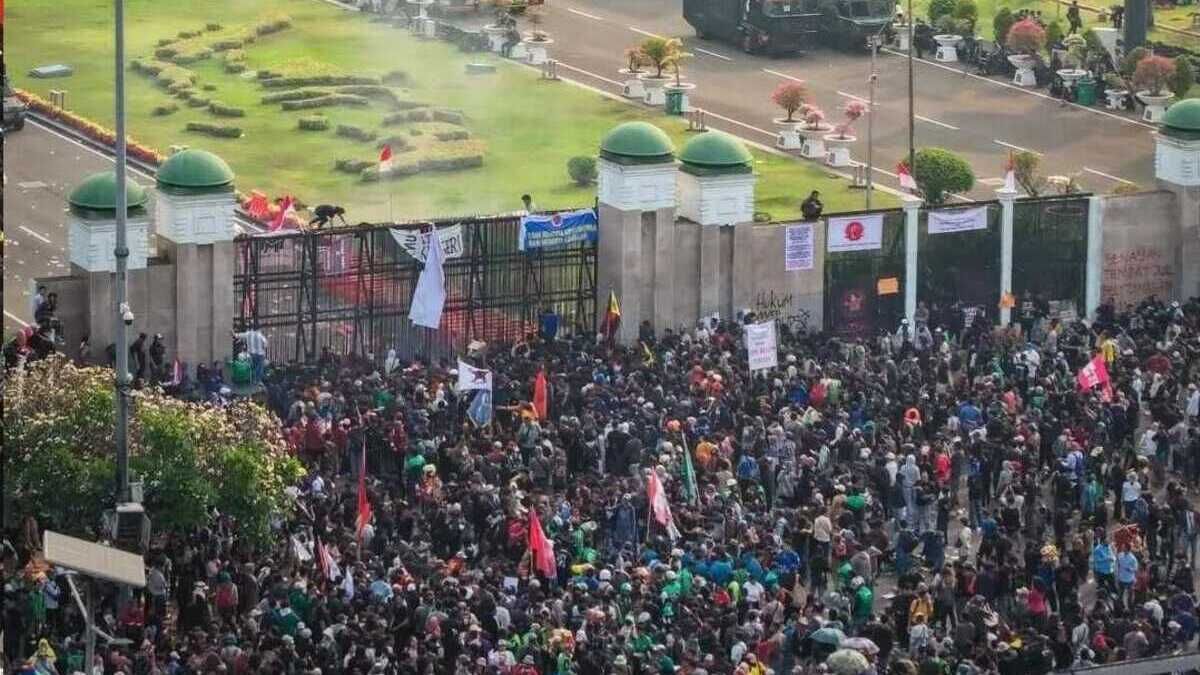
- Protesters returned to Indonesia's parliament demanding immediate passage of the Asset Forfeiture Bill.
- DPR lawmakers say they aim to complete final approval by December 2026.
- Student protesters also demanded accountability, social protections and stronger action against corruption.

Demonstrators in Indonesia returned to the streets on Thursday (27 August 2026) to demand the immediate passage of the long-delayed Asset Forfeiture Bill, reviving an issue that has remained unresolved for years.
The legislation, formally known as the Asset Forfeiture Bill, has been discussed as a measure to strengthen efforts to recover assets linked to corruption. Protesters have again made its passage one of their central demands.
The latest demonstrations brought together groups including residents from Pati, online motorcycle taxi drivers, students and civil society organisations at the House of Representatives (DPR) complex in Senayan, Jakarta.
The renewed pressure comes after years of debate over the bill, including a public exchange in 2023 between then Coordinating Minister for Political, Legal and Security Affairs Mahfud MD and lawmakers over whether the legislation should be passed.
Dispute over the bill dates back to 2023
On 29 March 2023, Mahfud publicly called on the DPR to immediately pass the Asset Forfeiture Bill.
Bambang Pacul, then chairman of Commission III and a PDI-P politician, responded that the request needed to be discussed with political party leaders.
“I am being frank about this. Perhaps the Asset Forfeiture Bill can be passed, but we have to speak with the party leaders first. It cannot be done here, sir,” Bambang said at the time.
The issue subsequently received less public attention as Indonesia's political leadership changed and new lawmakers entered the DPR.
The bill returned to the centre of public debate during demonstrations in late August 2025, following the death of online motorcycle taxi driver Affan Kurniawan, who was run over by a police tactical vehicle.
The demand for the bill's immediate passage was subsequently included in the “17+8 People's Demands”, which set a deadline of 5 September 2025.
That deadline passed without the bill being enacted.
DPR promises to continue work on legislation
DPR Speaker Puan Maharani said the legislature was prepared to receive public demands over the Asset Forfeiture Bill.
“If people want to convey their input and express their aspirations, we will certainly receive them at the DPR building,” Puan said in Jakarta on Wednesday (26 August).
She said members of the public had the opportunity to communicate their views to lawmakers, while urging protesters to maintain order.
“Let us not have any disorder. It is better that we maintain order, make sure everything proceeds properly, and ensure that there are no unwanted incidents,” she said.
Puan also said DPR leaders were open to meeting representatives of demonstrators.
“Yes, the DPR leadership could meet the protesters. Even today, the DPR leadership is meeting representatives of members of the public who want to meet,” she said.
Government says Prabowo has backed the bill
Muhammad Qodari, head of Indonesia's Presidential Communication Office, said the public demand for the Asset Forfeiture Bill was consistent with President Prabowo Subianto's stated position.
Qodari said Prabowo had expressed his commitment to the legislation twice.
The first was during Labour Day on 1 May 2025, followed by another expression of support during a meeting with religious figures on 1 September 2025.
However, Qodari said the DPR had authority over the legislative process.
“The government is waiting for developments because there will certainly be discussions with the government later, including preparing a list of problems and so on,” he said.
DPR targets December 2026
Commission III chairman Habiburokhman said lawmakers had approximately eight effective weeks of sitting time remaining to complete the bill, excluding parliamentary recess periods.
“If we calculate the effective time during the DPR's sitting period, after deducting the recess period, the discussion of the Asset Forfeiture Bill will only require around another eight weeks,” Habiburokhman said.
The Gerindra Party politician said Commission III intended to use the remaining period to complete the stages required to pass the legislation.
These would include public hearings to gather input, harmonisation, working meetings with the government and discussion of the List of Problem Inventories (DIM).
The process would then proceed to first-level approval before being brought to a plenary session for second-level approval.
Habiburokhman said the DPR aimed to complete the final approval in December 2026.
Pati protesters disperse after talks
The demonstration outside the DPR complex changed course on Thursday after protesters from the Aliansi Masyarakat Pati Bersatu (AMPB), or United Pati Community Alliance, dispersed following an audience with DPR representatives.
Central Jakarta Police Chief Commissioner Reynold Hutagalung said police personnel escorted the Pati protesters home.
Police said no protesters had been detained. Several people were, however, taken for identification after allegedly carrying sharp weapons or being suspected of involvement in pickpocketing.
“Their identities are currently being processed; they were taken directly (for processing),” Reynold said at Jakarta Metropolitan Police headquarters.
He said the Pati protesters had left voluntarily after completing their meeting with lawmakers.
“They have finished carrying out the audience together,” he said.
Security remained in place around Senayan as student groups and other civil society organisations continued their planned demonstrations.
Indonesia ranks 109th in global corruption index
The demand for the immediate passage of the Asset Forfeiture Bill comes as Indonesia continues to receive a low ranking in the 2025 Corruption Perceptions Index (CPI) published by Transparency International. Indonesia scored 34 out of 100, placing it 109th out of 182 countries and territories assessed.
A lower score indicates a higher perceived level of corruption in the public sector.
Indonesia shared 109th place with Algeria, Bosnia and Herzegovina, Laos, Malawi, Nepal and Sierra Leone. By comparison, Malaysia ranked 54th, with a score of 52, while Singapore ranked third globally, with a score of 84.
The CPI measures perceived public-sector corruption based on assessments by experts and businesspeople, drawing on 13 independent data sources. Scores range from 0 to 100, with 0 indicating highly perceived corruption and 100 indicating a very clean public sector
Student coalition presents 10 demands
The student demonstrations were organised by Gerakan Mahasiswa (GERAM), a coalition comprising more than 14 student organisations and civil society groups.
The coalition planned to begin its action at 2pm local time, with organisers estimating that about 1,000 people would attend.
GERAM action coordinator Ahmad Mixel M.I said the demonstration represented public oversight of the DPR's legislative, supervisory and budgetary functions.
The coalition also demanded that DPR leaders attend the demonstration and engage directly with protesters. Ahmad said a larger mobilisation would follow if the demands were rejected.
GERAM's 10 demands include calls for accountability from President Prabowo Subianto and Vice President Gibran Rakabuming Raka, the termination of the Merah Putih Village Cooperatives and Free Nutritious Meals (MBG) programmes, and opposition to tax policies that the coalition says burden lower-income communities.
The group is also calling for free education and healthcare, higher workers' wages, national disaster status for affected areas in Sumatra and Nusa Tenggara Timur (NTT), protection of domestic workers' rights, an end to the militarisation of civilian spaces, the release of political prisoners and the seizure of assets obtained through corruption.
Among the organisations participating are DPM UNUSIA, the Open University Student Alliance, BEM Universitas Trilogi, the Indonesian Student Union and the Political Prisoners' Union.