Two Chinese nationals win Fields Medals for first time in landmark mathematics achievement
Two Chinese nationals, Wang Hong and Deng Yu, have won the 2026 Fields Medal, marking the first time Chinese citizens have received the prestigious mathematics prize.
- Wang Hong and Deng Yu are the first Chinese nationals to receive Fields Medals.
- The two mathematicians were honoured for breakthroughs in harmonic analysis, geometric measure theory and partial differential equations.
- Their awards have been celebrated in China as evidence of growing strength in fundamental mathematics and science.

Two Chinese nationals have won the prestigious Fields Medal for the first time, marking a landmark moment for Chinese mathematics and highlighting the country's growing ambitions in advanced science and technology.
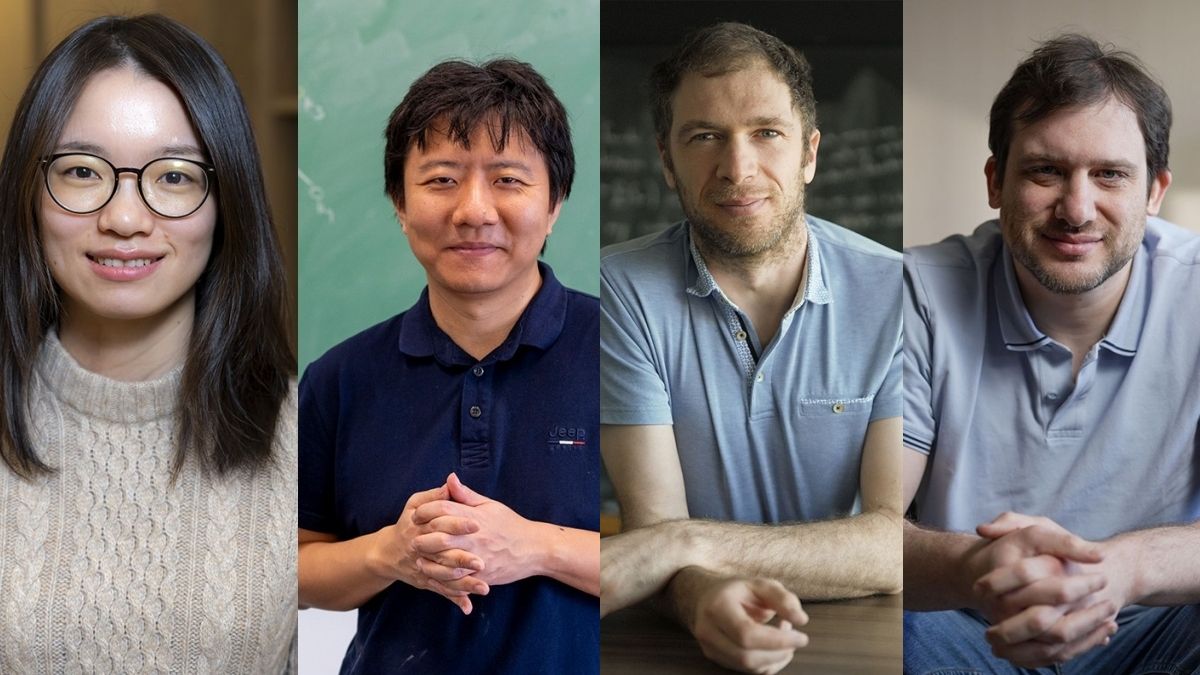
Wang Hong (王虹), 35, and Deng Yu (邓煜), 37, were named among four recipients of the 2026 Fields Medals on 23 July 2026 during the opening ceremony of the International Congress of Mathematicians in Philadelphia.
The International Mathematical Union announced the four laureates at the event, with American mathematician John Pardon of Stony Brook University in New York and Canadian mathematician Jacob Tsimerman of the University of Toronto joining Wang and Deng as this year's recipients.
The Fields Medal is widely regarded as one of the highest honours in mathematics.
Awarded every four years, it recognises outstanding achievement and the promise of future achievement by mathematicians under the age of 40.
The 2026 recipients each represent major contributions to different areas of modern mathematics, while the recognition of Wang and Deng has generated particular attention in China because they are the first Chinese nationals to receive the award.
A milestone for Chinese mathematics
Chinese social media platforms were filled with celebrations following the announcement, with the two leading trending topics on Weibo, China's X-like social media platform, focusing on the achievement.
State media and other Chinese news outlets also published extensive coverage of Wang and Deng, examining both their mathematical accomplishments and the significance of their awards for the country's scientific development.
Both mathematicians studied at Peking University, a leading research university in Beijing, before pursuing advanced academic careers overseas.
Wang grew up in Guilin in southern China and is now a professor at New York University and France's Institut des Hautes Études Scientifiques.
She was recognised for her work resolving a decades-old problem in harmonic analysis and geometric measure theory.
Deng, who grew up in Shenzhen, is a professor at the University of Chicago.
He received the medal for his progress on partial differential equations.
Wang is also the third woman to win the Fields Medal in the award's 90-year history.
The awards have been presented in China as a milestone in the country's effort to strengthen its position in both applied and fundamental science.
The achievement has also drawn attention to China's longstanding ambition to rank among the world's leading powers in science and technology, supported by substantial investment in universities, research and the recruitment of high-level academic talent.
State media commentary on the awards said there had long been a perception in Western academia that China was strong in competitive and applied mathematics but had yet to produce comparable original breakthroughs in fundamental theory.
The commentary said the emergence of Wang and Deng had "finally filled this gap", describing their success as a new standard for Chinese mathematics and as a challenge to what it characterised as existing prejudices.
The distinction between nationality and heritage
Chinese state media described Wang and Deng as the first Chinese nationals to win the Fields Medal, while noting the achievements of other mathematicians of Chinese background.
Shing-Tung Yau (丘成桐), a China-born mathematician, received the Fields Medal in 1982, but was not a Chinese citizen at the time.
Terence Tao, who was born in Australia and is ethnically Chinese, won the medal in 2006.
The 2026 awards therefore represent a specific milestone in terms of Chinese citizenship rather than the first Fields Medal awarded to a mathematician of Chinese heritage.
Yau, now a professor at Tsinghua University in Beijing, said in an interview with a Chinese state-linked media outlet that Wang and Deng's awards fulfilled an aspiration held by China's mathematics community for decades.
He also expressed hope that the two mathematicians would return to China to teach.
"We very much hope they will come back, because that is important for China," Yau said.
He added that he hoped that, in future, "scholars trained entirely in China will also be able to win the Fields Medal."
The comments touch on a longstanding challenge for China, which has sought to address the departure of highly talented students and researchers to universities and research institutions in the United States and elsewhere.
The issue, often described as "brain drain", has become increasingly significant as Chinese universities have expanded their international standing and the government has sought to attract leading researchers and develop domestic scientific capacity.
Overseas academic careers
Both Wang and Deng completed significant parts of their higher education outside China.
Deng transferred from Peking University to the Massachusetts Institute of Technology as an undergraduate before earning his PhD from Princeton University in 2015.
Wang graduated from Peking University and completed a master's degree in France before receiving her PhD from the Massachusetts Institute of Technology in 2019.
Her international academic career has since included appointments at New York University and the Institut des Hautes Études Scientifiques.
French President Emmanuel Macron personally called Wang to congratulate her on receiving the Fields Medal.
In comments shared by New York University after the announcement, Wang credited colleagues throughout her career for helping her reach the achievement.
"Moments like this never belong to just one person," she said.
"They are the culmination of years of chance encounters and unexpected questions that steer you in the right direction."
The other 2026 laureates
Pardon, 37, is a professor at Stony Brook University in the United States. He was recognised for achievements in symplectic geometry, including new approaches to virtual fundamental cycles, Fukaya categories of certain manifolds and the counting of holomorphic curves.
His work has also covered areas of geometry and topology, including group actions on 3-manifolds and knot theory.
Pardon won gold medals at the International Olympiad in Informatics for three consecutive years from 2005 to 2007. He graduated as valedictorian of Princeton University's class of 2011 and later earned his doctorate from Stanford University.
Tsimerman, 38, is a professor at the University of Toronto and is the first Fields medallist to have built his academic career in Canada.
He was recognised for recasting o-minimality as a fundamental method of complex algebraic and arithmetic geometry, as well as for his role in proving several central conjectures.
These included the Griffiths conjecture on the algebraicity of images of period maps and the André-Oort conjecture for Siegel modular varieties.
Tsimerman won International Mathematical Olympiad gold medals in two consecutive years. He studied mathematics at the University of Toronto before earning his doctorate at Princeton University in the United States.
The Fields Medal is awarded to up to four mathematicians every four years, with recipients required to be under 40.
Each winner receives a 14-karat gold medal engraved with an image of Archimedes, the ancient Greek mathematician, as well as a cash prize of CAD15,000 (approximately US$10,600).