US House narrowly passes US$1.15tn defence bill amid Iran war and Israel dispute
The US House of Representatives has passed the 2027 National Defense Authorization Act by 216 votes to 212, after a bitter partisan fight over the war on Iran, a provision deepening military technology cooperation with Israel, and the attachment of President Donald Trump's voting legislation.
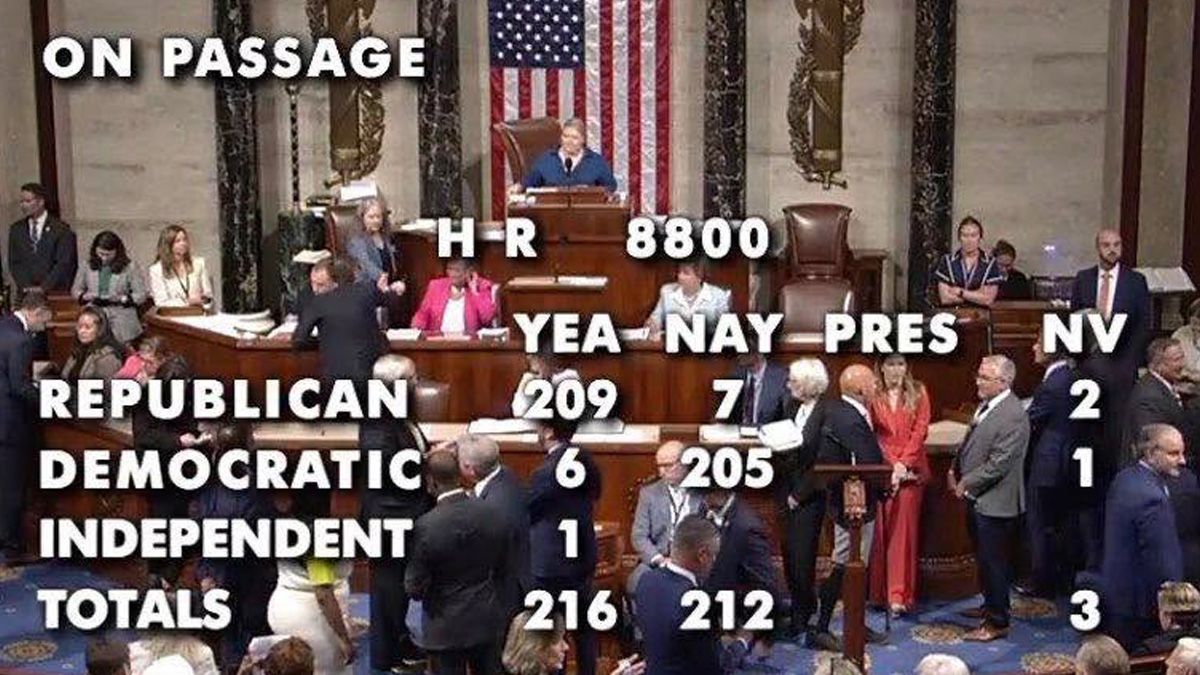
- House passes 2027 defence authorisation bill 216-212, with six Democrats in favour and seven Republicans opposed.
- Section 219, expanding US-Israel defence technology cooperation, drew bipartisan objections after an amendment to remove it was blocked.
- Bill now heads to the Senate, where Democrats stalled the chamber's own version last week.

The United States House of Representatives has passed a US$1.15 trillion defence policy bill by 216 votes to 212, sending the measure to the Senate amid one of the sharpest partisan divides the legislation has faced in decades.
The vote was held on Wednesday, 22 July 2026. According to the official tally displayed in the chamber, Republicans voted 209 in favour and seven against, Democrats voted six in favour and 205 against, and one independent supported the bill. Three members did not vote.
The six Democrats who backed the National Defense Authorization Act (NDAA) were Representatives Henry Cuellar of Texas, Don Davis of North Carolina, Jared Golden of Maine, Vicente Gonzalez of Texas, Adam Gray of California and Marie Gluesenkamp Perez of Washington.
All six Democrats who backed the bill have received campaign contributions from the American Israel Public Affairs Committee (AIPAC), according to Federal Election Commission records.
Seven Republicans opposed it: Representatives Josh Brecheen of Oklahoma, Tim Burchett of Tennessee, Eli Crane of Arizona, Harriet Hageman of Wyoming, Anna Paulina Luna of Florida, Thomas Massie of Kentucky and Chip Roy of Texas.
Those Democratic votes proved decisive, according to a report by Politico, allowing Republican leaders to absorb the defections from their own ranks.
What the bill authorises
The NDAA authorises defence programmes and policies for the 2027 fiscal year but does not itself appropriate funds. It endorses the US$1.15 trillion base budget requested by the White House through the annual appropriations process.
A further US$350 billion sought by President Donald Trump, which would bring total military spending to US$1.5 trillion, is not addressed in the bill and would have to move through a separate party-line reconciliation measure.
Al Jazeera reported that the request represents an increase from roughly US$900 billion in the previous year, a rise defence hawks describe as necessary and which critics have called unaffordable.
The legislation raises pay for all service members by between five and seven per cent, and authorises US$1.8 billion for barracks and family housing, alongside expanded access to education and childcare for military families, The Hill reported.
It authorises US$56 billion for aircraft development, covering next-generation fighter jets, B-21 Raiders, P-8 maritime patrol aircraft, F-35s, and Chinook and Blackhawk helicopters.
More than US$60 billion is directed towards a fourth Columbia-class ballistic missile submarine, two Virginia-class submarines and two Arleigh Burke-class destroyers. The bill also codifies several executive orders, including the Golden Dome missile defence programme.
The measure would additionally codify the renaming of the Department of Defense as the Department of War, and renews restrictions on significant troop withdrawals from Europe.
The Section 219 dispute
The most contentious element was Section 219, which directs Defense Secretary Pete Hegseth to appoint an executive agent at the Pentagon to oversee the United States-Israel Defense Technology Cooperation Initiative.
Massie and Democratic Representative Ro Khanna of California sought to strike the provision. Their amendment was not made in order by the House Rules Committee, and both announced they would oppose final passage.
"Final vote total for the NDAA today which tragically merges our military technology and supply chains with Israel's," Massie wrote in a social media post after the vote.
"Let's hope this version fails in the Senate because Section 219 is a betrayal of our sovereignty," he added.
The House instead adopted two amendments from Luna altering the section's duration, replacing an annual reporting requirement running to 2030 with one tied to the tenure of the designated executive agent.
Progressive Representative Alexandria Ocasio-Cortez, who voted against the bill, described the provision as an existential threat to American sovereignty and democracy.
Democratic objections
Democratic leaders recommended that members oppose the bill, citing the cost of the package, the conduct of the war against Iran, and the attachment of the Save America Act, a Trump-backed proposal to ban mail-in ballots and impose new voter identification requirements.
Adam Smith of Washington, the ranking Democrat on the House Armed Services Committee, had voted to advance the measure in committee but opposed it on the floor.
Smith said the bill had been "loaded with toxic, partisan amendments that continue the rightwing culture war assault on the LGBTQ+ community and preempt state and local laws under the guise of military readiness".
"We are in an incredibly, incredibly dangerous time. I want to maintain the bipartisan nature of this bill," Smith said ahead of the vote, according to Politico.
Rosa DeLauro, the senior Democrat on appropriations, said the annual bill had previously been consistently bipartisan and substantive, and expressed disappointment that it had become what she described as another partisan measure.
Progressive Representative Pramila Jayapal of Washington linked the spending to domestic pressures, saying a fraction of the money could have restored cuts to Medicaid or funded universal pre-kindergarten.
Republican defence of the bill
Speaker Mike Johnson said the legislation would ensure the United States maintained what he called the most lethal, most dynamic and most capable fighting force in the world.
Mike Rogers of Alabama, chair of the House Armed Services Committee and the bill's sponsor, said the budget accounted for the true cost of American deterrence for the first time in 40 years.
"For the sake of guaranteeing our freedom well into the future, we need to act now to reverse decades of underinvestment and neglect in our armed forces and our defense industrial base," Rogers said.
Amendments and the wider war debate
More than 300 amendments were made in order. The chamber adopted a proposal from Representative Andy Biggs of Arizona cutting the defence budget by 0.5 per cent if any Pentagon component fails an audit, with the savings directed to the Treasury Department.
An amendment from Crane to halt military assistance to Ukraine was defeated 76 votes to 350. A proposal from Representative Lauren Boebert to codify Trump's executive order banning transgender service members failed 212 to 217.
The House agreed to amendments from Representative Nancy Mace restricting some gender-related care through the military health insurer and barring transgender athletes from girls' sports at defence department schools.
Democrats secured provisions protecting collective bargaining rights for civilian defence employees, requiring the Pentagon to explain the dismissal of senior officers within five days, and renaming nine Army bases previously named for Confederate officers.
The Hill reported that 18 service members have been killed in action since the United States and Israel launched the war against Iran, with public opposition to the operations growing.
Separately, House Republicans approved a budget plan authorising US$73 billion for the war, short of the US$350 billion the Pentagon had sought. Congress is also considering a White House supplemental request of nearly US$90 billion, including US$67 billion for war costs.
The bill now moves to the Senate, where Democrats blocked consideration of that chamber's version last week. Minority Leader Chuck Schumer described the measure as a permission slip for the war on Iran.