Patrick Tse dies aged 89 as Nicholas Tse announces death of Hong Kong screen legend
Veteran Hong Kong actor Patrick Tse has died aged 89. Son Nicholas Tse announced the news, paying tribute to his father's lifelong dedication to film and television and urging fans to remember his enduring charm.
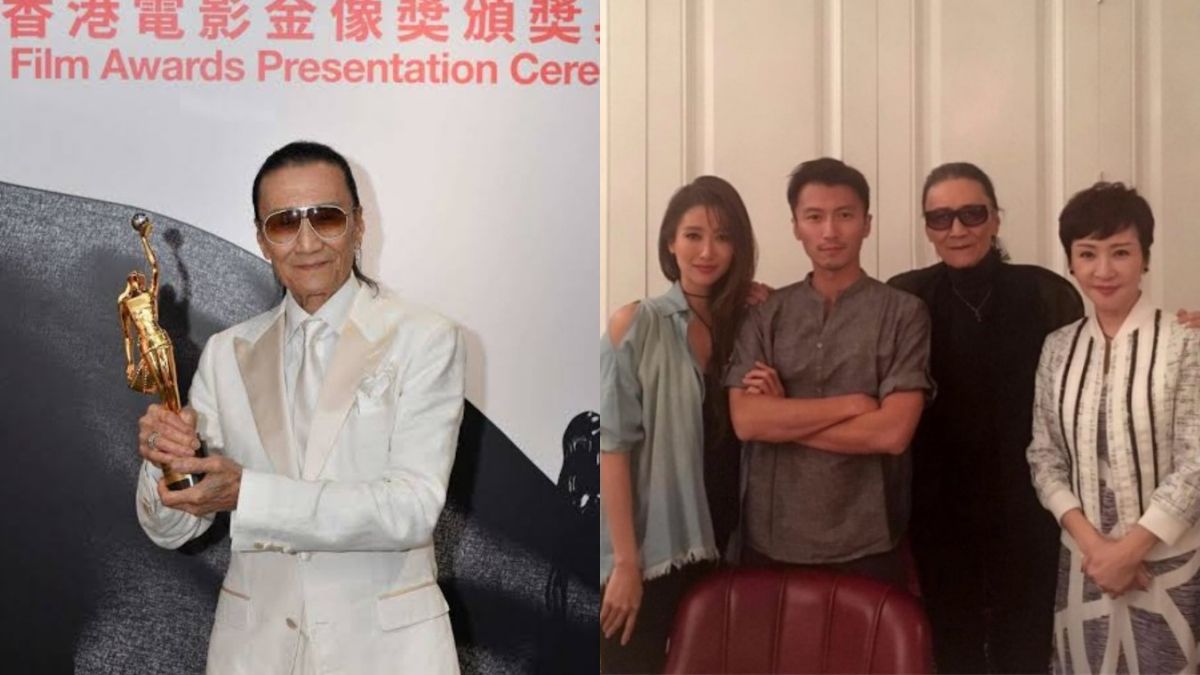
- Patrick Tse died on 20 July 2026 at the age of 89.
- Nicholas Tse announced his father's death and paid tribute to his lifelong dedication to entertainment.
- Tse's acting career spanned more than 70 years and culminated in major Hong Kong Film Awards honours.

Veteran Hong Kong actor Patrick Tse, widely known to generations of audiences as "Sei Gor" (Fourth Brother), has died at the age of 89, marking the end of one of the longest and most celebrated careers in Hong Kong's entertainment industry.
His death on 20 July 2026 was confirmed by his son, actor and singer Nicholas Tse, in a statement published on Weibo.
"It is with great regret that I announce that my father, Patrick Tse, has left us," Nicholas Tse wrote.
"He dedicated his entire life to film and entertainment, hoping to bring joy and smiles to every audience member."
Nicholas Tse reflected on both the public and private sides of his father.
He said that while he had witnessed moments of worry and discouragement during his childhood, Patrick Tse always insisted on appearing before cameras in his best condition.
He recalled one of his father's favourite sayings: "The show must go on."
Nicholas Tse urged fans to remember Patrick Tse with the same confidence and charisma that defined his public image.
"If you think of Sei Gor, think of my father, don't cry, don't be too sad — he would think that's not cool enough. We just need to keep his forever charming, forever smiling perfect image in our hearts," he wrote.
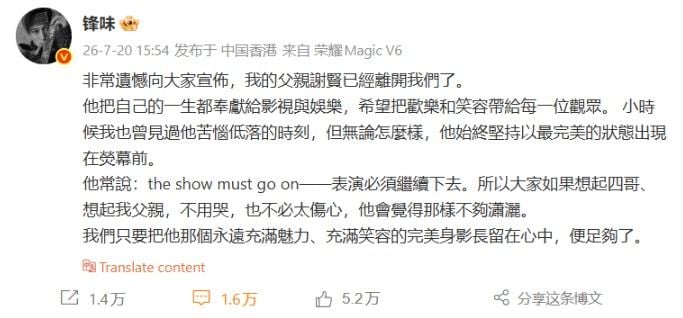
The announcement followed earlier reports by Hong Kong media that Patrick Tse had died.
According to multiple Hong Kong media outlets, Nicholas Tse, who had been preparing for concert performances scheduled for late July on the Chinese mainland, returned urgently to Hong Kong following his father's death.
The reports said the family intends to honour Patrick Tse's wishes by keeping funeral arrangements private and low-key.
Health had remained a subject of public interest in recent years.
Patrick Tse had largely withdrawn from public appearances and spent much of his later years away from the spotlight.
Hong Kong media had repeatedly reported speculation over his physical condition, including rumours that he had suffered a stroke or become paralysed.
Those rumours were challenged in April 2026 when Patrick Tse was photographed visiting a café on Victoria Peak.
Although he appeared noticeably slimmer than before and was seen using a wheelchair for mobility, with a walking stick also nearby, media reports noted that he retained the elegant style and confident presence that had become synonymous with his image throughout his career.
Born Tse Ka-yuk in 1936, Patrick Tse became affectionately known as "Fourth Brother" for two reasons.
He was the fourth child in his family, while his portrayal of Law Sei-hoi in the classic TVB drama "The Shell Game" further cemented the nickname among audiences.
Patrick Tse entered the entertainment industry during the 1950s.
Blessed with striking looks and an effortlessly sophisticated screen presence, he quickly established himself as one of Hong Kong cinema's leading romantic actors.
By the 1950s and 1960s, he had become one of the territory's most recognisable leading men, attracting widespread popularity with audiences and building a reputation that endured across several generations.
His career ultimately spanned more than seven decades.
Unlike many performers of his era, Patrick Tse remained professionally active well into his later years.
His contributions were formally recognised in 2019 when he received the Lifetime Achievement Award at the 38th Hong Kong Film Awards.
The honour acknowledged his decades-long influence on Hong Kong film and television and his enduring contribution to the entertainment industry.
Patrick Tse continued to achieve new milestones even after receiving the lifetime honour.
In 2022, he won the Best Actor award at the 40th Hong Kong Film Awards for his performance in the film Time.
At 85, he became the oldest recipient of the Best Actor honour in the history of the Hong Kong Film Awards.
The victory underscored his longevity and demonstrated that he remained capable of delivering acclaimed performances more than 70 years after beginning his acting career.
Beyond his professional achievements, Patrick Tse's personal life also attracted sustained public attention.
His relationships frequently featured in entertainment headlines over several decades.
He was romantically linked with actresses Kelly Lai Chen and Josephine Siao before marrying Taiwanese actress Chen Chen in 1974.
That marriage lasted three years before ending in divorce in 1977.
Patrick Tse later pursued a relationship with former actress Debora Lee.
The couple married in 1979 and had two children together, Nicholas Tse and Jennifer Tse.
Although Patrick Tse and Debora Lee divorced in 1995, they remained one of Hong Kong entertainment's most closely followed former celebrity couples.
Later in life, Patrick Tse entered a relationship with a mainland Chinese partner known publicly as CoCo, who was nearly five decades younger than him.
The relationship drew widespread public attention because of the significant age difference.
The couple lived together for a period before separating in 2017.
Hong Kong media reported at the time that Patrick Tse had given CoCo HK$20 million as part of their separation, although the reported figure was never officially confirmed by the family.
Throughout changing trends in Hong Kong cinema and television, Patrick Tse remained one of the territory's most recognisable screen personalities.
His distinctive style, confidence and longevity helped shape his reputation as one of the defining figures of Hong Kong entertainment.
His death closes a career that stretched from the golden age of Cantonese cinema through the television boom and into the modern era of Hong Kong filmmaking.