

Foreign syndicates linked to housebreaking cases spark public concern over visa-free entry for Chinese nationals
Recent housebreaking cases in Singapore linked to Chinese nationals have sparked public concern over the visa-free entry policy for PRC citizens. Critics question the effectiveness of immigration checks, as suspects exploited the policy to commit crimes and flee swiftly, raising doubts about security.
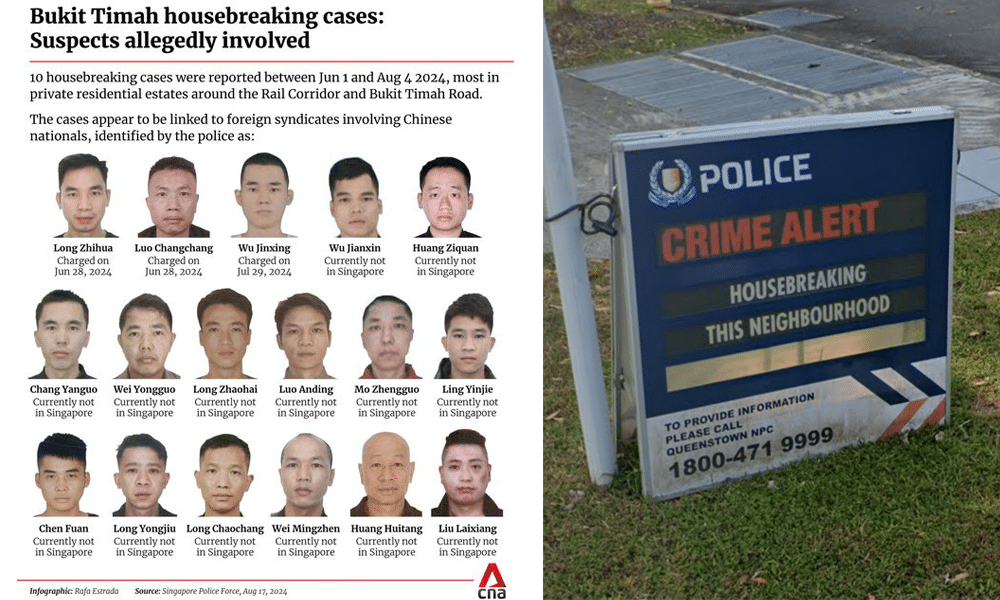

A recent surge in housebreaking incidents in private residential estates across Singapore has been linked to foreign syndicates, primarily involving Chinese nationals, according to a statement by the police on Saturday (17 August).
The authorities have already arrested and charged three individuals in court, while efforts are ongoing to locate another 14 suspects who have since left the country.
The Singapore Police Force (SPF) revealed to local media that they are collaborating with Chinese authorities to gather more information and track down the suspects. They also encouraged the public to provide any relevant information that might assist in the investigation.
Preliminary investigations suggest that these syndicates operate in small groups, targeting residences by scaling perimeter walls or fences.
The suspects are believed to be transient travellers who entered Singapore on Social Visit Passes, typically just a day or two before committing the crimes. After executing the break-ins, the suspects would swiftly leave the scene and attempt to exit the country to evade detection.
The targeted homes are often located near park connectors or forested areas, providing natural cover for the criminal activities. The stolen items are sometimes hidden in nearby forests and later retrieved by accomplices.
Sudden Spike in Cases
Prior to this recent spate of break-ins, housebreaking crimes were on a downward trend, with 59 cases reported in the first half of this year, compared to 70 during the same period last year. However, between 1 June and 4 August 2024, 10 housebreaking cases were reported, mostly in private estates around the Rail Corridor and Bukit Timah Road.
The total value of items stolen in these 10 cases is estimated at S$3.85 million (US$2.92 million), of which about S$1.36 million worth of items have been recovered. The police have since apprehended and charged three suspects.
Chinese nationals Long Zhihua, 38, and Luo Changchang, 43, were charged on 28 June, while Wu Jinxing, 27, was charged on 29 July.
Wu was arrested on 27 July in a forested area near the Rail Corridor and charged with dishonestly retaining stolen property worth over S$180,000. Items seized from him include an orange Hermes Birkin bag valued at S$75,000, approximately S$68,800 in Singapore dollars, and foreign currencies amounting to S$78,800, along with luxury watches, including a S$30,000 Jaeger-LeCoultre watch.
Increased Police Presence and Aerial Patrols
In response to the surge in housebreaking cases, the SPF has intensified patrols in private residential estates around the affected areas. Drones equipped with cameras, thermal sensors, and blinkers will complement ground patrols, enhancing visibility and aiding in the detection of suspicious activities. These drones will also support search operations in response to housebreaking incidents or sightings of suspicious individuals.
Mobile cameras, known as Mobicams, have been strategically deployed at key locations, including major junctions and main entry and exit points of the estates. These cameras, which have self-sustainable power supplies, can be quickly set up outdoors when necessary.
Community Involvement and Preventive Measures
The SPF has been engaging with residents of landed properties, particularly those near park connectors and forested areas, distributing crime prevention advisories and erecting crime alert signs in areas prone to break-ins. The increased outreach has led to a rise in calls reporting suspicious sightings, though many have turned out to be false alarms.
Residents are also participating in the Citizens on Patrol scheme, undergoing training to patrol their neighbourhoods in groups.
Speaking to the media, Law and Home Affairs Minister K Shanmugam acknowledged that while Singapore generally enjoys low crime rates, the recent trend of foreign criminals targeting local residences presents a new threat.
The emergence of foreigners coming into Singapore to target houses and working in teams "is a threat that we now have to deal with", he added.
He urged Singaporeans to remain vigilant and report any suspicious activities in their neighbourhoods.
Public Response and Concerns Over Visa-Free Entry
The news of the syndicates' activities has sparked considerable concern among the public, particularly regarding the recent removal of visa requirements for Chinese nationals. Commenting on Channel News Asia's Facebook page, many members of the public questioned the decision to allow visa-free entry for visitors from China, expressing fears that this policy may have contributed to the surge in crimes.
One commenter remarked, "Easy entry and exit out of Singapore. Some people have been sleeping." Another expressed alarm, stating, "Time for the government to have stricter border control. To have so many Chinese nationals come in and commit crimes here is very alarming. This may be the tip of the iceberg because there may be cases unreported."
Another netizen questioned the policy directly: "Could this be a result of the visa-free entry implemented early this year? This is not totally unexpected." Some also called for the reinstatement of visa requirements, with one person writing, "Government should reinstate the PRC to get their Visa before coming to Singapore. Singaporeans better not leave their valuables to chop seat."
Criticism of the visa-free policy also extended to its perceived broader implications. "Time to take away this scheme. It’s only bringing in more harm than helping. Who's the one who suggested this brainless idea? Trying to be a bootlicker also must use brain first if this is desirable, don’t keep thinking of $$$. Foreigners are saying our government is money-faced already! Don’t prove them right!" wrote another commenter.
The visa-free scheme, which has become a point of contention, refers to the new 30-day visa-free arrangement between Singapore and China implemented in February this year.
Prior to this, Chinese passport holders were required to apply for a visa to enter Singapore. The arrangement was announced in December last year by then-Deputy Prime Minister Lawrence Wong, now Prime Minister, who emphasized that the new visa regime would facilitate travel for business people, academics, students, tourists, and those with family connections.
When asked earlier about concerns over opening Singapore’s borders to Chinese travellers, Mr Wong noted that this is not the first time Singapore has administered a visa-free regime.
He highlighted that visitors from more than 70 countries, including all ASEAN member states, Australia, Japan, and South Korea, can already enter Singapore visa-free.
“We have experience with it. Visa-free does not mean zero immigration check,” he said, adding that there are systems at the back-end that will do the necessary checks.
However, with the suspects in these recent housebreaking cases being identified as Chinese nationals who seemingly exploited the visa-free entry, the public is left wondering: is Singapore’s immigration check system as foolproof as Mr Wong had envisioned?


