Singapore and US sign landmark nuclear cooperation agreement
Singapore and the US signed a "123 Agreement" on 31 July to explore nuclear technology for climate and energy needs. The deal, set for 30 years, aims to enhance bilateral nuclear cooperation.
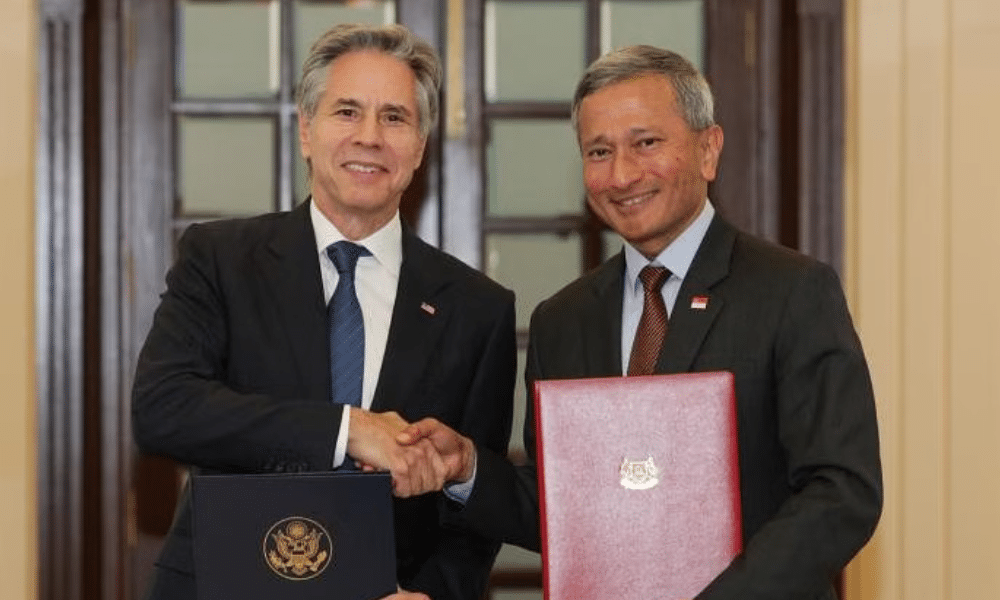

On Wednesday, 31 July, Singapore and the United States signed a landmark agreement to explore how nuclear technology can support climate and energy needs.
The "123 Agreement" was signed by Foreign Affairs Minister Vivian Balakrishnan and US Secretary of State Antony Blinken during the second day of his official visit to Singapore.
Despite this significant development, Singapore has not made any decisions regarding the deployment of nuclear energy.
According to a factsheet appended to the joint statement, any decision on deployment will require detailed studies of the safety, reliability, affordability, and environmental sustainability of nuclear energy within Singapore's local context. It was noted that most advanced nuclear reactor designs are still in the research and development phase and have not yet begun commercial operation.
The agreement aims to deepen nuclear cooperation and build on the strong bilateral partnership between Singapore and the US.
Expected to come into force by the end of 2024, the agreement will last for 30 years and enable Singapore to collaborate with other countries using nuclear energy technologies and designs that include components or intellectual property of US origin.
During the signing ceremony, Dr Balakrishnan emphasized the importance of nuclear non-proliferation, which refers to preventing the spread of nuclear weapons, as essential to international peace and security. He acknowledged that current conventional nuclear technologies are not suitable for Singapore but stressed the need to stay informed about advances in civil nuclear technology.
The agreement, he said, will facilitate access to information and technological expertise and deepen engagements with US civil nuclear experts.
The US currently has 24 active 123 Agreements, including with China, India, and Japan. Several ASEAN member states also have agreements with the US, such as Indonesia and Vietnam, whose respective deals came into force in 1981 and 2014, and the Philippines, whose agreement entered into force earlier this month on 2 July.
Understanding 123 Agreements
123 Agreements provide a legal framework for peaceful nuclear cooperation, including the export of nuclear material, equipment, and components from the US to another country, according to the US Department of State’s website. These agreements also facilitate cooperation in areas such as educational and technological transfers and collaborations between US and partner countries. Partners are bound by a set of non-proliferation requirements to ensure that information obtained through the agreement is used solely for peaceful purposes.
US Congress approval is needed for the deal, which will facilitate Singapore’s access to detailed information on US nuclear energy technologies and expertise under export control.
Exploring Nuclear Power in Singapore
There have been discussions about exploring nuclear power’s feasibility as a green energy source in Singapore, as the country aims to decarbonize its power sector to achieve its net-zero emissions target by 2050.
A 2022 report on Singapore’s energy future, commissioned by the Energy Market Authority, stated that nuclear energy could supply about a tenth of the country’s energy needs by 2050.
In April, Second Minister for Trade and Industry Tan See Leng said that Singapore plans to build a pool of about 100 nuclear energy experts in the medium to long term but emphasized that no decision had been made on the deployment of nuclear energy.
Speaking to reporters after the signing ceremony on Wednesday, Dr Tan mentioned that recent technological advances, particularly in small modular reactors, have made it possible for Singapore to study whether newer developments could enable the country to be self-sufficient.
"We are committed to a decarbonization journey, a process that will end by 2050, resulting in net-zero emissions. We will do everything possible to ensure that we achieve those targets while also ensuring our energy security and making it cost-effective for all our citizens," said Dr Tan.
"Clean nuclear energy is one possible option, but let me be clear, we have not decided whether we're going to use nuclear energy eventually or not."
Through the agreement with the US and other capacity-building initiatives, Singapore and the US intend to strengthen civil nuclear cooperation to better understand how advanced nuclear energy technologies, including small modular reactors, can potentially support climate goals while balancing critical energy needs.
Further Initiatives
The US’ Foundational Infrastructure for the Responsible Use of Small Modular Reactor Technology (FIRST) program aims to support partners in building capabilities to better understand small modular reactors and other advanced nuclear energy technologies, as well as key issues such as nuclear safety, security, and non-proliferation.
Under the FIRST program, Singapore will gain access to the network of US entities involved in civilian nuclear energy, including the US National Laboratories and companies developing newer nuclear energy technologies, facilitating Singapore's capability-building process.
FIRST will also serve as a platform to coordinate US-Singapore civil nuclear cooperation, according to the factsheet.