

Dr Koh Poh Koon defends high-tech farming resilience amid I.F.F.I closes Tuas facility
In a recent Zaobao interview, Dr Koh Poh Koon defended Singapore's high-tech farming resilience, even as a recipient of the Singapore Food Agency's 30 by 30 grant in 2020 reportedly closed its Tuas facility recently, underscoring the grim challenges the sector faces.
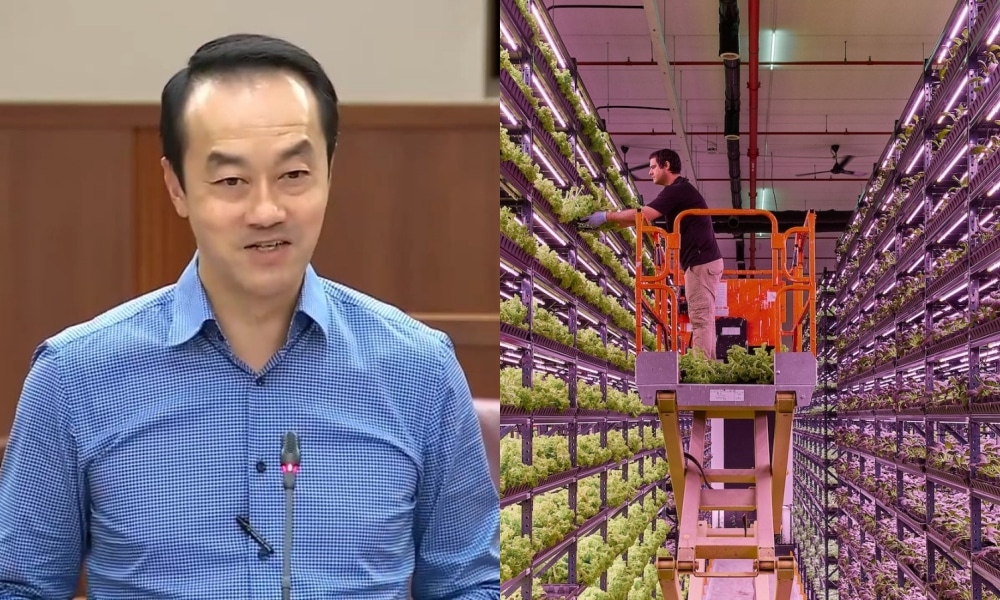

In an early May interview with Singapore's Chinese media Lianhe Zaobao, Dr Koh Poh Koon, Senior Minister of State for Manpower, and Sustainability and the Environment, addressed the decline in domestic vegetable production, which decreased by approximately 15% year-on-year.
Acknowledging the recent challenges faced by agricultural operators in the city-state, Dr Koh pointed out factors such as the relocation of many farms to new sites and the adoption of high-tech systems like hydroponics.
The COVID-19 pandemic disrupted this transition period, causing delays in the transportation of technological components and increasing energy costs, he added.
Seafood producers also faced challenges from supply chain disruptions, as well as rising energy and feed prices, leading to weakened productivity and a decrease of about 7% in domestic seafood production compared to the previous year.
He admitted that achieving the "30 by 30 Vision" set in 2019, which aims to meet 30% of the population's nutritional needs through local agricultural productivity by 2030, remains a significant challenge.
Currently, the local industry has not surpassed meeting 10% of the population's nutritional needs.
Dr Koh defends Singapore's high-tech farming resilience
While Dr Koh did not disclose the specific level to which the local agricultural industry has met nutritional needs so far, he underscored that despite these setbacks, the industry is not stagnant and has been making progress.
He said that agriculture is a challenging field, but if all parties work together to support local food production, progress toward the goal can be made.
Dr Koh noted that while the government can provide research and development funds and capital expenditures, consumer support for local agriculture operators is crucial.
Agriculture operators can increase production with subsidies, but without consumer demand, the food will eventually spoil, making it difficult for producers to sustain production, he explained
"We don’t necessarily have to achieve the target outright, but we need the drive to pursue it. Without this impetus, we might fall short of our aspirations."
On 20 May, the SFA released its annual food statistics report, revealing a decline in local vegetable and seafood production in 2023.
According to the report, local vegetable production year-on-year declined by around 15%, accounting for only 3.2% of local consumption, compared to 3.9% in 2022. Despite an increase in the number of vegetable farms—from 111 in 2022 to 115 in 2023—production still decreased.
These production setbacks coincide with various challenges encountered by the local farming sector.
With over 90% of food imports, Singapore remains susceptible to global supply chain disruptions, including disease outbreaks, foreign policy shifts, and geopolitical tensions, as noted by SFA.
Dr Koh compared the agricultural sector to startup scene
Regarding whether Singapore can meet the target on time, Dr Koh said the more crucial issue is whether a solid foundation has been laid and if the agricultural sector is moving in the right direction.
"Can we perfectly achieve the 30 by 30 Vision? Perhaps not... But we shouldn’t be overly fixated on the numbers because temporary impacts on agriculture, such as pandemic shocks, construction delays, and rising prices, are understandable. There’s no need to be overly anxious; quality farms still exist."
Dr Koh stated that the COVID-19 pandemic impacted many sectors, including agriculture, and it will take time for the effects to stabilize.
As the Lim Chu Kang farmland development plans are expected to materialize by the end of this year or early next year, the next few years could be a critical period for assessing the 30 by 30 Vision.
"Reevaluating the goals during unstable times might lead to setting unrealistic or overly conservative targets. If the targets are too ambitious and ultimately unmet, it could be discouraging."
On VertiVegies' recent challenge with its joint venture partner, Dr Koh said, "Joint venture issues are beyond the government's control. "
Dr Koh compared the agricultural sector to a startup scene, where some entrepreneurs succeed while others face challenges.
"The local agricultural industry is more like a start-up company, and within start-ups, for every 10, nine may fail."
He believed that regardless of the reasons for players entering or exiting, there is no need for excessive anxiety and concern.
He acknowledged the inevitability of failures but assured support from the government to create an environment conducive to development without interfering with market dynamics.
"The government will not interfere with the normal evolution and operation of the market, as this is the natural way for the ecosystem to select the strongest players."
Dr Koh: Premature to determine Singapore's 30 by 30 Vision success
In a Facebook post, Dr Koh added that Embarking on the 30 by 30 Vision also means facing challenges head-on, such as having limited land and inflationary pressures.
"Despite these, we pressed ahead to rally our industry toward a common goal and send a signal on the importance of food security amid increasing food supply disruptions. "
However, Dr Koh acknowledged that it is premature to determine if Singapore will achieve the 30 by 30 vision.
"Whatever the outcome, this concerted effort will lay a good foundation in developing our agri-food industry, which is key for our food security and resilience."
Singapore’s high-tech farming sector facing grim challenges ahead, with I.F.F.I closed its Tuas facility recently
In fact, Singapore's media reports have highlighted the significant challenges facing Singapore’s high-tech farming sector.
For instance, The Straits Times (ST) on Sunday (26 May) reported that Indoor Farm Factory Innovation (I.F.F.I), once lauded as a promising player in Singapore's future farming sector and said to have the capacity to produce approximately 300 tonnes of leafy greens annually, shuttered its expansive 38,000 sq m facility in Tuas.
The parent company of this local indoor farm, precision engineering firm TranZPlus Engineering, has been placed under liquidation, as evidenced by court documents filed for insolvency in November 2023.
I.F.F.I cultivated a diverse range of crops spanning from arugula and kale to green lettuce and red bok choy, marketing its produce under the brand name Next Farmers, previously available at FairPrice supermarkets.
In September 2020, I.F.F.I was selected as one of nine recipients of the Singapore Food Agency’s (SFA) 30 by 30 express grant, an initiative allocating a total of S$39.4 million to aid farms in amplifying production during the COVID-19 pandemic.
As per SFA’s media release regarding the 30 by 30 express grant in 2020, I.F.F.I was allocated funds to establish a sprawling high-tech indoor farm, boasting a meticulously controlled, pesticide-free environment.
VertiVegies, another firm abandoned its plans to construct an indoor farm in Lim Chu Kang after encountering issues with its joint venture partner, Chinese farming company SananBio, which was supposed to supply the production hardware. The company also returned a 2ha plot of land to SFA in April 2022.
Additionally, local farm Sky Greens, known for its patented vertical farming systems that promote innovative and environmentally friendly vegetable cultivation, is scaling down its operations.
In March this year, The Temasek-backed food technology firm Eat Just Inc. has halted the production of its cultivated meat in Singapore, casting a shadow over the future of alternative protein sources in the region.


