House shelves Hegseth impeachment 211-204; 10 of 11 absent Democrats had AIPAC-linked funding
The US House voted 211-204 to refer Thomas Massie’s impeachment resolution against Pete Hegseth to committee, effectively killing it. Campaign finance records show 10 of the 11 absent Democrats received money routed through AIPAC’s PAC.
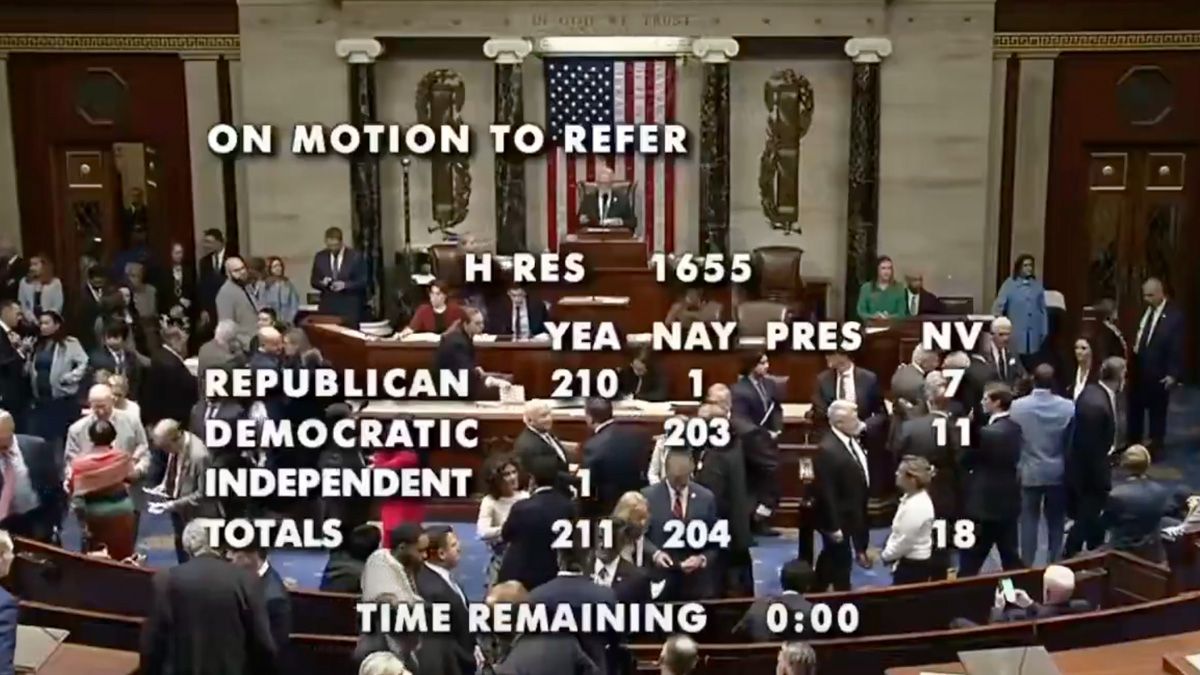
- House referred Hegseth impeachment to committee 211-204; Massie was the only Republican opposed.
- Ten of 11 absent Democrats received AIPAC PAC-linked funds totalling about US$2.36 million.
- Democrats can revive impeachment next year; Senator Ted Cruz expects Hegseth to resign or be fired.

The US House of Representatives on Tuesday, 10 November 2026, blocked an effort to impeach Defence Secretary Pete Hegseth, voting 211-204 to refer Representative Thomas Massie’s impeachment resolution to the Republican-led House Judiciary Committee.
The referral effectively kills the measure in the current Congress, the BBC reported, as little time remains before Democrats take control of both chambers in January 2027.
Massie, a Kentucky Republican, was the only member of his party to vote against the referral. He was joined by all 203 Democrats who voted, according to the House Clerk’s record of the vote.
The 211 votes in favour came from 210 Republicans and one independent, Representative Kevin Kiley of California. Eighteen members did not vote: 11 Democrats and seven Republicans.
A review of federal campaign finance data compiled by the tracking site SignalData shows that 10 of the 11 absent Democrats have received campaign money routed through the political action committee of the American Israel Public Affairs Committee (AIPAC).
The records establish a financial relationship, but do not show that AIPAC influenced any member’s decision to miss the vote. Two of the absent members have said they were delayed by a traffic incident on their way to the chamber.
How the vote unfolded
Massie read his resolution on the House floor on Monday, accusing Hegseth of eight violations of law or the Constitution over the Iran war and military operations in Venezuela, Yemen, the Caribbean Sea and the eastern Pacific Ocean.
Top Democrats backed the resolution, but Republicans moved to kill it by referring it to the Judiciary Committee, The Guardian reported. The motion passed largely along party lines.
House Speaker Mike Johnson had predicted earlier in the day that the impeachment bid would fail, according to the BBC.
The Guardian noted that the vote came a week after Republicans suffered their worst midterm defeat in more than half a century, losing control of both chambers. It said the result underscored lawmakers’ continued wariness of crossing President Donald Trump.
The motion to refer, recorded as Roll Call 317 on House Resolution 1655, was taken at 6.02pm Washington time on Tuesday.
The 11 absent Democrats
The House Clerk’s record lists the 11 Democrats who did not vote as Julia Brownley, Lou Correa, Laura Gillen, Steven Horsford, Jonathan Jackson, Nancy Pelosi, Brittany Pettersen, Melanie Stansbury, Haley Stevens, Marilyn Strickland and Frederica Wilson.
Ten of them received money through AIPAC’s PAC between January 2022 and 14 October 2026, according to SignalData’s records. The records are based on Federal Election Commission (FEC) filings and were last updated on 6 November 2026.
The figures are rounded cumulative totals, net of refunds. They include both contributions from the PAC’s own funds and individual donations earmarked through the PAC.
The amounts recorded are: Haley Stevens of Michigan, US$1,170,000; Laura Gillen of New York, US$467,000; Marilyn Strickland of Washington, US$291,000; and Steven Horsford of Nevada, US$186,000.
Also listed are Brittany Pettersen of Colorado, US$72,000; Julia Brownley of California, US$63,000; Lou Correa of California, US$54,000; Frederica Wilson of Florida, US$33,000; Nancy Pelosi of California, US$15,000; and Jonathan Jackson of Illinois, US$13,000.
Combined, the 10 members received approximately US$2.36 million through the PAC over the three election cycles.
The exception is Melanie Stansbury of New Mexico. SignalData records no AIPAC PAC contributions to her campaign, although the separate Track AIPAC database lists US$57,000 in broader pro-Israel political contributions.
Stevens has by far the largest AIPAC-related footprint among the group. In addition to the US$1.17 million routed through the PAC, AIPAC’s affiliated super PAC, United Democracy Project (UDP), spent US$14.37 million independently in support of her.
That independent spending did not enter Stevens’ campaign account and is not a donation to her.
Of Stevens’ PAC-linked total, around US$30,000 came directly from AIPAC PAC’s own funds. The remaining US$1.14 million consisted of individual contributions earmarked through the PAC.
What the records do and do not show
AIPAC-linked money is widespread in Congress. SignalData identifies 166 of 259 sitting Democrats, or about 64 per cent, as having received funds through AIPAC PAC since 2022. Among the absentees, the proportion is 10 of 11.
The absent group is small, and the comparison alone does not establish causation or any coordinated action.
AIPAC also announced on 21 October 2026 that it would stop issuing endorsements, making direct PAC contributions and earmarking funds for candidates, NPR reported. Its super PAC, UDP, will continue to operate.
The historical contributions predate that change and are not evidence of any arrangement surrounding the 10 November vote.
Absent members explain
Four of the 11 absent Democrats have spoken publicly about missing the vote. Two said they were held up by a traffic incident on their way to the chamber.
Stansbury said on X that she and other members were blocked from entering the Capitol by a traffic incident and a police escort of a bus during the vote. When she reached the chamber, the vote had just closed.
She said she immediately filed a “NO” vote on the motion, as documented in the Congressional Record, adding: “Pete Hegseth must be impeached now.”
Jackson gave a similar account. He said a traffic incident and a police-escorted bus delayed him and other members until the vote had closed, and that he had since entered his “NO” vote in the Congressional Record.
Jackson described the referral as “a move designed to stall accountability without a direct vote on the merits”.
Such entries in the Congressional Record show how a member would have voted, but they do not change the official result.
Correa said in a statement on missing votes that he would undergo a medical procedure in Orange County. On his doctor’s advice, he said, he would avoid travel until medically cleared and work from his district.
Pettersen did not give a reason for her absence. She said she had been “denied the ability to vote” on the motion, and that she had helped introduce articles of impeachment against Hegseth since April.
“Next year House Democrats will impeach Hegseth and neither Johnson nor Trump will be able to stop us,” she wrote.
The other seven absentees, Brownley, Gillen, Horsford, Pelosi, Stevens, Strickland and Wilson, had not publicly explained their absence at the time of writing.
All 11 drew criticism in replies on social media. Correa was also criticised by users even though he had published his statement.
Trump and the Pentagon celebrate
Trump hailed the outcome on Truth Social, saying the effort “has miserably FAILED” and describing it as the “EXONERATION of a Great American Patriot”.
He credited “Victories in Venezuela and Iran” and record military recruitment for the result, and wrote that Democrats “continue to weaponize and abuse the United States of America”.
Pentagon spokesperson Sean Parnell said the referral of what he called “baseless impeachment articles” marked “total victory for Secretary Hegseth, the Department of War, and the American warfighter”.
Hegseth calls effort ‘sabotage’
Hours before the vote, Hegseth held his first Pentagon news briefing in six months, where he called the impeachment effort “a farce” and “a stunt”, describing Massie as “disgruntled and defeated”.
He argued the resolution signalled to adversaries “that the United States will actually punish its own warriors and its own civilian leadership for successfully executing lawful military operations”. “This is not patriotism. This is sabotage,” he said.
Hegseth said Massie was motivated by policy differences, and “not high crimes, not misdemeanours, not treason, not bribery”.
Not the final word
Impeachment resolutions can be taken up again in a new Congress, the BBC noted, meaning Democrats could revive the effort next year.
Massie had acknowledged his bid might not succeed immediately. He argued it could push Trump to replace Hegseth before Democrats launched their own process, giving the Senate time to confirm a successor while Republicans were still in control.
House Democratic Leader Hakeem Jeffries, expected to become Speaker in January, told PBS on Tuesday he remained “a hard yes”. He called Hegseth “the architect of this reckless and costly war of choice in Iran”.
Doubts over Hegseth’s tenure also extend to Republicans. Texas Senator Ted Cruz said on Tuesday he expected Hegseth to resign or be fired by Trump, according to the BBC.
Other Republicans defended him. Representative Warren Davidson of Ohio, who had voted for war powers resolutions to end the Iran conflict, told The Guardian that impeachment was “an effort to blame-shift on to Hegseth Congress’s failure and President Trump’s decision”.
The impeachment articles
Massie’s eight articles allege that Hegseth attacked Iran without congressional authorisation and disregarded a war powers resolution adopted by the House and Senate in June requiring an end to the conflict.
They also accuse him of ignoring laws meant to minimise civilian casualties, citing a US strike on a school in Minab, Iran, that The Guardian reported killed more than 168 people.
Other articles allege “extrajudicial killings” in strikes on suspected drug boats in the Caribbean and eastern Pacific, and retaliation against Senator Mark Kelly, an Arizona Democrat, for his criticism of the Defence Secretary.
The final two articles concern the operation that captured then-Venezuelan President Nicolás Maduro and a bombing campaign in Yemen.